


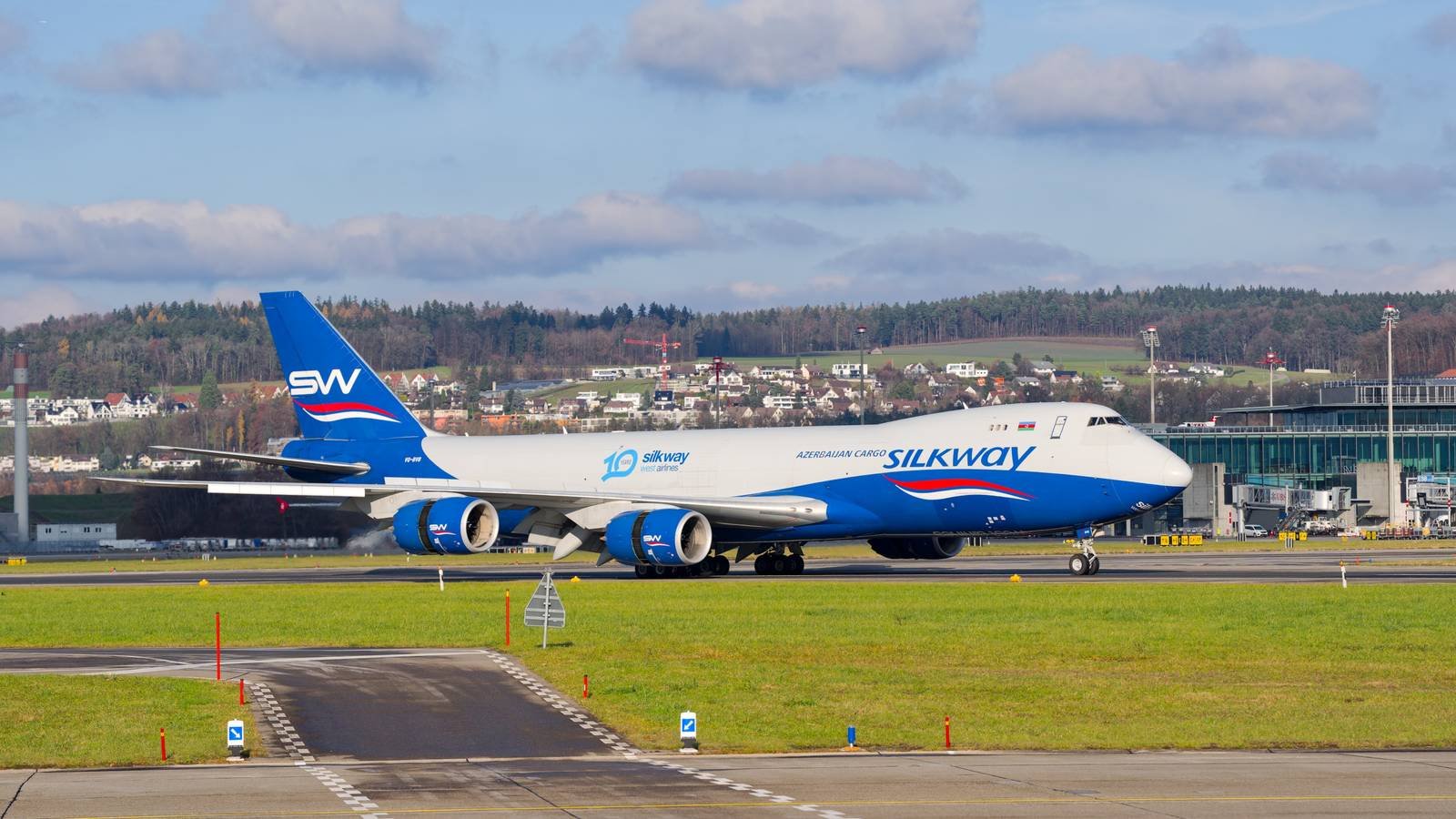
A Boeing 747-8F operated by Silk Way West landed at Dallas/Fort Worth International Airport (DFW) under emergency conditions on Tuesday after apparently flying to Dallas instead of its intended destination of Houston. Flight 7L5722, operated by VQ-BVB, departed Mexico City’s Felipe Ángeles International Airport (NLU) at 7:29 AM local time, and made an emergency landing at DFW at 10:51 AM.
The aircraft reportedly had only 6,000 pounds of fuel remaining, described during the radio exchange as approximately 30 minutes of endurance, when its pilots declared Pan-Pan over the Dallas area. The crew then requested immediate vectors to Runway 26R at  Houston George Bush Intercontinental Airport (IAH), apparently without recognizing that they were on approach to Dallas Love Field (DAL). Dallas-area controllers rejected that plan, declared an emergency for the aircraft, and directed it to nearby DFW.
A Houston Flight Becomes A Dallas Arrival

Flight 7L5722 normally operates between Mexico City and Houston, and FlightAware shows that the previous two NLU-IAH services on July 21 and July 28. But Tuesday’s flight inexplicably continued north beyond Houston, and entered the Dallas terminal area.
The tracking records reveal an extraordinary sequence of destination changes. FlightAware displays three entries for the same 07:29 departure: an NLU–IAH flight marked as diverted, an NLU–DAL)flight also marked as diverted, and the completed NLU–DFW flight. Flightradar24 similarly identifies Love Field as the destination, before recording the diversion to DFW.
This suggests that Houston was associated with the original operation, before DAL entered at least one flight-plan or flight-data system. It does not establish who changed the destination or whether the cause involved dispatch, ATC, an incorrectly entered flight plan, the aircraft’s flight-management system, or a data-processing error. What is clear from the track is that the aircraft flew toward Dallas rather than beginning its arrival into Houston.
Simple Flying has reached out to Silk Way West for comment on the flight, and will update the article with any feedback.
The Controllers Step In As Fuel Becomes Critical

The apparent confusion quickly caught the attention of aviation spotters, and excerpts of the ATC recording were quickly posted online. What becomes clear is that the Silk Way West 747 was being handled by Dallas-area controllers as it progressed toward an arrival at Love Field, when the crew reported its fuel situation. The pilots declared Pan-Pan, advised that they were “running out of fuel,” and requested priority vectors to… Runway 26R at Houston.
“Pan-Pan” identifies an urgency condition that may not yet involve immediate danger but requires priority assistance. FAA guidance says “an aircraft is in at least an urgent condition when a pilot becomes doubtful about its position or fuel endurance.” Controllers are also instructed to treat an aircraft as an emergency whenever they believe an emergency or urgent situation exists, even if the crew has not transmitted “Mayday.”
Flight 7L5722 Timeline | |
|---|---|
Stage | What Happened |
Departure | Flight 7L5722 departed Mexico City’s Felipe Ángeles Airport, with Houston shown as the destination by FlightAware. |
En route | Flightradar24 recorded Dallas Love Field as the flight’s destination, although the reason for the discrepancy remains unclear. |
Dallas arrival | The Boeing 747 continued into the Dallas terminal area and was reportedly being positioned for an arrival at Love Field. |
Fuel warning | The crew declared Pan-Pan and reported approximately 6,000 pounds of fuel remaining. |
Houston request | The pilots request immediate vectors to Houston Intercontinental’s Runway 26R. |
ATC intervention | Dallas-area controllers determined the aircraft could not safely continue to Houston and declared an emergency on its behalf. |
Diversion | The aircraft was redirected to nearby Dallas/Fort Worth International Airport. |
Landing | VQ-BVB landed safely on DFW’s Runway 18R and was met by emergency vehicles. |
Later flight | The aircraft subsequently departed DFW later in the day and completed a short flight to Houston. |
In the audio, the controller is clearly confused, and can be heard saying:
“Okay sir, you are not even near Houston right now sir, if you want to get to Houston, how much fuel do you have sir, because you are several hundred miles out?”
The pilot replied that he had just 6,000 pounds of fuel remaining, and again reiterated that “we want to go to Houston now, but the shortcut please.” The controller, clearly baffled and frustrated, determined that the 747 had no realistic prospect of safely covering the remaining distance to Houston, so declared an emergency on its behalf.
The aircraft was vectored to DFW’s Runway 18R, where it landed safely and was met by aircraft rescue and firefighting vehicles. Runway 18R/36L is 13,400 feet long (4,084 meters), making DFW significantly better equipped than Love Field for an emergency arrival by a large, four-engined freighter. The fact that Houston was indeed the originally intended destination became apparent when VQ-BVB made the short trip to IAH later on Tuesday afternoon.
How Did A Houston-Bound 747 Reach Dallas?

The flight has stirred up plenty of debate in online forums, with speculation as to what exactly happened. One possibility is that DAL was mistakenly entered as the destination in an amended flight plan, causing the aircraft to receive a route toward Dallas while the crew continued to expect a Houston arrival.
Another explanation is that the pilots accepted a clearance to Dallas without recognizing that it conflicted with the intended operation. The duplicate FlightAware entries offer evidence that the destination changed, but they don’t establish where or how the error originated.
The most concerning element is the apparent disconnect between the aircraft’s position and the pilots’ request. Asking for vectors to a specific Houston runway while already over North Texas suggests that the crew was working from an incorrect understanding of its location or destination. However, the complete ATC record — including the original clearance, any amendments and the crew’s readbacks — will be required before responsibility can be assigned.
