


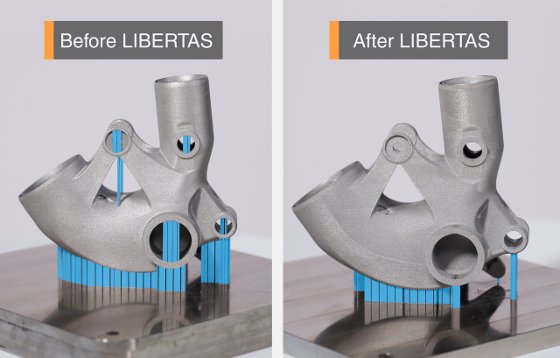
Global engineering firm Renishaw has introduced LIBERTAS, a new software technology for its RenAM 500 series metal additive manufacturing (AM) systems that targets two persistent challenges in laser powder bed fusion (LPBF): rough downskin surfaces and reliance on support structures.
Support structures in LPBF manage heat and distortion during a build, but they also add material use, extend build times, and increase post-processing work. LIBERTAS adjusts scan parameters and laser paths dynamically across different sections of a part’s geometry during 3D printing. This gives engineers finer control over thermal behavior throughout the build, which lowers downskin roughness and material consumption while cutting down on, or removing entirely, the need for supports.
Applications across aerospace, medical and consumer products
By loosening the dependence on supports, particularly for geometries that would otherwise need them in hard-to-reach areas, the software opens up designs that were previously difficult or costly to produce with AM, and that CNC machining could not reach due to tool-access limits. Renishaw points to dental frameworks, aerospace components such as nozzle guide vanes and blisks, and consumer products like wearable devices as example applications. The company positions the technology for the medical, aerospace and defense, and consumer electronics sectors.
Availability and system specifications
LIBERTAS is delivered as an upgrade module within Renishaw’s QuantAM build preparation software, so it does not require new hardware. A single license can be applied across multiple RenAM 500 systems. The RenAM 500 series has a build volume of 250 mm × 250 mm × 350 mm and is available with one (500S), two (500D), or four (500Q) 500W lasers.
Closing the support gap through software
Renishaw’s approach with LIBERTAS extends the RenAM 500 systems customers already own, treating support dependency and downskin roughness as problems to solve through a QuantAM software upgrade rather than a new machine purchase.
Materialise took a similar route with its e-Stage for Metal+ module, launched in 2024 for its Magics build preparation software. It uses physics-based modeling to automate support generation for LPBF, cutting the material and post-processing costs that come with over-built supports. Materialise integrated its Magics build preparation software with Renishaw’s RenAM 500 metal 3D printers through a 2024 partnership aimed at streamlining workflows and giving users more control over the build process.
Velo3D built support elimination directly into its Flow software, pairing it with the company’s Sapphire 3D printers to enable shallow overhangs down to 5° and large inner diameters without added supports. Both examples point to the same shift LIBERTAS reflects: reducing support dependency in metal AM is increasingly handled in software, not solved by new hardware alone.
3D Printing Industry is inviting speakers for its 2026 Additive Manufacturing Applications (AMA) series, covering Energy, Healthcare, Automotive and Mobility, Aerospace, Space and Defense, and Software. Each online event focuses on real production deployments, qualification, and supply chain integration. Practitioners interested in contributing can complete the call for speakers form here.
To stay up to date with the latest 3D printing news, don’t forget to subscribe to the 3D Printing Industry newsletter or follow us on LinkedIn.
Explore the full Future of 3D Printing and Executive Survey series from 3D Printing Industry, featuring perspectives from CEOs, engineers, and industry leaders on the industrialization of additive manufacturing, 3D printing industry trends 2026, qualification, supply chains, and additive manufacturing industry analysis.
Featured image shows Renishaw’s LIBERTAS software dynamically adjusts scan parameters across different sections of a part, enabling engineers to print complex geometries with smoother downskin surfaces, and greatly reducing or eliminating the need for supports. Image via Renishaw.
