


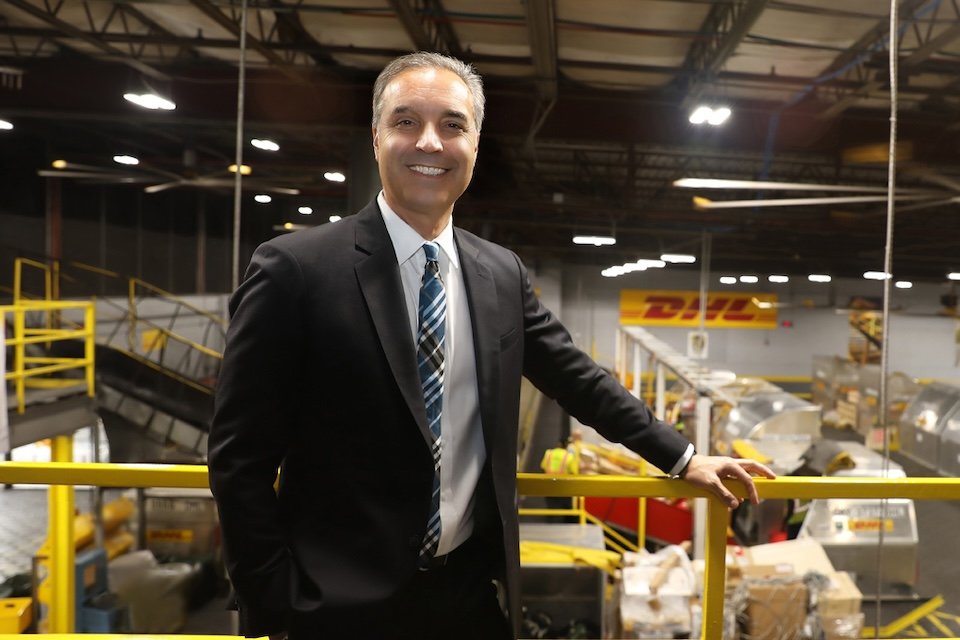
DHL Express has seen the weight of shipments it carries increase strongly in the second quarter as underlying market fundamentals drive heavier shipments to the integrator model and the division focuses on industrial customers.
Speaking to Air Cargo News in London this week, Mike Parra, the chief executive of DHL Express for Europe, said that growth in the weight of shipments carried by its European business had been tracking in the high single digits in recent weeks.
Meanwhile, in the second quarter of the year, the overall division’s Time Definite International product saw the weight of shipments carried increase 9.4% year on year, with Europe up 2.9%.
Parra explained the increase in weight carried was part of an ongoing trend that had seen increasingly heavier items being carried by the Express division since DHL was launched in 1969 carrying documents.
In recent years, the shift to heavier shipments has been partly driven by e-commerce platforms moving away from the integrators to lower-cost bulk transport and ‘local hero’ last-mile networks, resulting in the share of heavier shipments increasing.
However, the current geopolitical unpredictability and war in Iran have helped accelerate the change as an increasing number of urgent heavier items find their way into the express network because of the speed, certainty and uncomplicated pricing model on offer.
To capitalise on the trend and as part of its strategy to refocus on industrial customers, at the start of the year, DHL Express launched a Heavy Weight Express (HWX) service that can transport shipments of up to 1,000 kg per piece and 3,000 kg per shipment.
As well as time‑definite delivery, the service included end‑to‑end control, monitoring and all‑in pricing that “eliminates the rate volatility and cost uncertainties associated with other areas of freight”.
Parra said that the shift to express driven by current geopolitical conditions is not necessarily temporary, as customers quickly get used to the level of service and reliability that is offered through express.
“We are not trying to take that business away from our forwarding division, but where we have a customer that has an oil rig that is down and needs a 300kg part quickly transported, then they’ll use DHL Express,” Parra explained.
“As we target those customers and they are coming over to us, they are seeing the safety, the security, the value of tracking and, more importantly, that it will get there in time.”
The deciding factor on whether a customer uses express or forwarding tends to be based around the speed required – if a shipment needs moving in a couple of days, then express is the answer, while a longer timeframe allows the use of a forwarding solution.
Express also has size limitations, Parra explained.
Forwarding shift
Parra’s remarks back up DHL’s recent second-quarter results call with investors where company bosses noted an ongoing shift from freight forwarding to express.
During the call, Group chief executive Tobias Meyer remarked that the express business had been on a 50-year journey of taking share from the general airfreight market and there was the opportunity for further “significant share gains”.
Meyer also added that the express product had increasingly improved its cost position compared with the forwarding market.
While a shift in weight partly explains the volume gains made by the express division in Europe, Parra added that there were also other factors at play.
For one, he said that the express division – also into Europe – had benefitted from the rise in demand for semiconductor and data centre volumes.
There has also been a shift in trade patterns since the first half of last year when the current US administration implemented its tariff programme, resulting in companies from other countries – in particular Asia Pacific – shifting their focus away from the US to other areas of the world.
Also, the company was able to quickly pivot and sustain its air network in the Middle East when the Iran war broke out, shifting from Bahrain and Dubai into Riyadh and Muscat within 48 hours.
The conflict in the Middle East had also resulted in a shift away from ocean as box line operations were disrupted and companies were willing to “pay a bit more and put it on a fixed express network”.
The company has also been able to add widebody Boeing 767 and Boeing 777 capacity to European destinations to capitalise on rising demand to and from the region, Parra said.
The company’s intra-European network has also been able to provide solutions for companies affected by the disruption of Germany’s barge networks as a result of low water levels.
E-commerce rules impact
Meanwhile, Parra also gave an update on how the European Union’s new €3 charge for shipments with a value of less than €150, which also brought in some data requirement changes, was affecting demand.
So far, he said, the new charge had seen DHL’s e-commerce volumes dip but “nowhere near as much as we thought they would dip”.
However, he added that the charge had only been implemented in July and it is still early to gauge the full impact.
“We are one month in, and we are in a summer lull, but it was a single-digit decline [in e-commerce volumes], not double-digit. It is hard; you don’t know what to anticipate.”
Parra speculated that the charge might have only affected demand for very low-cost one-off items where the new charge will have a greater impact on the overall cost.
Looking forward, he said the charge, which will be followed up with a €2 processing fee in November, could result in some e-commerce shift to more traditional distribution networks utilising regional warehousing.
