


The Guam Additive Materials and Manufacturing Accelerator (GAMMA) applications center will reach full operating capacity by February 2027, according to Neal Orringer, co-founder, president and board chairperson of the Applied Science and Technology Research Organization of America (ASTRO America), the non-profit managing the initiative.
The date lands roughly 15 months after the facility’s ceremony at Dededo’s Pacific Industrial Park on November 6, 2025 and it revises a more aggressive schedule ASTRO set out earlier this year. Previously, Orringer had targeted initial operating capability for late summer 2026, with machines installed, a quality management system in place and first parts potentially rolling out by the end of August.
“We are going as fast as we can here to get everything together,” Orringer said during his recent visit to the island this summer to review progress.
ASTRO is running GAMMA under a $40 million mandate from the U.S. Navy‘s Maritime Industrial Base Program office, with the objective of relocating defense sustainment capability into the Indo-Pacific rather than shipping it across the Pacific. The pitch is straightforward arithmetic: components for submarines, ambulances and fire engines that currently take months or years to source from off-island could instead be produced in a couple of weeks.
Evaluation, not printing, is the hard part
The turnaround claim rests less on print speed than on qualification, and Orringer and GAMMA director and general manager Alex Benham both stressed that the applications center was scoped around evaluation from the outset.
“Evaluation is important − it takes hundreds of pages of data to confirm that parts are made right. Because if a part doesn’t have adequate density, if it can’t withstand impact, then it can be life and death,” Orringer said.
Microscopy, digital inspection tools, robotic welders and CNC milling machines are already installed in the warehouse. Higher-grade inspection equipment, including an X-ray CT scanner, is still to come. That sequencing matters for a facility whose principal customer certifies parts against naval standards: without non-destructive volumetric inspection on site, density and porosity verification for critical components has to happen somewhere else, which reintroduces exactly the logistics delay GAMMA exists to remove.
Building a workforce that outlasts the contract
Orringer was blunt that hardware alone does not create an industry. “You cannot have a manufacturing industry without well-trained, highly competent people. Our goal is not just to create a program that will only last for a couple of years,” he said.
ASTRO has partnered with the Colorado School of Mines and with the University of Guam, which currently offers a certified civil engineering program. The plan is to stand up a complementary mechanical engineering program on the island, though Orringer said he wants to push its start to fall 2027 rather than rush it. He expects demand to be there: “I think there’s a hunger here to get into this industry.”
Once the Navy requirement is served, ASTRO intends to open the center to other military branches, Guam government agencies and local organizations. Orringer cited conversations with the governor and lieutenant governor about emergency response vehicles and Guam Power Authority trucks, fleets grounded by parts that, as he put it, cannot be ordered anywhere.

A forward node in the Navy’s AM strategy
GAMMA is one piece of a broader naval effort to treat additive manufacturing as a readiness tool rather than a prototyping curiosity. The Navy has been pushing qualification work hard: Johns Hopkins APL and NAVSEA have been examining whether additively built components can be trusted across the 33-year service life of a Virginia-class submarine, with NAVSEA’s technical lead framing the requirement as predictability across suppliers, not merely feasibility.
On the supply side, AML3D secured a contract via BlueForge Alliance in April 2026 to produce five high-demand replacement components for active submarines that are no longer available through the OEM, precisely the obsolescence problem GAMMA is meant to solve locally. In addition, the Navy has deployed metal and polymer systems at RIMPAC in Hawaii, testing cold spray and hybrid DED in an expeditionary setting.
What distinguishes GAMMA from those efforts is geography. Guam sits inside the operating area it serves, which is the entire argument. “This factory in February 2027 is going to be a world-class factory that rivals any major advanced manufacturing factory anywhere in the world. And it just happens to be in Guam,” said Orringer.
3D Printing Industry is inviting speakers for its 2026 Additive Manufacturing Applications (AMA) series, covering Energy, Healthcare, Automotive and Mobility, Aerospace, Space and Defense, and Software. Each online event focuses on real production deployments, qualification, and supply chain integration. Practitioners interested in contributing can complete the call for speakers form here.
To stay up to date with the latest 3D printing news, don’t forget to subscribe to the 3D Printing Industry newsletter or follow us on LinkedIn.
Explore the full Future of 3D Printing and Executive Survey series from 3D Printing Industry, featuring perspectives from CEOs, engineers, and industry leaders on the industrialization of additive manufacturing, 3D printing industry trends 2026, qualification, supply chains, and additive manufacturing industry analysis.
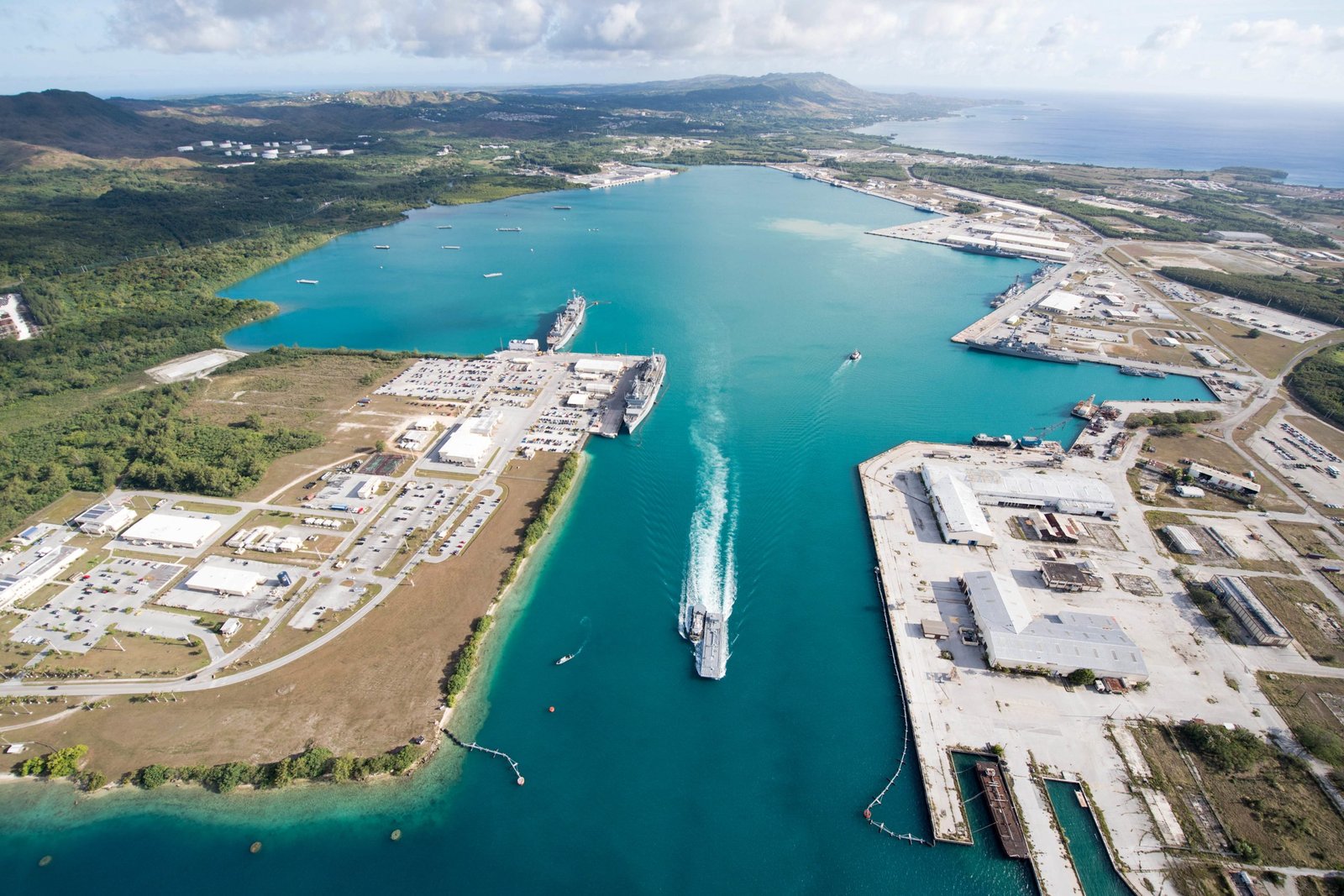
Featured image shows An aerial view of the U.S. Naval base in Guam. Photo via the U.S. Navy
