


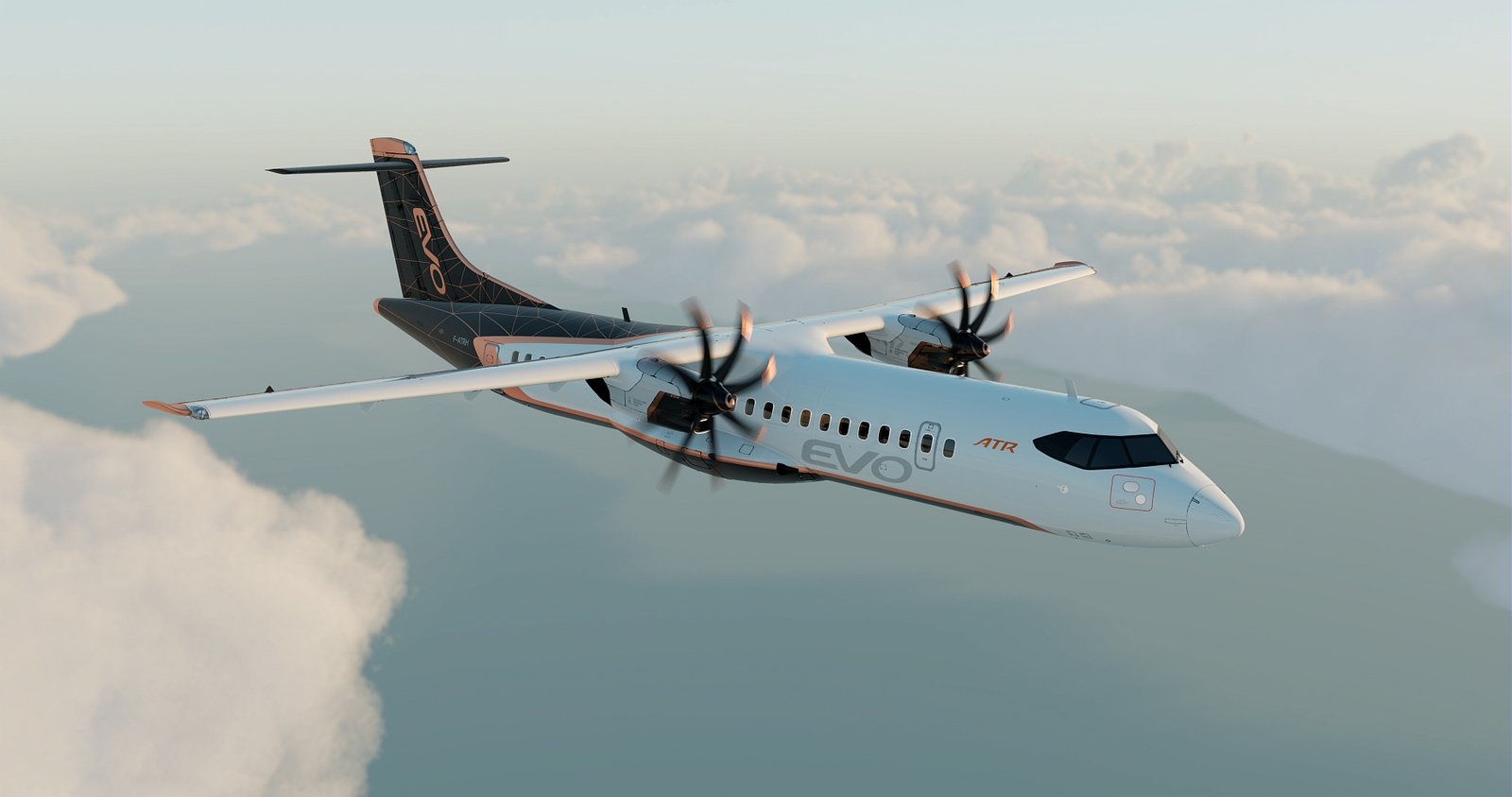
New propulsion architecture is one of several options being investigated by the airframer for its future Evo variant of the twin-turboprop.
Regional aircraft manufacturer ATR hopes by the end of this year to have completed the first “baseline” design of the hybrid-electric ATR 72-600 demonstrator it plans to fly in 2029.
A successful validation of the technology will then inform the design of the manufacturer’s proposed Evo variant – for which a next-generation conventional turboprop engine is also being considered – targeted at service entry around 2035.
ATR’s work is being informed by four separate projects which kicked off earlier this year, all part-funded by the EU’s Clean Aviation body under its second phase.
Clean Aviation allocated a total of €154 million to the four projects, against a combined cost of €231 million.
Two of these, PHARES and OSYRYS, are respectively directed by Pratt & Whitney Canada and Safran, while the other pair, HERACLES and DEMETRA, are led by ATR itself.
“It is one of the first times in Clean Aviation where we have four integrated projects to deliver one objective,” says Giovanna Ferraro, head of future projects and R&T at ATR.
Essentially, the first three projects feed into DEMETRA, which covers the development of the flying testbed plus additional ground-test activities for certain systems or equipment.
For the testbed, the airframer will modify an ATR 72-600, replacing one of its stock PW127 engines with a hybridised model developed through PHARES and incorporating the high-voltage electrical distribution system from OSYRYS.
HERACLES, meanwhile, will define the overall concept for what Clean Aviation calls the ultra-efficient regional aircraft, incorporating a broad suite of technologies that could equip the Evo.
Ferraro admits the “alignment and synchronisation” of the four projects is “quite a job”, particularly as DEMETRA depends so heavily on the others.
Project progress
Nonetheless, progress is still possible on the demonstrator, she says, even at this early stage: “Because we started [all four projects] at the same time we have set some assumptions that will be refined along the way.”
Although multiple Clean Aviation phase one projects were focused on regional aviation, a change in overall leadership for the pillar – from Leonardo to ATR – has meant a slower start to the latest effort.
“We do not start from zero but a change of leadership still takes a little bit of adjustment,” she says.
Nonetheless Ferraro says the team is “on track” to have the “first baseline” for the demonstrator ready by year-end, to be followed by another two iterations ahead of the start of aircraft modification.
These will include integration of the new systems, including the hybrid engine and advanced propeller, reinforcement of the airframe and wing, and alterations to the fuselage to integrate the battery packs, which, for the demonstrator, will be housed inside the passenger cabin.
If ATR has until 2029 to prepare the demonstrator, the technologies on which it rests will need to be ready slightly before that, says ATR’s new chief engineer Damien Proust.
Besides validating the hybrid powertrain, the project is also “opening the way” for the development of “an industrial system” to support its production, he says.
“Because we are not only talking about only a prototype: we are talking about what is the architecture for an industrialisation afterwards of a commercial aircraft.”
P&W’s goal is for around 10% of the total output from the mild-hybrid engines – using a battery electric system to supplement the gas turbine – to be provided by the electric motors, delivering an overall 20% efficiency improvement.
For reference, the PW127M/XT engines that currently power the ATR 72-600 generate around 2,750shp (2,050kW).
Successfully proving the hybrid-electric concept on the demonstrator, plus the ground tests of other innovations, will then inform a decision by the Airbus-Leonardo joint venture on what technologies could be incorporated into the Evo, if launched.
Indeed, the airframer is also considering whether a next-generation thermal engine could offer an alternative route to achieving the Evo’s green goals.
“We are studying both hybrid-electric technologies and a next-generation thermal engine because our objective is to deliver a meaningful step-change in efficiency while maintaining the reliability, affordability and versatility that regional operators require,” says Proust.
“The hybrid-electric demonstration we are leading through Clean Aviation by 2030 will be a key milestone, but we are also working closely with Pratt & Whitney Canada on an ultra-efficient thermal engine because technology maturity remains an important consideration.”
Critically, however, Proust remains convinced that a hybrid- rather than full-electric powertrain is the correct option.
“Full electric is not viable for the class of aircraft we operate, neither now nor in the near future,” he says.
“We project that the most performing batteries in the next 10 years will not be sufficient to have a full-electric [80-passenger aircraft].”
Tentatively targeted for service entry around 2035, following a launch decision about five years earlier, the Evo is meant to deliver a 30% fuel-burn saving over the current ATR.
However, this will not be achieved through the new engines alone. Other proposed updates include aerodynamic improvements, a “new flight-control architecture” and a higher-aspect-ratio wing.
Proust declines to reveal by how much the wing will change, noting that the current structure already boasts a respectable 11:1 ratio, but says ”we will go a bit thinner and a bit longer” in the future.
“The value is not set. But we already have a high ratio with the ATR, higher than an [Airbus] A320, for instance.”
However, any plans for a truss-braced design – explored in Clean Aviation’s first phase – have been dropped.
Weighty matters
Ferraro also sees little opportunity or requirement to cut weight significantly: the ATR is already “optimised”, she says, highlighting its composite empennage and wing.
Although ATR hopes to investigate some ways to trim mass when the next round of Clean Aviation projects kick off next year, for example “some solutions for the acoustic treatment in the fuselage”, overall “we don’t see big sources of weight saving”.
Besides, any mass benefit from the greater adoption of composite material “would be a bit contradictory to the DNA of the aircraft”, says Proust, which needs to remain both affordable and repairable for regional operators.
ATR has submitted a proposal for the latest batch of Clean Aviation funding related to the airframe and “enabling system”, says Ferraro, covering the aerodynamic and structural optimisation of the wing, fuselage, empennage, plus advanced anti-icing and flight-control systems.
In the case of the latter, ATR is exploring whether a full fly-by-wire system could “make sense” for the regional turboprop, although a range of options are being explored.
Proposals seeking funding through Clean Aviation’s fourth call were submitted in May with a selection decision expected in September.
Proust, who joined ATR in May from Airbus, succeeding Daniel Cuchet, calls Ferraro’s work “preparing the future” the “coolest” role in the company.
However, his nearer-term focus is no less important. The question, he says, is “what are the next five years of improvements that could be brought to the operators of the current platform?” while also serving as a “bridge until the next generation”.
The post ATR targets year-end for ‘baseline’ design of hybrid-electric demonstrator first appeared on FlightGlobal.
