


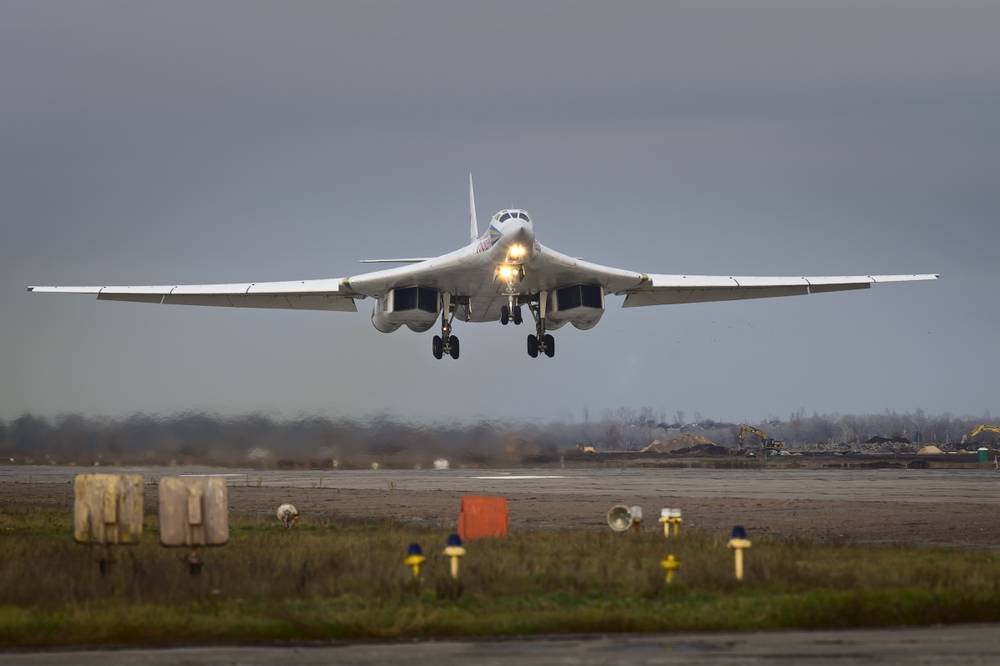
Only three countries in the world are considered to be strategic bomber powers: these are the United States, Russia, and China. Historically, the US and Russia were in a class of their own, while China’s large but H-6-based force occupied a lower tier in terms of range, survivability, and overall capability (Xi’an H-6 bomber, heavily derived from the 1950s-era Soviet Tupolev Tu-16).
However, this is changing, and while the US is moving to cement its position, China is moving to challenge it. It is becoming increasingly an open question if Russia can remain in this exclusive club. Russia’s bomber fleet is aging and is facing structural issues that can not be easily solved. The current conflict has significantly accelerated the decline the bomber force was already suffering from.
Russia has restarted production of the Tu-160 in its modernized Tu-160M configuration, but this itself illustrates the problem: its new strategic bombers remain an evolution of non-stealth Cold War designs. The USAF is moving onto its second-generation stealthy B-21 Raider and China is developing its Xi’an H-20 stealth bomber.
Russia’s Soviet Inheritance
When the Soviet Union collapsed in late 1991, production of the Soviet/Russian strategic bombers ground to a halt. Since then, Russia has been mostly coasting off its Soviet inheritance, although it has restarted artisanal-level production of its Soviet-era Tu-160 bomber. The collapse of the USSR saw countries like Belarus and Ukraine inherit long-range and strategic bombers like the Tu-16, Tu-22, Tu-95, and Tu-160.
These countries lacked the economic ability to feasibly maintain these fleets. It wasn’t long before Belarus, Russia, Ukraine, and others retired their fleets of Tu-16s. Ukraine found itself with a large fleet of around 100 Tu-22s, Tu-95s, and Tu-160s. It eventually reached a deal to transfer some of them to Russia in exchange for the supply of gas and as part of a greater set of assurances of Russia respecting Ukrainian sovereignty.
Half of Russia’s Tu-160s in service today are formerly Ukrainian Air Force strategic bombers. Ukraine transferred 11 Tu-160s and three Tu-95s to Russia: those that weren’t transferred were destroyed, with a few others put on display. In February 2001, the Kyiv Independent reported that “Ukraine dismantled its last Tu-160 Blackjack strategic bomber and a Tu-22M Backfire bomber on Friday, under the US-Ukrainian Cooperative Threat Reduction Program.”
Russia’s Estimated Bomber Fleet In 2022

In 2022, it was estimated that Russia had 130-140 longe range/strategic bombers remaining in service or inventory, or a little larger than Ukraine’s fleet in the early 1990s. IISS’s 2022 The Military Balance report estimated Russia had 14-16 Tu-160s, 55-60 Tu-95s, and around 61 Tu-22M3s (with the number ranging from 58 to 66 in some estimates).
The number of operational bombers is estimated to have been some percentage of these figures. It needs to be emphasized that Russia does not publish its in-service numbers, its inventory numbers, or its readiness rates. The United States does, and it is easy to separate active aircraft and aircraft that will be maintained and returned to service from those placed in storage at the Davis-Monthan boneyard.
Russian bomber fleet | 2022 estimate | Confirmed losses (per Oryx) | Number operational in 2025/2026 per Ukraine |
|---|---|---|---|
Tupolev Tu-160M1/2/3 | 16 (20-21 in 2026) | Approximately 10 | |
Tupolev Tu-22M3 | Approximately 60 | 12 (approx 24 claimed) | Perhaps seven for operational use, up to 11 |
Tupolev Tu-95MS | 55-60 | 11 | 36 in inventory, of which up to 12 are active at any one time |
Total | Approximately 140 | 23+ (confirmed) | At least 39 |
However, it is very difficult to separate de facto retired Russian airframes parked around bases from those active or expected to be serviced and returned to use. Russia is struggling with the fact that its Tu-22 and Tu-95 bombers have been out of production for decades. It is becoming increasingly hard to maintain the aircraft, especially the Kuznetsov NK-25 Afterburning turbofan engines on the Tu-22.
Direct wartime losses are only one strain on the fleet: the other main strain is increased usage, which is believed to be using up the remaining service life of the bombers. Threats on Russian air bases also force them to disperse to remote bases, which adds even more flight time and strain during operations.
Russia’s Fleet Of Tu-160 Blackjacks

As Russia received the Ukrainian bombers in the 1990s, its ability to acquire new bombers largely dried up. Russia has worked to produce more prestige Tu-160 Blackjacks, although initially some of these were completed using semi-complete airframes and components left over from the Soviet Union. Today, the Tu-160 is the only Russian bomber in production and is believed to be delivered at a rate of around 0–2 per year.
Partly thanks to the work of Guy Plopsky on X, the Blackjack is the only bomber for which it is possible to have reasonably precise inventory numbers. In August 2026, he posted that “footage shows that ‘Alexander Golovanov’ (B/N “05” Red / RF-94104) has also been modernized to the Tu-160M standard. There are now at least seven modernized Tu-160Ms plus at least three new production Tu-160Ms (a.k.a Tu-160M2).”
This means that Russia now has ten upgraded Tu-160M/M2 Blackjacks in service, excluding the other non-modernized Blackjacks. Plopsky estimates that there are 10-11 older Tu-160M1s, bringing the total fleet size to 20-21 Tu-160s of all variants. It is unclear how many of these older Tu-160s are currently operational. No Tu-160s are known to have been lost during the conflict in Ukraine from 2022 until the time of writing.
Russia’s Strained Fleet Of Tu-95MS Bombers

The Tu-95MS “Bear” turboprop bomber has been the backbone of Russia’s strategic bomber operations in the Ukraine conflict, and the fleet appears to have suffered significantly. As of the time of writing, the Oryx blog has tallied a total of 11 Tu-95MS lost, including three damaged. This should be treated as a base figure: it is not always possible to independently confirm losses. It is also worth noting that all Tu-95 losses have been on the ground.
While 11 losses represent only around 20% of the estimated pre-war fleet of 55-60 Bears, the strain is much worse than the figure may suggest. Many of these losses have been aircraft fueled for operations or flown to forward airbases ahead of operations. In other words, these appear to be mostly fully operational airframes. The most recent Russian Tu-95 loss came in July 2026 when a Tu-95 had its tail torn off in a Ukrainian strike.
In 2025, around the time of Ukraine’s Operation Spiderweb, Ukrainian Air Force spokesperson Yurii Ihnat was quoted as saying Russia had around 36 Tu-95MS in service, with the remainder acting as spare-parts donors. Ukrainian estimates suggest a total inventory of 40-60, of which no more than 12 are ready at any one time.
The Last Of Russia’s Tu-22M3 Bombers

Of the Russian bomber fleet, it would seem the Tu-22 Backfire is the hardest hit, and the fleet is now on its way out. The Oryx blog lists a total of 12 Tu-22M3s lost, of which three were damaged. One of these bombers was shot down by Ukraine in 2023, while three of them were lost (2024, 2025, 2026) in mishaps. These four are total losses, with it being unlikely they would be useful for any salvaged parts.
Losing one Tu-22M3 per year in test flights could suggest the fleet is strained and maintenance is poor. Ukraine has estimated that only 10-12 Tu-22M3s are operational at any one point, with some Ukrainian OSINT accounts in April 2026 claiming that Russia’s total remaining inventory is around 18 aircraft, of which only seven are actively used for combat strikes against Ukraine. In August 2026, Ukraine’s Defense Express suggested that Russia may have lost over 70% of its Tu-22M3 over the course of the conflict.
However, this estimate includes higher claimed Ukrainian victories than confirmed by Oryx (a total of 24 losses), as well as assuming no Russian reactivations of old, previously retired aircraft. It also has no assumptions about airframes wearing out and becoming parts donors. At any rate, it would appear that Russia’s Tu-22M3 fleet is highly strained and there are legitimate questions about whether there will be an operational fleet of any reasonable size at all by 2030.
Looking Ahead To 2030

Looking ahead to 2030, the future appears bleak for Russia’s strategic fleet. While there has not been a rerun of Operation Spiderweb, Russia still lost two bombers in the first half of 2026. Before 2025’s Operation Spiderweb, Russia only used Tu-95s and Tu-22s for missions against Ukraine. It appeared to have sufficient numbers of these bombers available for the raids. It appeared to be reluctant to use its limited number of prestige Tu-160s and reserve them for the nuclear role.
One Tu-160 was parked at one of the airbases attacked in Operation Spiderweb, but was not attacked by Ukraine, perhaps as an effort to maintain escalation and not attack Russia’s nuclear triad. After the operation, Russia started using Tu-160s in conventional strikes for the first time against Ukraine. One interpretation is that Russia now needs them to make up the numbers.
At the same time, Russia’s stealthy Tupolev PAK DA bomber program to replace the Tu-95 and Tu-160 hasn’t flown and is likely years away. It remains in static ground testing. It is widely believed that Russia has de-prioritized allocating its limited resources to expensive next-generation programs to fight future conflicts and is instead more interested in programs that are relevant to its current conflict.
It is impossible to say for certain what Russia’s bomber fleet will look like in 2030. However, it is safe to say it has been significantly reduced since 2022. There is no short- or medium-term solution for Russia to reverse those losses, overcome structural problems, and compete with the US’s B-52J and B-21 efforts or China’s modernized H-6 and upcoming H-20 bombers on a peer-on-peer basis.
