


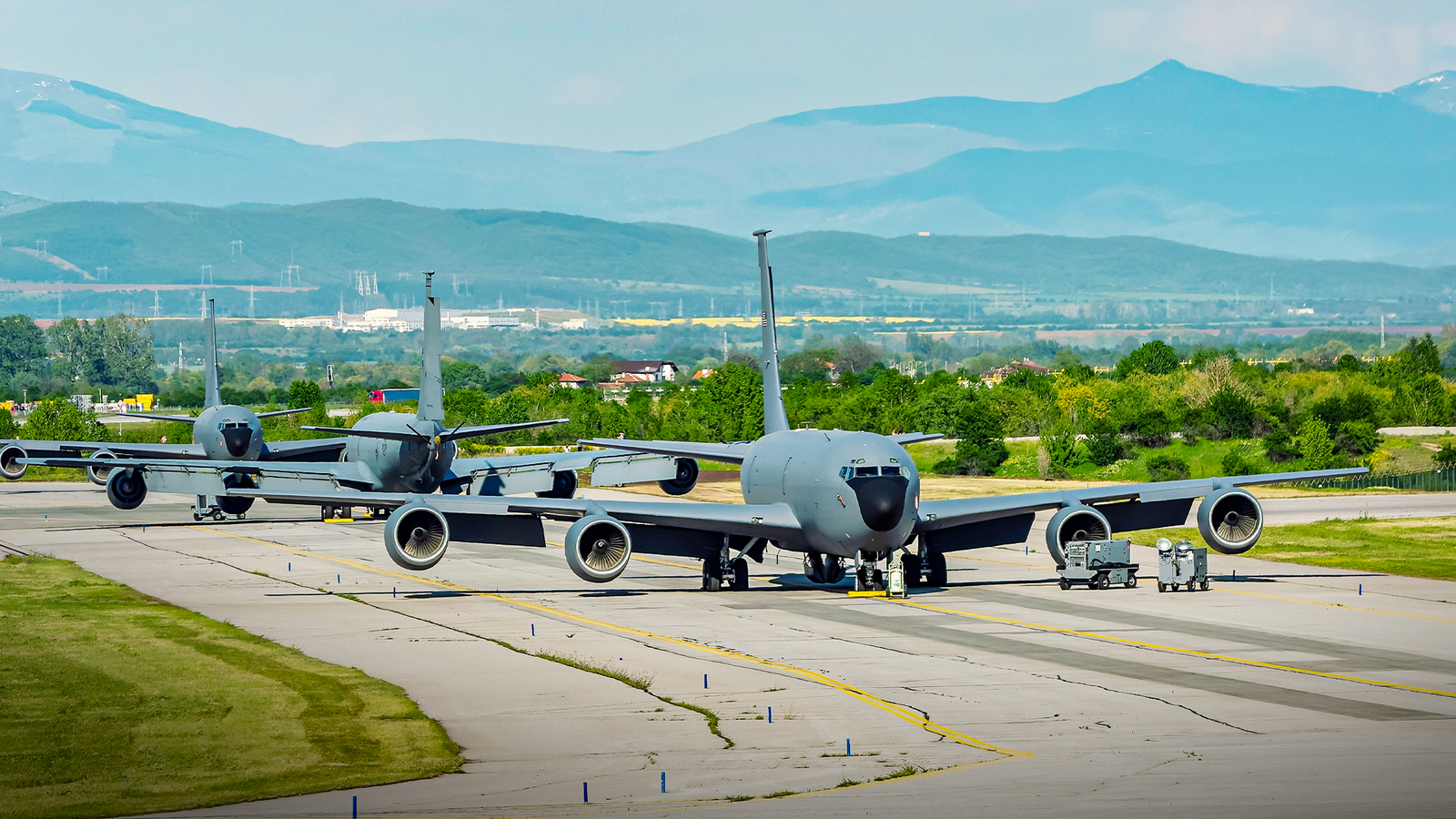
Tel Aviv’s Ben Gurion Airport (TLV) has been an integral part of the air campaign for the US Air Force in joint missions with Israel during Operation Epic Fury. When hostilities began at the end of February, civilian air traffic was largely suspended or significantly reduced in and around the region surrounding Iran. Along with many of the Gulf States, Israeli commercial aviation was cut back as military aircraft filled the skies over the Middle East.
That has started to change this summer as the two to three dozen-strong contingent of USAF tanker jets leave Ben Gurion. These aircraft are being repositioned to both make them harder targets for enemy ballistic missiles or drones, and free up the tarmac for civil air traffic. The airport has only been operating about a third of the commercial flights that it normally schedules due to the heavy airfield usage by military planes.
The Warbirds Head To Tel Aviv
Ben Gurion is one of the largest and most important international hubs in Israel. As the summer season continues, up to 2.5 million passengers are expected to pass through its doors in August. There are only 99 available parking stands at the airfield, with 72 reportedly occupied by USAF airframes at peak times since OEF began. Prior to the coalition bombing campaign, the airport had expected its busiest summer on record.
Plans for a record-breaking travel season were derailed by the conflict, and Israeli Transportation Minister Miri Regev has lobbied aggressively for a 20 airframe limit on military parking applications. Despite the congestion caused by warbirds, summer traffic is the busiest since 2023, with roughly 100,000 daily travelers flying to and from Tel Aviv. Since hostilities have been slowly winding down, the airport is finally making progress in ramping capacity up even higher.
The question is why USAF tankers fill the airfield at Ben Gurion at all when they could have been stationed at Israeli Air Force bases instead. The simple answer is that the scale of aircraft deployments is unprecedented. US Central Command described OEF as the greatest concentration of American military firepower in a generation. Tactical airframes filled the ramps at Israeli and joint bases around the Gulf. Tel Aviv offered a strategically valuable overflow location and also provided a layer of protection, as it is not a priority target for the enemy.
No Airstrip Unscathed By Epic Fury

The airfield at Ben Gurion still came under fire even though it was not one of the highest priority targets during the conflict between Iran, Israel, and America. In mid-March 2026, Iran launched a series of missile barrages specifically targeting what it claimed was ‘the heart of Tel Aviv’. Despite dense air defense layers, the airfield perimeter was breached, underscoring the extreme vulnerability of clustering high-value military assets.
Catch what other flight trackers miss
Emergency squawks, holds, NOTAMs — live signals, no signup.
Open tracker
Catch what other flight trackers miss
Emergency squawks, holds, NOTAMs — live signals, no signup.
Open tracker
While no US military airframes were destroyed onsite, the Air Force later confirmed that several KC-135 Stratotankers sustained damage. Israel’s air defense systems successfully intercepted the bulk of the threats. Bomblets released from Iranian ballistic missile cluster warheads and heavy interceptor debris fell directly into the airfield. The fallout led the Israel Airports Authority to implement rolling passenger caps and force traffic reductions to prevent overcrowding during active missile alerts.
Regev’s ministry formally barred any additional tankers from landing beyond the 20-plane limit, a decision serious enough that senior CENTCOM officials contacted Israeli Defense Force leadership directly. According to Ynet News, an Israeli official responded that as long as the Americans were not fighting Iran, they did not plan to increase the cap. The Times of Israel reported that the airport insisted on completely vacating all military aircraft to allocate every parking stand to the surge in holiday flyers.
The Price Of Conflict

The administration of the Tel Aviv airport and the Israeli Transportation Ministry stated that at least 80 parking stands were required for the airfield to operate at normal capacity. Heading into August, projected passenger numbers require all of the tarmac to be available for commercial airliners, according to the Times of Israel. Even a tanker drawdown that fully complies with the 20-aircraft cap does not eliminate the underlying tension between the IAA and the USAF.
The surge in travelers comes as several airlines have resumed service to Ben Gurion, as the danger to the airfield has once again subsided. El Al, Arkia, and Israir have expanded summer schedules to absorb the surge. Although most North American airlines have not yet resumed flights to Tel Aviv, major European carriers like Lufthansa, ITA Airways, and Eurowings have successfully returned. United and Delta Air Lines are also slated to come back in September, which will further increase the need for airliner parking.
Still, the 20-tanker limit did not hold. On July 14, the United States halted the planned removal of aircraft from Ben Gurion as fighting with Iran resumed, even as CENTCOM announced it had completed a tenth consecutive night of strikes against Iranian targets. Four additional tankers landed at Ben Gurion that same week, pushing the total back up to 33 despite 13 aircraft having been scheduled to depart. Israeli officials reported the USAF planned to bring roughly 10 more tankers into the country in the following days.
American Tankers Staying For The Long-haul

The USAF appears to be preparing for a permanent deployment of tanker jets in Israel following the conclusion of OEF. Rather than relying on Tel Aviv’s primary civilian hub, future permanent deployments of KC-135 Stratotankers and KC-46 Pegasus aircraft are being rerouted to bases like Nevatim, Ovda Air Base, and Ramon Airport. The Pentagon is also actively moving to disperse assets further from Iran’s immediate weapons range.
Migrating these assets permanently to military bases immediately frees up essential gate space for widebody jetliners in Tel Aviv. The tanker congestion previously forced the Israel Airports Authority to consider canceling up to 50,000 commercial tickets to prevent total gridlock. Operating out of southern military airfields segregates tactical military corridors from commercial flight paths, reducing delays and lowering the risk of in-flight hazards.
The relocation has accelerated ahead of the airport’s peak travel month. However, per agreements between CENTCOM and the Israeli military, the relocated KC-135 and KC-46 fleets retain an emergency return clause. In the event of a fresh regional escalation or a collapse in peace talks, the tankers could re-occupy Ben Gurion on short notice.
Investing In Israeli Air Power

The US and Israel have funneled engineering resources into military installations, most notably Ovda Air Base in the southern Negev Desert. Massive concrete engineering projects are underway to expand and reinforce parking aprons to withstand the high gross weight of fully loaded tankers. Other infrastructure upgrades include buried, blast-resistant fuel storage tanks and high-speed distribution pipelines.
There are also ongoing upgrades to counter missile and anti-drone defense systems. That includes integration with the Aegis system, THAAD, and Israel’s domestic systems to reinforce the ‘Iron Dome’ that defends its airspace. The goal is to transform these airfields into heavily fortified, self-sustaining logistics hubs capable of withstanding dense missile and drone attacks. Funding for the multi-billion-dollar infrastructure developments is shared through a deal that combines US foreign military aid with Israel’s own defense budget.
One of the major upgrades is the hardening of aircraft shelters for the tanker jets. The existing reinforced parking is made for fighter jets that are much smaller. These barriers ensure that if one tanker is hit, the explosive fragments and burning fuel are contained, preventing a chain-reaction explosion across the tarmac. The upgraded airbases will also feature the densest concentration of multi-layered air defense systems in the region.
Hardening The Iron Dome Over Israel

The massive salvos of ballistic missiles, cruise missiles, and drone swarms launched by Iran against Israel and other American Gulf partner nations have shown chinks in the armor of the Western bloc counter-missile technology. While most of the aerial assaults were repelled, some significant losses were taken by the USAF, including tankers and an extremely precious airborne early warning and control aircraft in Saudi Arabia. To prevent this outcome in the event of future hostilities, air defenses are being further reinforced.
Permanent Arrow-3 and David’s Sling batteries are being built on the perimeter defenses of southern bases like Ovda to destroy incoming medium- and long-range ballistic targets high in the atmosphere. Additionally, short-range Iron Dome batteries and Counter-Rocket, Artillery, and Mortar systems are deployed around fuel farms and runways specifically to target low-altitude drone swarms and cluster bombs.
Another major force enhancement on the sensor side of air defense is integration with the US Navy. Ground systems are being linked via secure tactical data networks, such as Link 16, to USN Aegis-equipped destroyers, which have extremely long-range and accurate radar systems. Nearly constant rotations of vessels operate in the Red Sea and Eastern Mediterranean, providing a unified, real-time tracking radar picture of the skies over the Gulf.
A significant portion of the infrastructure costs is covered by the United States’ annual $3.3 billion Foreign Military Financing commitment to Israel, along with supplemental emergency appropriations. The US Construction in Israel Program through the Army Corps of Engineers is also contributing to the upgrades.
