


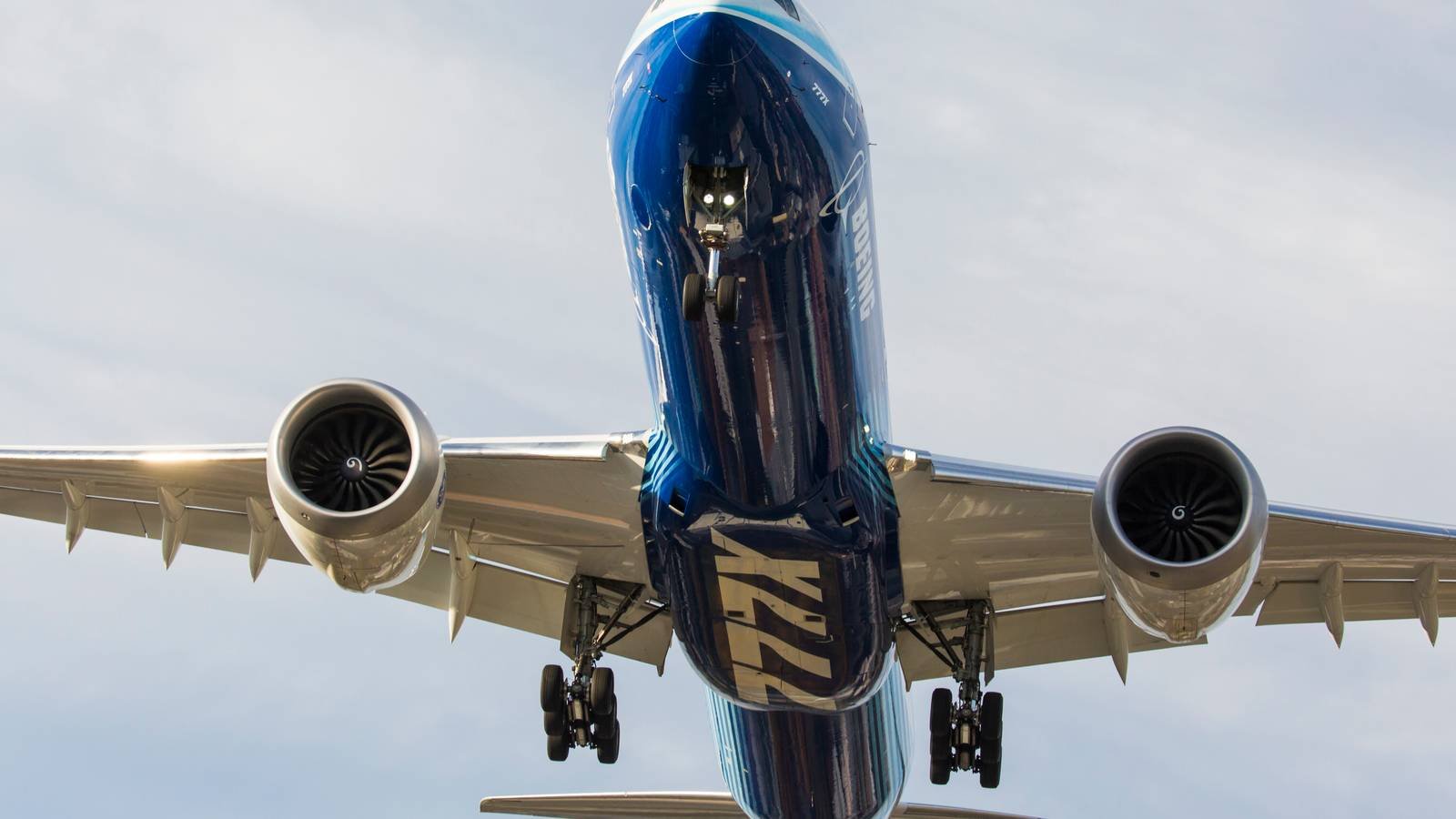
NASA spent years developing chevron technology for airliner engines in an effort to make aircraft quieter, which became one of the more iconic external features of the Boeing 787 Dreamliner. But Boeing has already moved beyond those quieting chevrons with its incoming Boeing 777X family powered by the huge GE9X turbofan engines. The massive size of the GE9X engines provides them with an inherent advantage that makes it easier to dispense with the chevrons and the small but measurable penalty they entail.
But while the GE9X has a size advantage allowing it to increase its bypass ratio and decrease engine noise, new narrowbody and business jet engines are also able to dispense with chevrons. Chevrons offer a tale in the march of technological development. They represent a time in the 2000s and 2010s when engineers sought to reduce noise outside of the exhaust. New engines tell the tale of how technology has advanced to the point where noise reduction can be achieved within the engine.
NASA’s Chevron Breakthrough
In March 2025, NASA published a piece entitled “NASA’s Chevron Technology Quiets the Skies.” The article starts with “Shortly after dawn on March 27, 2001, NASA pilot Bill Rieke took off from an airfield just outside of Phoenix in NASA’s blue-and-white Learjet 25 and flew low over a series of microphones for the first flight test of a groundbreaking NASA technology.” That new technology being described was experimental, jagged-edge nozzles, the forerunners of chevron nozzles.
As with many commercial airline technologies, the idea traces back to military aircraft designs. Fighter jets used rectangular notches or tabs on the engine nozzle’s exit to help disguise its infrared (heat) signature. NASA researchers had discovered that these could also reduce engine noise by helping mix the hot air from the engine core with the cooler air blowing through the engine fan. During the 1990s, the agency found that “a serrated, or sawtooth, shape, referred to as a chevron, offered more promise.”
NASA then contracted General Electric and Pratt & Whitney to develop an array of tab and chevron designs to be analyzed in Glenn’s unique Aero-Acoustic Propulsion Laboratory (AAPL). In the late 1990s, NASA tested the technology and found that it worked in reducing noise. It writes, “the chevron’s three-decibel noise decrease was analogous to the difference between running two lawnmowers and one.” NASA dismissively says chevrons have a “negligible” 0.25% reduction of thrust.
The Thrust Chevron Penalty

Airbus, Embraer, Bombardier (CSeries, later the A220), and COMAC never used them in the same way. Boeing has dropped them from its last aircraft design, the Boeing 777X. There are various reasons for this. One is that the “negligible” compromise that NASA mentioned is still consequential. NASA says the loss in thrust is around 0.25%, although some estimates put this at 0.5%.
One NASA study describes good chevron designs as producing significant noise reductions with less than 1% thrust-coefficient reduction under cruise conditions. Meanwhile, another NASA study says, “Reduction in broadside overall sound pressure level (OASPL) and thrust loss is compared in Figure 14 for each chevron calculation. OASPL benefit ranges from 2.6 to 3.8 dB, while values of thrust loss are between 3.4% and 5.5%.“
One 2005 Airbus study says, “Through model testing, it became apparent that the chevrons had a small but measurable effect on engine performance. This performance impact would have to be countered to ensure that the end result would be no difference in the operation of the aircraft.” Efficiency gains are all about marginal improvements, and a 0.5% penalty is consequential. At the same time, there are penalties for extra weight (although they reduce the need for noise-damping materials) and for engine complexity.
Chevrons Became A Temporary Boeing Thing

Eventually, the technology was rolled out on the Boeing 787 Dreamliner and the related Boeing 747-8 upgrade. Some of the technologies and design approaches developed for the 787 era also found their way into the 737 MAX, including the use of chevron nozzles. But given the thrust penalties and the associated fuel efficiency penalty, they were never ideal. Engineers would seek to recover that penalty if possible.
For many, the chevrons seemed like the future, but in the end they were a phase restricted to Boeing. This depends on exactly what constitutes a chevron and on how the Airbus A320neos powered by the CFM International LEAP-1A are classified. It should be stressed that the technology was available to other airplane makers, and it wasn’t developed exclusively by NASA for Boeing.
Perhaps more importantly, engineers were able to find other ways to reduce engine noise. New engine designs have sought to meet noise regulations by reducing noise within the engine, removing the need for chevrons. This is easier to do with larger engines with very high bypass ratios, like the Boeing 777X’s GE9X.
Boeing’s Upcoming 777X

The Boeing 777-9 is set to be the largest twin-engine airliner ever to enter service. It is also powered by the world’s largest aero engine ever built, although, ironically, rated with a lower thrust rating than the older GE90 due to changes in how engines are rated. Overall, it is worth noting that the Boeing 777X is intended to be an evolutionary, not revolutionary development.
Boeing advertises the Boeing 777X family as offering 20% lower fuel use and a 40% smaller noise footprint “than the airplanes it will replace,“presumably the 777-300ER. It claims the 777X has “10% lower operating costs than the competition,” which is a thinly veiled reference to the Airbus A350-1000.
Boeing claims that the 777X will have a 5% lower specific fuel consumption than the competing engine, a 10% lower specific fuel consumption vs. the older GE90-115B, an 8dB margin to Stage 5 noise limits, and 55% emissions within the CAEP/8 margin. This should be understood as advertising, and many of the claims vis-à-vis the A350-1000 are disputed by Airbus.
The GE9X’s 134-Inch Diameter

But what is more interesting for this article is Boeing’s emphasis on 40% noise reduction and its 8dB margin to Stage 5 noise limits. The Boeing 777X is achieving this while ditching the chevrons, allowing it to recover the thrust penalty on the Dreamliner. In short, the underlying engine technology has improved to the point where GE can achieve the required noise performance through the engine’s basic architecture and acoustic treatment.
The GE9X comes with an enormous 134-inch (3.4 meter) fan and an impressive 10:1 bypass ratio. The large fan is key to enabling the high bypass ratio. This then allows the engine to be more fuel-efficient and to reduce the velocity of the air being accelerated by the engine. For its part, GE Aerospace says, “Turbofan engine: Per pound of static thrust produced, the GE9X is the quietest turbofan engine GE Aerospace has ever produced, and is designed to meet current and anticipated next level of noise certification standards on the B777X Family.”
GE Aerospace GE9X turbofan (per GE Aerospace, Boeing) | |
|---|---|
Diameter | 134 inches (3.4 meters) |
Max test thrust | 134,300 lbf (world record) |
Max certified thrust | 110,000 lbf (GE90 certified for 115,000 lbf) |
Bypass ratio | 10:1 |
Fuel efficiency improvement | 10% over GE90-115B (advertised) |
Sound improvement | 40% (smaller noise footprint than the airplanes it will replace) |
Noise margin | 8dB margin to Stage 5 noise limits (advertised) |
Put another way, the higher bypass ratio allows more air to be accelerated by the fan but at a lower velocity. That produces a lower exhaust velocity, resulting in less violent air mixing. It’s the violent air mixing that produces the intense jet engine noise. The GE9X can address the noise issue through its fundamental architecture.
Even Small Engines Abandon Chevrons

While the engine diameter may be the largest single factor in reducing noise, it is not the only one. The GE9X turbofan incorporates extensive acoustic improvements and aerodynamic optimization throughout the engine and nacelle. This is important, as after all, not all engines are ultra-large turbofans like the GE9X. Even the small modern engines for business jets have been able to avoid the need to incorporate chevrons to meet noise limits.
One excellent example is GE Aerospace’s Passport, which lacks chevrons and powers the Bombardier Global 7000/8000. GE explicitly states that the Passport meets FAA Stage 4 noise requirements and uses technologies, including its 52-inch fan blisk, to reduce cabin noise and vibration. Looking ahead, CFM is working on open fan technologies to power the next generation of narrowbody aircraft through its RISE program.
CFM says that RISE program engineers have developed a fan design that minimizes noise while maximizing efficiency. It claims “the simpler design leverages 21st-century technologies to eliminate weight and noise issues and achieve improved fuel efficiencies.” Meanwhile, Rolls-Royce is looking to re-enter the narrowbody engine market by using technologies developed through its massive UltraFan demonstrator program. It doesn’t look like chevrons will return.
