


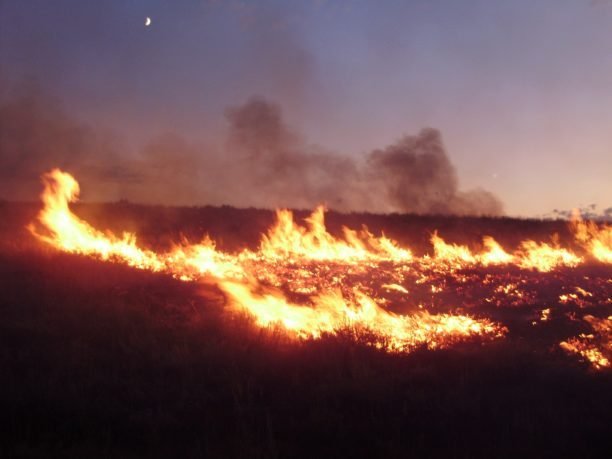
Five unauthorized drone flights over Oregon’s Wrights Spring Fire grounded firefighting aircraft, highlighting a growing safety problem during wildfire operations.
By DRONELIFE Features Editor Jim Magill
As massive wildfires continue to ravage vast areas of the West and northwestern U.S., the problem of unauthorized drones flying in disaster areas continues to hamper aerial firefighting operations.
Officials with the Northwest Incident Management Team 7, an interagency government group that manages wildland fires across the Pacific Northwest, this week reported that UAVs and manned aircraft battling the Wrights Spring Fire in Klamath County, Oregon were grounded after unauthorized drones were spotted flying in the restricted airspace above the disaster area.
“What’s occurred in this incident is we’ve had five different incursions of drones over a number of days, Cheyne Rossbach, a spokesman for the incident management team, said in an interview. “These five incursions had the impact of basically grounding our UAS platforms for one night.”
Four of the incursions occurred at night and one during the daylight hours. Officials have been unable to identify the pilots of the drones or take any legal action.
After spotting the unauthorized drones, firefighting teams were forced to ground their own UAVs, used to perform reconnaissance missions, gather infrared data on the fire, and for ignition purposes, using fire to fight the fire. The grounding also impacted the firefighting teams’ manned aircraft, including three Type 1 helicopters, the largest, and most powerful heavy-lift aircraft used in wildland firefighting operations, Rossbach said.
The choppers were grounded during the last hour of their operational period, during which they dropped large bucket of water onto specific targeted of the fire.
The Wrights Spring Fire, located about two miles west of Sprague River, Oregon, which has been burning since August 5, is estimated to be about 55,500 acres in size and involved the efforts of about 700 firefighting personnel. As of Tuesday afternoon, it was estimated to be about 65% contained.
Don Ferguson, another incident management team spokesman, said the incidents, which involved drones flying in areas in which the FAA had imposed temporary flight restrictions, could have had devastating results for firefighting operations.
“One consequence is that we have to get our aircraft out of the way, both drones and our tactical aircraft,” he said. Another terrifying potential consequence of unauthorized drones flying within the disaster response airspace is the potential of a collision with a manned aircraft.
One such incident occurred in California in January 2025, when a drone collided with a firefighting aircraft over the Palisades fire. The collision damaged the wing of the Super Scooper firefighting plane, forcing it to be grounded.
“That has not happened to us, not on this fire, but, that’s just terrifying,” Ferguson said. “That’s why we make sure that every news release we put out, every bulletin board we post to the public has that typical warning there that says, ‘If you fly, we can’t.’”
The potential risk of a drone-on-aircraft disaster is even greater with the use of the large Type 1 helicopters, whose rotors create “an incredible draw of air,” Ferguson said. “With these light drone platforms, the risk is that if one comes in proximity and it gets pulled into those rotors, then you have a catastrophic event.”
The fact that four of the drone incursions took place at night could indicate that the pilots were unaware of the rules regarding TFRs restrictions over disaster areas.
“We’ve tried to really make it clear that our temporary flight restrictions that are in place are 24/7. I think a lot of times people will see aircraft in the air during the day, and then they are not seeing things at night necessarily. But that doesn’t mean we’re still not using the airspace,” Ferguson said.
“I think that for the public, it’s the curiosity of, ‘Oh, there’s a fire, and maybe there’s a chance to get some cool pictures.’ And those cool photos can potentially interfere or delay operations, or cost a life in the worst-case scenario.”
Continuing problem with drone incursions
In recent months, incidents involving unauthorized drones flying in restricted airspace over wildfires and other disaster areas has become a growing problem. In a recent Facebook post, the U.S. Forest Service reported that there have been 67 drone incursions reported near wildfires this year alone.
Earlier this month, the FBI and local officials reported a series of overflights of drones above wildfires in eastern Washington state, which also resulted in the temporary grounding of firefighting aircraft.
In an email statement, an FAA spokesman pointed to the dangers of flying a drone near a wildfire as well the potential penalties the UAV pilot could incur.
“When drones are flown near wildfires, fire response agencies often have to ground their aircraft to avoid the risk of a midair collision. Delays in airborne response can threaten firefighters on the ground, residents and property in nearby communities, and may allow wildfires to grow larger,” the spokesman said.
The FAA routinely imposes TFRs during emergencies to protect aircraft involved in disaster response operations. “Unless specifically authorized, all other aircraft, including drones, are prohibited from operating within a TFR.”
Drone pilots caught interfering with firefighting efforts on public lands can be charged with a federal crime punishable by up to two years in prison, the spokesman said.
“The FAA reviews all reports of unauthorized drone operations and investigates when appropriate. Drone operators who conduct unsafe operations that endanger other aircraft or people on the ground may also face fines of up to $75,000. In addition, the FAA may suspend or revoke drone operators’ pilot certificates.”
Read more:

Jim Magill is a Houston-based writer with almost a quarter-century of experience covering technical and economic developments in the oil and gas industry. After retiring in December 2019 as a senior editor with S&P Global Platts, Jim began writing about emerging technologies, such as artificial intelligence, robots and drones, and the ways in which they’re contributing to our society. In addition to DroneLife, Jim is a contributor to Forbes.com and his work has appeared in the Houston Chronicle, U.S. News & World Report, and Unmanned Systems, a publication of the Association for Unmanned Vehicle Systems International
