


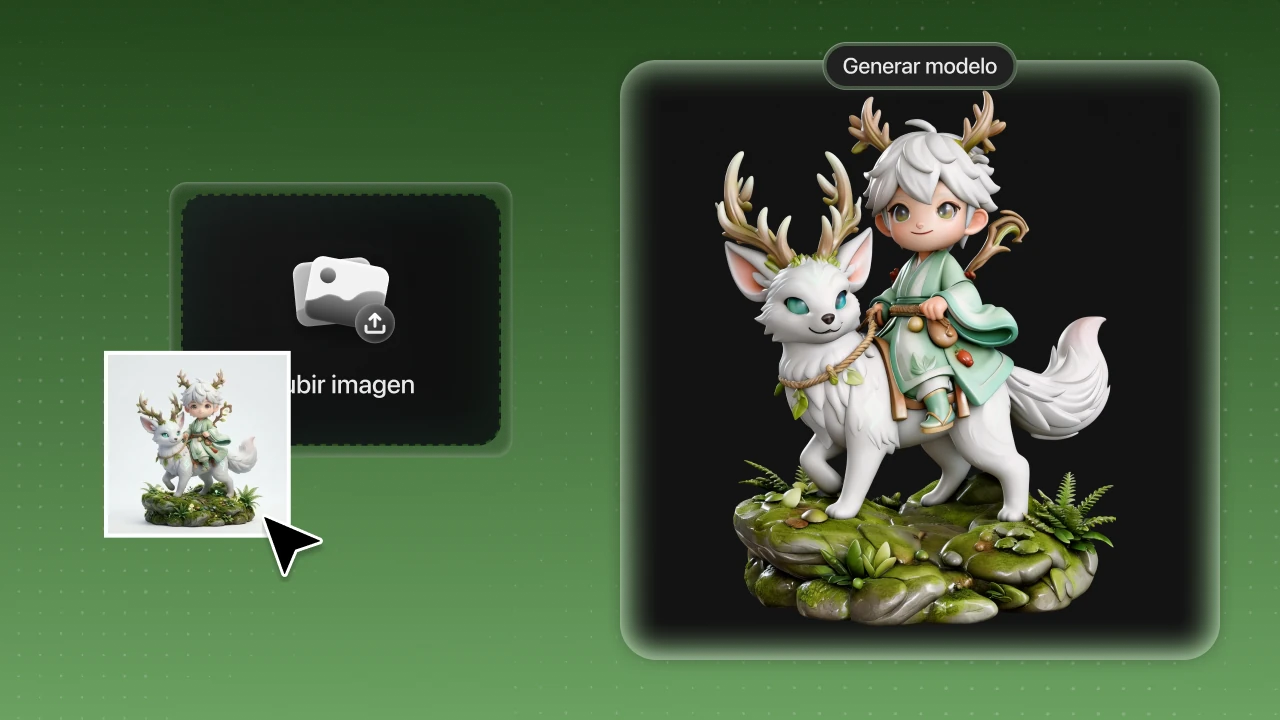
Hi3D, the browser-based AI model generation platform built on its proprietary Sparc3D engine, has launched Hi3D V3.0, an AI 3D generation model the company describes as the first commercially available version to reach 2048³ voxel resolution.
The update centers on three areas: geometric detail, structural accuracy, and texture output.
Finer Detail and Structural Accuracy
At 2048³ voxel resolution, Hi3D says V3.0 retains fine structural detail even under close zoom, avoiding the blurring or merging that can occur at lower resolutions. The model can generate small, adjoining parts as separate components rather than fusing them together, and it can render shallow engraving, surface texture, thin walls, and unsupported overhangs.
Hi3D also cites improvements in spatial reasoning, resulting in more consistent geometry from multiple viewpoints, including occluded areas and intersecting objects, along with steadier results in rear and side views.
Texture output has been raised to a maximum of 8K resolution, paired with an in-house UV completion algorithm. The company credits this combination with producing cleaner pattern edges, smoother color transitions, and more defined surface ornamentation.
Platform Tools and Free Access Window
The free access period ran from August 19 through August 20, 2026, alongside a 70 percent discount on annual subscription plans.
V3.0 is built into Hi3D’s broader 3D creation platform, which includes an image-to-3D conversion tool, an AI texturing tool for untextured models, and tools for splitting models into printable parts with connectors for assembly. The platform also supports converting textured models into color regions for compatible multicolor 3D printing.
Hi3D positions the update as relevant across several fields that rely on 3D assets, including 3D printing, gaming and film, digital art, jewelry and fashion, industrial design, and tourism and education.
Positioning Around Precision in a Crowded Field
Hi3D’s emphasis on reaching 2048³ voxel resolution reflects a push to compete on output fidelity as AI 3D generation platforms increasingly overlap on basic capabilities, making different aspects of output quality more important points of differentiation.
Meshy 7 takes a different axis of competition, focusing on how closely a generated model matches the original input image rather than on resolution, to cut down on manual rework. Tripo AI raised $50 million to develop model architectures aimed at production-ready geometry: while Hi3D emphasizes preserving fine geometric detail through higher resolution, Tripo focuses on coherent geometry and topology for production-ready meshes.
Each company has picked a different technical benchmark to differentiate an otherwise similar product category.
3D Printing Industry is inviting speakers for its 2026 Additive Manufacturing Applications (AMA) series, covering Energy, Healthcare, Automotive and Mobility, Aerospace, Space and Defense, and Software. Each online event focuses on real production deployments, qualification, and supply chain integration. Practitioners interested in contributing can complete the call for speakers form here.
To stay up to date with the latest 3D printing news, don’t forget to subscribe to the 3D Printing Industry newsletter or follow us on LinkedIn.
Explore the full Future of 3D Printing and Executive Survey series from 3D Printing Industry, featuring perspectives from CEOs, engineers, and industry leaders on the industrialization of additive manufacturing, 3D printing industry trends 2026, qualification, supply chains, and additive manufacturing industry analysis.
Featured image shows Model Maker Feature AI. Image via Hi3D.
