


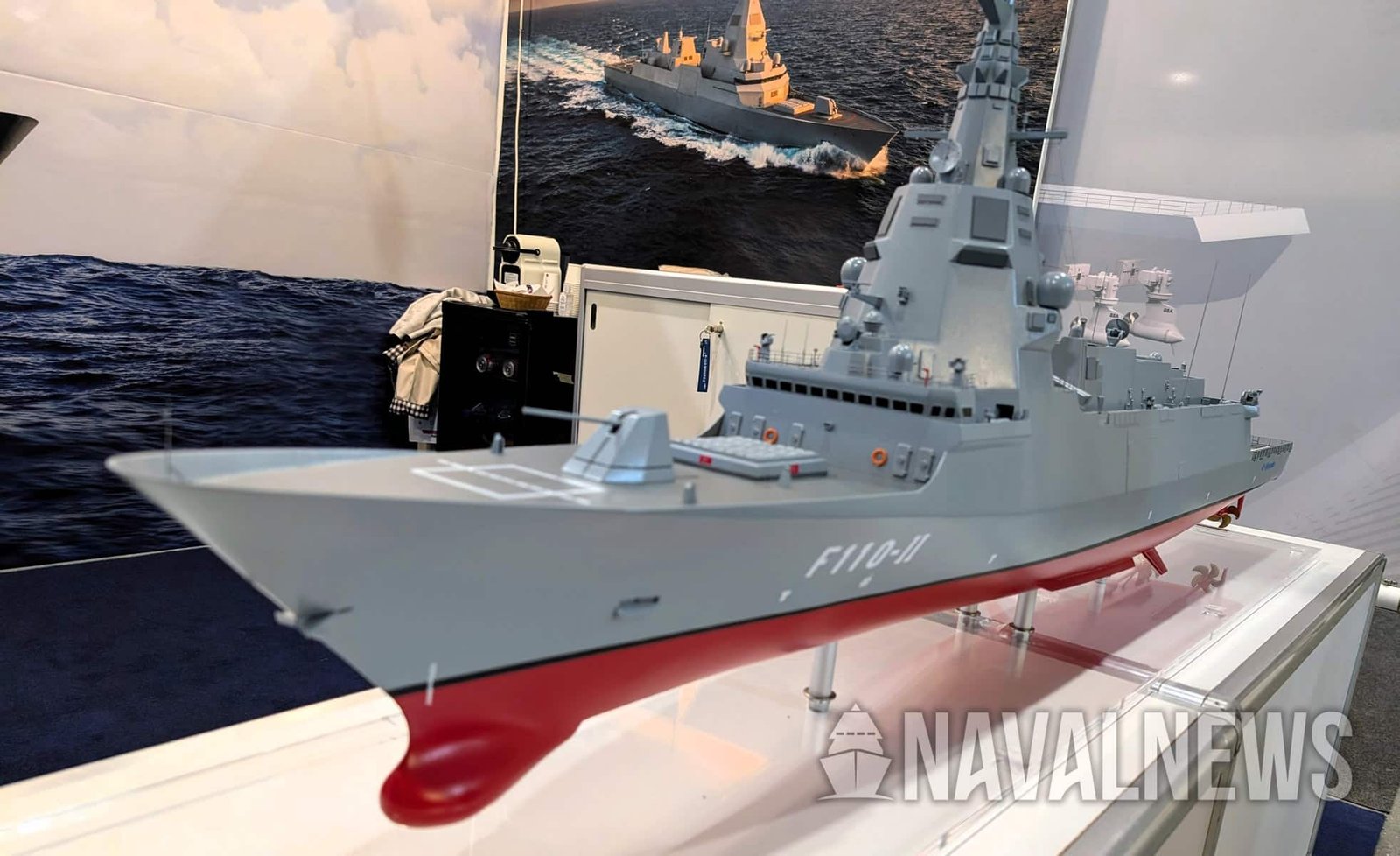
At DALO Industry Days 2026, Navantia unveiled a scale model of the F-110 Flight II / IAMD, an enhanced evolution of the F-110 design featuring significantly increased air-defense capabilities and optimized for high-intensity naval warfare.
Spanish shipbuilder Navantia revealed in Denmark a scale model of the F-110 Flight II frigate for the first time. Designated the F-110 Flight II for the domestic market and Integrated Air and Missile Defence (IAMD) for export, the enhanced variant builds on the baseline F-110 (Bonifaz-class of Spanish Navy) design with significantly increased anti-air warfare capabilities. Navantia is set deliver two F-110 Flight II frigates to the Spanish Navy in addition to five F-110 Flight I vessels, three of which are already under construction. Navantia unveiled the F-110 Flight II/IAMD at DALO Industry Days because it aims to propose this design for an upcoming frigate requirement of the Royal Danish Navy.
The F-110 IAMD is a significantly enlarged and enhanced evolution of Navantia’s F-110 frigate, designed to provide increased air-defense and area air-defense capabilities while retaining the platform’s multi-mission character, including anti-submarine warfare (ASW) and anti-surface warfare (ASuW) capabilities.
It is a high-end warship designed for high-intensity naval warfare, integrating the latest technologies and advanced combat capabilities. The frigate measures approximately 150 meters in length (5 meters larger than F-110 Flight I) and 18.6 meters in maximum beam, with a full-load displacement of around 6,700 tonnes (about 600 tons heavier than F-110 Flight I). It is slightly larger, but far more powerful than the F-100 frigate design (Álvaro de Bazán-class). It will arguably be one of the most powerful warships of its size, with an armament surpassing that of some significantly larger vessels.
The F-110 IAMD is designed for a maximum speed of more than 29 knots, approximately 3 knots faster than the baseline F-110 Flight I thanks to more powerful gas turbines, while its cruising speed exceeds 18 knots. The increased speed is to allow the vessel to keep up with carrier strike groups (CSG) and fulfil the key role of Air Defense Commander of the CSG. The ship has a stated range of approximately 4,100 nautical miles at 12 knots, providing substantial endurance for extended deployments.
The frigate can accommodate a crew of approximately 170 sailors, with additional accommodation for 37 personnel, allowing for embarked mission personnel, specialists, or a NATO level command staff. The ship features a multi-mission bay that has space for RHIB, unmanned systems and a variety of mission modules.
F-110 Flight II / IAMD’s Armament
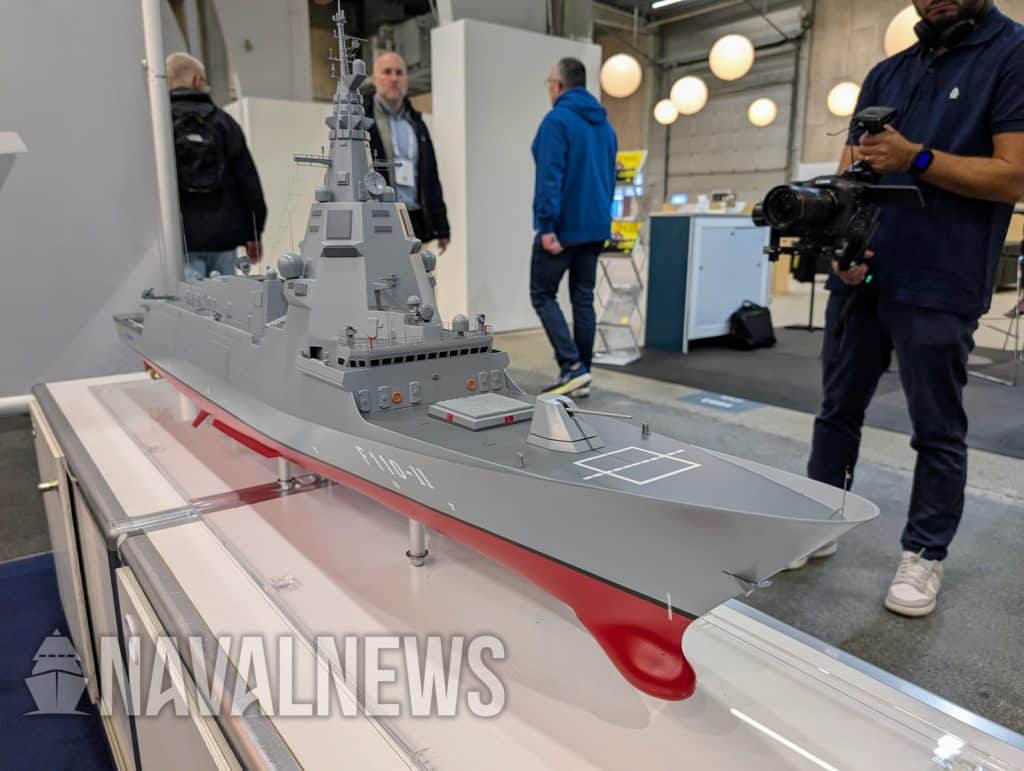
The F-110 IAMD features a comprehensive weapons suite tailored to its enhanced air-defense and multi-mission role. At the heart of its air-defense capability is a 48-cell Mk 41 Strike Length vertical launching system (VLS) forward of the bridge and one 16-cell Mk41 Tactical Length VLS enclosed within the superstructure and ahead of the helicopter hangar. That’s a tremendous increase of cells carried by the new F-110 variant in comparison with the Flight I units with their 16-cell VLS.
Together, the two VLS installations of F-110 Flight II provide a total of 64 cells capable of accommodating up to 64 SM-2 surface-to-air missiles (SAM), providing the frigate with an extended-range air-defense capability. Alternatively, the VLS can be configured to carry up to 256 RIM-162 Evolved Sea Sparrow Missiles (ESSM) through quad-packing or a combination of SM-2 and ESSM.
For anti-surface warfare, the frigate is equipped with eight Kongsberg Naval Strike Missiles (NSM), housed in two quadruple launchers positioned amidships. The F-110 IAMD also retains a robust anti-submarine warfare capability, with two twin Mk 32 Mod 9 torpedo launcher for Mk 54 lightweight torpedoes, one mounted on each side of the ship, complemented by the ship’s embarked NH-90 or MH-60R helicopter.
The main gun is the Leonardo OTO 127/64 LW 127mm naval gun, providing both conventional naval gunfire and extended-range precision-strike capabilities when equipped with suitable ammunition. For close-in defense and protection against surface and asymetric threats, the ship carries two Escribano E&M Sentinel 30 30mm RWS (presented as CIWS), four Sentinel 2.0 12.7mm RWS and a number of 12.7mm HMGs.
The armament suite also includes six SRBOC Mk36 decoy launching systems to counter advanced anti-ship missile threats, as well as a directed-energy weapon (DEW) and launchers for loitering munitions, further enhancing the ship’s defensive capabilities and overall multi-mission flexibility.
F-110 Flight II / IAMD’s Electronic Equipment and Sensors
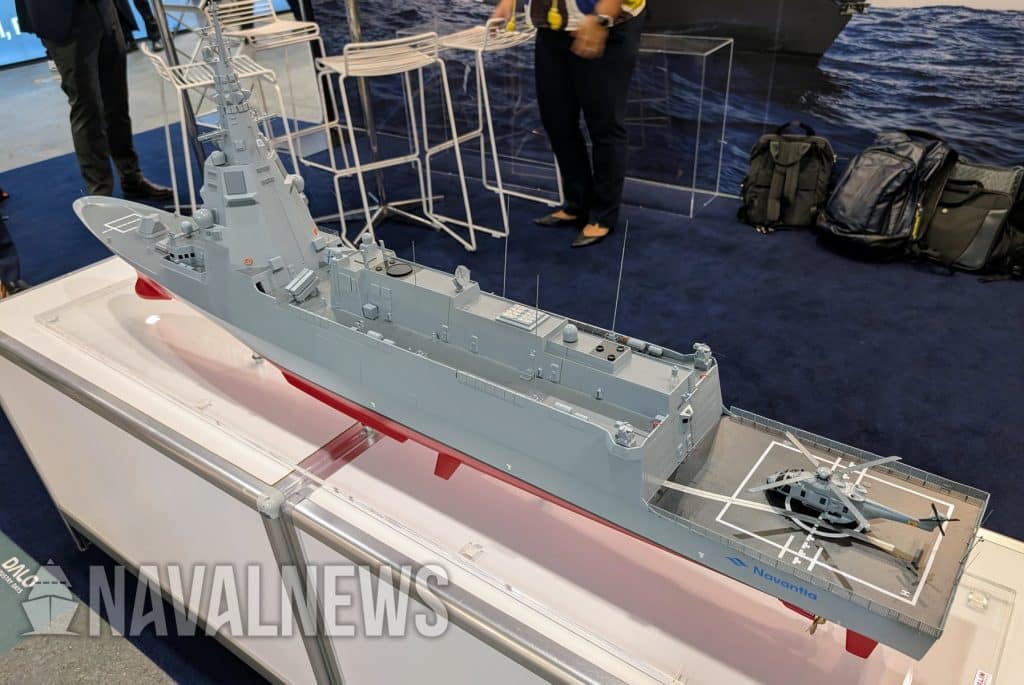
The Flight II will retain the same type of multifunction radar (MFR), but in an enhanced configuration. This will be Lockheed Martin’s AN/SPY-7(V)2 S-band solid-state radar, with each array fully populated with 100 sub-array suites (SAS), compared with 68 on the Flight I ships. The increased number of SAS will provide greater capacity for the simultaneous detection, tracking, and discrimination of multiple and more demanding targets.
The system will also incorporate Cooperative Engagement Capability (CEC) and the Aegis International Aegis Fire Control Loop (IAFCL), a weapon and fire-control software solution that links the AN/SPY-7(V)2 with Navantia’s SCOMBA combat management system (CMS), enabling the generation of a unified operational picture and coordinated management of air-defense engagements.
The rest of the equipment is identical to Flight I variant. Spanish manufacturer Indra provides the PRISMA-25X advanced solid-state MFR for surface surveillance and low-altitude air-target tracking, as well as the electronic warfare suite comprising the Rigel i110 R-ESM and R-ECM systems, the Regulus i110 C-ESM, the IFF system, and the IRST i110, developed in collaboration with Technobit, which also supplies the data-link systems. These sensors are integrated into a common mast structure supplied by Navantia.
Navantia also supplies the DORNA FCR for the control of the OTO 127/64 naval gun, the HERMESYS Integrated Communications and Control System (ICCS), the DIGITAL TWIN system, and the MINERVA Integrated Navigation Bridge System (INBS).
The underwater sensor suite is supplied by Thales. This comprises the BLUEMASTER (UMS 4110) hull-mounted sonar (HMS), the CAPTAS-4 Compact variable-depth sonar (VDS) in a dependent-towed configuration, the TUUM-6 digital underwater communications system (DUWCS), and the BLUESCAN collaborative digital acoustic and ASW data fusion system. Saab provides the L-ESM capability in the form of the naval laser-warning system (NLWS).
For torpedo defense, Lockheed Martin supplies the AN/SLQ-25E NIXIE towed electro-acoustic torpedo countermeasure system, while Raytheon provides the two AN/SPG-62 fire-control radars (FCRs) and the Mk 99 FCSs used for terminal guidance of the ship’s SAM. The Flight II variant will also incorporate a dedicated C-UAS capability, although the specific sensor to be used has not yet been disclosed.
Proven Design and Platform Highlights
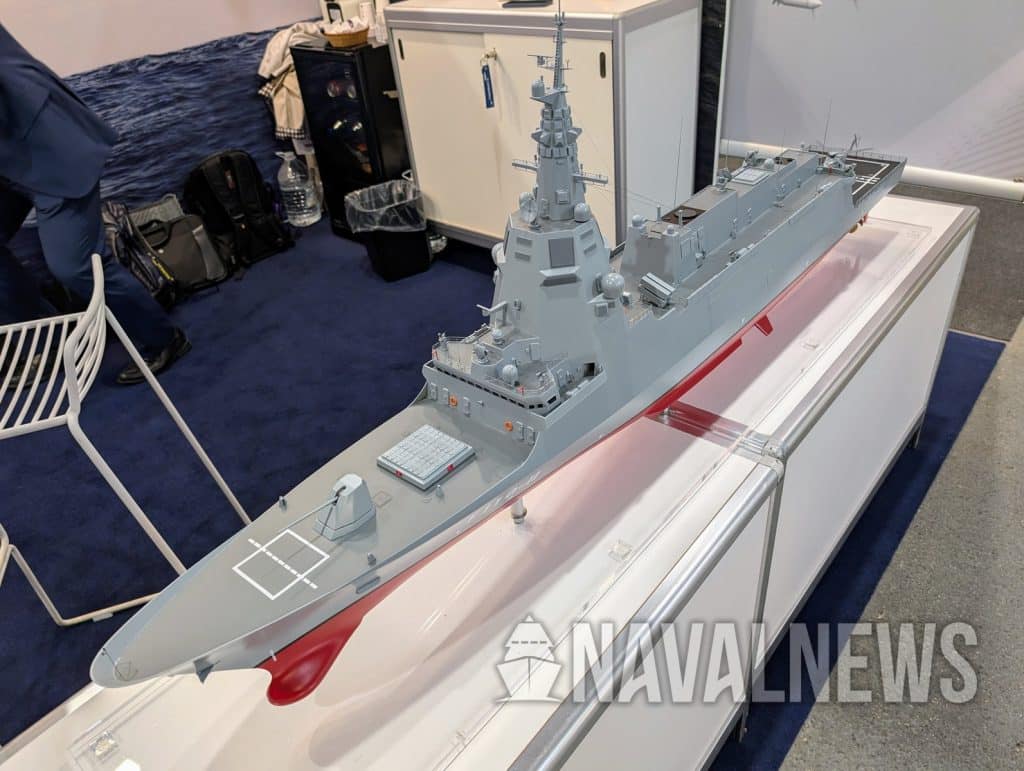
According to Navantia, the F-110 Flight II/IAMD is based on a proven, low-risk design with active program backing and full NATO interoperability. High survivability and redundancy are embedded into the design, while generous growth margins allow for the future integration of additional weapons, sensors, and mission systems. Extensive automation reduces crew requirements, while the design is optimized to minimize operating and through-life support costs, helping to reduce overall program risk and accelerate delivery.
The design incorporates reduced signatures, CBRN protection, separated machinery spaces, fire zones, and advanced damage-control features, enabling the frigate to operate effectively in high-threat environments. Built to demanding naval standards, including IACS, ANEP-77, SOLAS, and MARPOL, the F-110 IAMD combines excellent seakeeping with long-range ocean-going performance. Its efficient and quiet CODLAG propulsion system further enhances endurance and acoustic discretion.
The frigate is also designed to support a wide range of aviation and mission assets, including NH90 and MH-60R helicopters, UAVs, RHIBs, and modular mission payloads, accommodated through its hangar and multi-mission bay. Ample growth margins and modularity allow the platform to evolve as operational requirements and technologies evolve.
Watch: Navantia Unveils F-110 Flight II Design at DALO 2026
Naval News interview with Alfonso Vala, Sales Director Europe at Navantia, discussing the key upgrades of the F-110 Flight II / IAMD design unveiled at DALO Industry Days 2026 in Herning, Denmark.
