


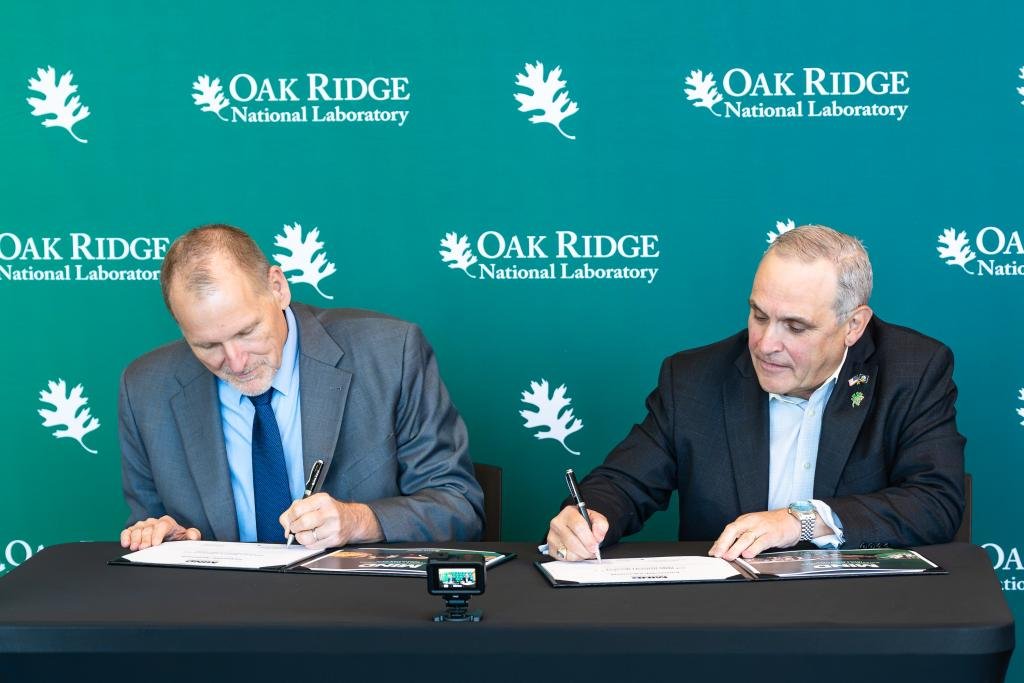
Oak Ridge National Laboratory (ORNL) and Idaho National Laboratory (INL) announced a new collaboration to expand the domestic supply chain for industrial pressure vessels using wire arc additive manufacturing (WAAM), a move aimed at accelerating the qualification of critical nuclear components as the U.S. races to scale up its nuclear energy portfolio.
The partnership was unveiled at Materials and Manufacturing Innovation Days (M2IND), an ORNL-hosted event bringing together industry, government and research leaders to discuss AI-enabled manufacturing, nuclear infrastructure and domestic supply chain security.
A Manufacturing Bottleneck, Addressed by WAAM
Pressure vessels are traditionally made through forging. But limited domestic forging capacity has become a bottleneck as the U.S. works to expand nuclear energy production. WAAM offers an alternative path to a more resilient domestic supply chain.
The two labs will combine their respective strengths to develop the process: ORNL’s expertise in additive manufacturing and real-time monitoring, and INL’s decades of experience in nuclear reactor component design, testing and deployment. INL will also contribute tools from its Prometheus AI initiative, part of the lab’s broader Genesis Mission project, while ORNL leads the additive manufacturing work at the DOE’s Manufacturing Demonstration Facility (MDF).
Shannon Bragg-Sitton, INL associate laboratory director for Energy and Environment Science and Technology, said the collaboration would speed up development across the board. “INL and its industry partners will accelerate development of new reactor designs, components and manufacturing methods by applying AI tools, such as those developed under Prometheus, to support the commercial adoption and deployment of nuclear energy and meet the growing needs of American communities, manufacturers and AI data centers,” she said.
From Demonstration to “Born-Qualified” Components
The initiative builds on a milestone reached in July, when MDF scientists printed a small nuclear pressure vessel, roughly 3 feet by 5 feet, using ORNL’s MedUSA platform. The system relies on three coordinated robotic arms to build complex parts by melting wire with electric arcs, and the July print demonstrated that a steel alloy relevant to nuclear applications could be formed into a closed, domed vessel shape at scale.
That demonstration was displayed at M2IND alongside the partnership announcement. Researchers are now turning to the qualification side of the problem: using AI-driven digital tools to verify a component’s shape and material properties while it is still being 3D printed.
“We would like to achieve born-qualified pressure vessel components using data gathered during printing to confidently assess their worthiness for extreme environments,” said Patxi Fernandez-Zelaia, ORNL’s lead researcher on the project.
Looking ahead, the labs say the printing and verification methods developed for pressure vessels could extend to other nuclear reactor components, and potentially to large metal structural parts used in chemical refining, oil and gas, defense and aerospace industries.
The pressure vessel work extends a broader push at ORNL to embed additive manufacturing throughout the nuclear construction and component pipeline. The lab has already placed 3D printed parts inside operating reactors: in 2021, printed fuel assembly brackets developed with the Tennessee Valley Authority and Framatome were installed at TVA’s Browns Ferry plant, reportedly the first 3D printed safety-related components used in a commercial reactor.
More recently, ORNL has also applied large-format 3D printing beyond individual components, supplying modular 3D printed formwork for Kairos Power’s Hermes molten salt reactor under construction at the K-25/East Tennessee Technology Park site in Oak Ridge, the first Gen IV reactor to receive an NRC construction permit and now targeted for operation as soon as 2027.
AI as a Qualification Tool for Nuclear Sector
The ORNL-INL pressure vessel partnership is a bet on data, not just hardware. Pairing WAAM with INL’s Prometheus AI tools and ORNL’s in-process monitoring targets nuclear sector’s real bottleneck: whether a 3D printed part can be trusted without months of destructive testing.
That framing is spreading fast. Argonne National Laboratory just submitted a proposal to open a formal ASME code pathway for laser powder bed fusion in nuclear reactor manufacturing, built with Oak Ridge, Idaho, and Los Alamos national labs. The effort pairs real-time process monitoring and AI-driven analytics to build a fuller digital picture of printed-component performance, and sits inside the Department of Energy‘s broader Genesis Mission linking national labs, datasets, and computing power. Researchers there flag the same core problem ORNL-INL is solving: qualifying an additively manufactured part is a fundamentally different problem than qualifying a material, since AM makes both at once, and in-situ monitoring is increasingly seen as the fix at the component level.
ORNL has run this play before. Its Peregrine AI software for real-time print-defect detection has already been tested on the Transformational Challenge Reactor program, which is pursuing what would be the world’s first additively manufactured nuclear reactor. Same logic, same lab, now scaled up to pressure vessels. The message across all three efforts: AI in nuclear printing isn’t shortcutting regulation, it’s building the evidence regulators will demand.
3D Printing Industry is inviting speakers for its 2026 Additive Manufacturing Applications (AMA) series, covering Energy, Healthcare, Automotive and Mobility, Aerospace, Space and Defense, and Software. Each online event focuses on real production deployments, qualification, and supply chain integration. Practitioners interested in contributing can complete the call for speakers form here.
To stay up to date with the latest 3D printing news, don’t forget to subscribe to the 3D Printing Industry newsletter or follow us on LinkedIn.
Explore the full Future of 3D Printing and Executive Survey series from 3D Printing Industry, featuring perspectives from CEOs, engineers, and industry leaders on the industrialization of additive manufacturing, 3D printing industry trends 2026, qualification, supply chains, and additive manufacturing industry analysis.
Featured image shows Robert Wagner, ORNL associate laboratory director, left, and Anthony Nickens, INL division director, announce a partnership between ORNL and INL during M2IND. Photo via Carlos Jones/ORNL, U.S. Dept. of Energy
