


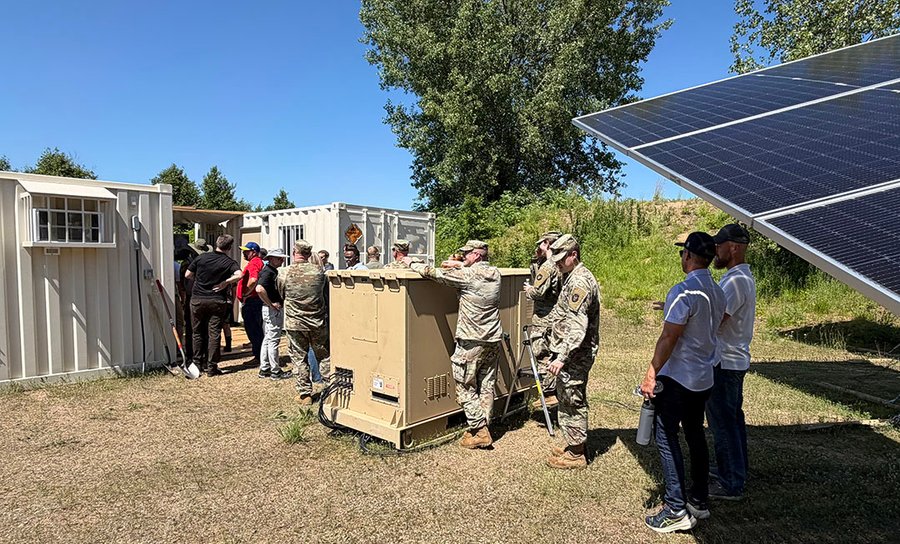
Minneapolis-based company Chromatic 3D Materials has established a rocket propellant test-firing capability at Camp Ripley, a 53,000-acre Minnesota National Guard training facility near Little Falls, under a five-year lease agreement that took effect June 1. The company says the site gives it a closed-loop environment, a propellant print lab paired directly with on-site test-firing infrastructure, meant to compress the time between fabricating a new propellant formulation and firing it under real conditions.
“Development and manufacturing speed are critical in modern defense,” said Cora Leibig, CEO of Chromatic 3D Materials. “Our presence at Camp Ripley allows us to rapidly demonstrate performance, validate manufacturing approaches and reduce the time required to deliver advanced propulsion solutions to rocket manufacturers.”
From Print Lab to Live Fire, Without Leaving the Site
The arrangement lets Chromatic move directly from fabrication to evaluation instead of shipping propellant components between separate production and testing facilities. By co-locating both functions at Camp Ripley, the company can iterate on propellant performance, formulations and grain geometries and get results back from live-fire testing in far less time than a distributed setup would allow.
Camp Ripley offers a secure, controlled environment that aligns with Department of War testing standards, letting Chromatic run propulsion demonstrations while staying closely tied to its Minnesota operations. The company frames the facility as a step toward full-scale rocket propellant manufacturing, with the accelerated test cycles meant to prove out repeatability and performance ahead of broader deployment across tactical and strategic propulsion systems.
A Partnership Built Through a Defense Innovation Hub
Chromatic’s access to Camp Ripley came through Defense Innovation OnRamp Hub: Minnesota and the Minnesota National Security Ecosystem, which connected the company with the base and the Minnesota National Guard. OnRamp Hub: Minnesota operates under the Department of War’s broader push to speed the adoption of dual-use technologies, commercial innovations with both civilian and military applications, into national security programs.
“Commercial companies often have promising technologies but need access to the right partners, facilities, and testing environments to demonstrate their capabilities and move forward,” said Matt Hickey, managing director of OnRamp Hub: Minnesota. “Our role is to help make those connections, reduce barriers to testing and evaluation, and create pathways that accelerate getting commercial technologies into the hands of the warfighter. The collaboration between OnRamp Hub: Minnesota, Chromatic, LEMA, Camp Ripley, and the Minnesota National Guard is a strong example of what that can look like in practice.”
The partnership also drew in LEMA, a Minnesota-based expeditionary power company working under contract with the U.S. Army Corps of Engineers, to explore pairing resilient, portable power generation with Chromatic’s propulsion testing work.
Alongside the propellant testing, Chromatic and LEMA are using Camp Ripley to demonstrate forward-deployed solar power generation. The two companies are exploring how distributed, resilient energy systems could support manufacturing and testing operations in austere, resource-constrained settings, pairing portable solar generation with on-site propellant production to model an energy-independent, rapidly deployable defense infrastructure.
Chromatic’s Role in 3D Printing and What Camp Ripley Adds
Founded in 2016, the company developed RX-AM (Reactive Extrusion Additive Manufacturing), a proprietary platform for 3D printing durable elastomeric materials, and over the past two years has extended that platform to rocket propellant by adapting conventional polybutadiene binder chemistries into its printing process.
Earlier this year, that work reached a milestone: Chromatic 3D Materials completed prototype printing and static-fire testing of its 3D printed propellant, sustaining combustion pressures above 1,800 psi without structural failure, with a multi-material printing capability that lets propellant be printed directly onto or within structural components, opening up geometries and thrust-control options conventional manufacturing can’t reach.
Camp Ripley gives that platform a permanent home to keep pushing past prototype stage. Instead of shipping printed propellant to a separate range, Chromatic can now fabricate and static-fire test in the same location.
A Wider Push to Bring Rocket Motor Production Home
Chromatic’s move addresses a specific gap in defense manufacturing: getting 3D printed propellant from prototype into a repeatable, testable production cycle without shipping it between separate facilities.
The approach mirrors a broader strategy in the sector. Ursa Major has taken a similar approach at larger scale. Ursa Major built a 400-acre solid rocket motor test facility in Weld County, Colorado, designed as the primary testing and certification site for SRMs made with its software-driven, additive-enabled Lynx manufacturing process, a system built to handle multiple motor sizes without retooling.
Raytheon and Ursa Major have also already put the approach into practice: their 3D printed SRM completed a successful U.S. Army flight test, with Ursa Major citing nearly 300 static test fires completed in a single year as evidence of how much faster additive production can move.

Camp Ripley is Chromatic’s version of the same strategy: fewer shipping delays, more test fires, faster proof.
3D Printing Industry is inviting speakers for its 2026 Additive Manufacturing Applications (AMA) series, covering Energy, Healthcare, Automotive and Mobility, Aerospace, Space and Defense, and Software. Each online event focuses on real production deployments, qualification, and supply chain integration. Practitioners interested in contributing can complete the call for speakers form here.
To stay up to date with the latest 3D printing news, don’t forget to subscribe to the 3D Printing Industry newsletter or follow us on LinkedIn.
Explore the full Future of 3D Printing and Executive Survey series from 3D Printing Industry, featuring perspectives from CEOs, engineers, and industry leaders on the industrialization of additive manufacturing, 3D printing industry trends 2026, qualification, supply chains, and additive manufacturing industry analysis.
Featured image shows Rocket Propellant Test Site at Minnesota’s Camp Ripley. Photo via Chromatic 3D Materials.
