


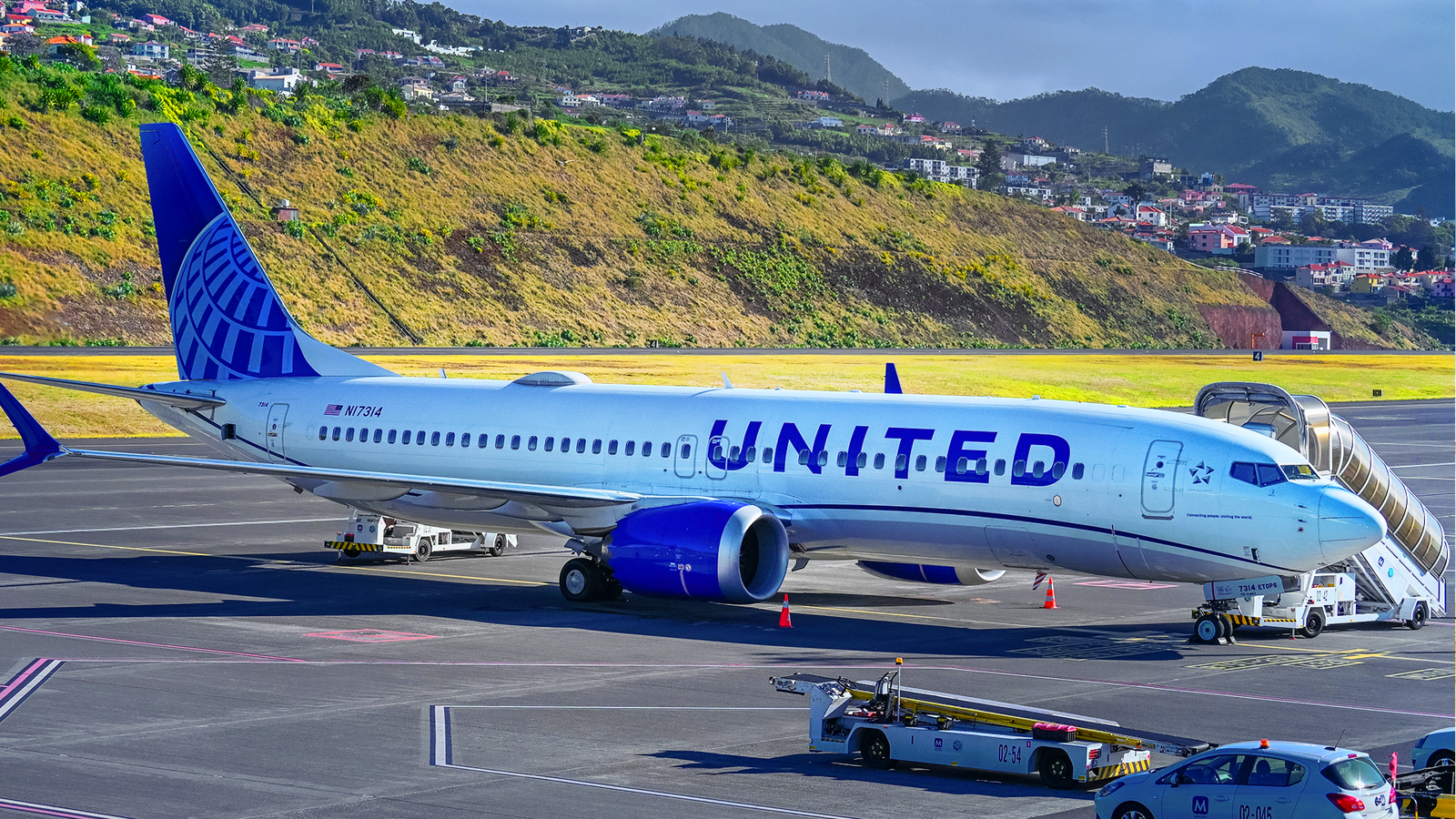
United Airlines is innovating with its long-haul network in a way that its competitors simply aren’t. This article comes shortly after United announced a massive international expansion for 2027, including many destinations that aren’t yet served by any other US airline. Meanwhile, the carrier has been doing this for years, adding service to destinations that many observers didn’t even expect because of how left-field the choices sometimes seemed to be.
For the summer 2025 season, United launched a new route from its hub in Newark Liberty International Airport (EWR) to Madeira Airport (FNC). FNC is known for being one of the most unusual airports in the world for its runway design and unique approach, but it’s otherwise only the fourth-largest in Portugal. United serves Madeira seasonally with a Boeing 737 MAX 8, and this route has returned for the 2026 summer season. Here’s why it exists today.
United’s Services To Madeira

United flies nonstop between EWR and FNC during the summer season, with flights operating between May 16 and September 22. Services run three times per week, departing EWR on Tuesdays, Thursdays, and Saturdays. United uses a 166-seat Boeing 737 MAX 8 on this route, with the departing flight assigned the number UA 522, while the return is assigned the flight number UA 523. Flight times are blocked at six hours and 50 minutes for UA 522, while UA 523 is blocked at seven hours and 30 minutes.
Madeira is well known among enthusiasts for its unusual approach, which was previously flown primarily by Europe-based pilots but is now also flown by Americans. If you hop on the Simple Flying Flight Tracker, you’ll see that every morning, UA 522 has to fly right downwind to Runway 05 (the more commonly used runway direction), then essentially do a visual circle-to-land maneuver below 1,000 feet. This type of procedure, in which pilots manually turn the aircraft 180 degrees for landing at low altitudes, is rare in commercial aviation.
Pilots tend to enjoy operations like these because they challenge a crew member’s skills and are unique compared to the standard ILS approaches seen all over the world. While flight crews are always focused on safety first, there is an element of fun to approaches like Madeira. Of course, airlines don’t launch routes to airports because it’s fun for the pilots. If United launched a route like Newark to Madeira and brought it back for the 2026 summer season, it would mean the business case must be strong, too.
United’s Joint Venture Situation

Transatlantic demand from the US to Europe seems almost limitless, so new European routes are expected by all three US carriers every year. However, United is more liberal in launching routesbecause of its transatlantic joint venture with Lufthansa and the Lufthansa Group airlines. In practice, its primary European hubs for connections to other European destinations are Frankfurt and Munich. American’s primary transatlantic joint venture partner is British Airways, whereas Delta partners with Air France and KLM.
Generally, American and Delta will sell tickets to many of the same destinations that United serves nonstop. Only the tickets will include a stopover in Heathrow, Paris, or Amsterdam. This is more or less fine because connecting at these airports adds only a few hours to the overall journey, which is usually acceptable to airline loyalists. Connecting in Germany, however, adds several hours when traveling to destinations in Western Europe or the Atlantic.
The location of United’s European joint venture hubs means it must serve certain destinations in Western Europe nonstop to remain competitive, whereas its competitors can efficiently route passengers through partner airline hubs. Madeira is an extreme example, as it’s an island in the Atlantic Ocean, but this is generally United’s network strategy for Europe. Of course, there’s also another major reason why such routes can be valuable for United Airlines.
Strategic Value Over Direct Profits

A route like Newark to Madeira ultimately isn’t very expensive to operate due to the low operating costs of the 737 MAX 8, but it won’t bring in much revenue either. On the surface, you might end up questioning whether the aircraft is making more money flying to Madeira than by operating another frequency to Fort Lauderdale, Chicago, or Boston. However, what United Airlines has become quite adept at, in part necessitated by its European joint venture agreement, is thinking outside the box.
The ‘big three’ (American, Delta, United) don’t make significant revenue from passenger flights. Instead, their profits come from loyalty programs, where they earn revenue primarily by selling miles to program partners like credit card providers without spending much to create the miles. Demand for miles increases airlines’ profits, and carriers have increasingly recognized this. As such, they’re focusing on making their brands more desirable and increasing excitement, which results in higher demand for miles.
The three airlines are all attempting this in different ways, but United has been leveraging its long-haul network to a much greater degree than its rivals. On its own, a route between Newark and Madeira is a low-risk, low-reward flight, but the strategic value of this route is much greater than slotting the plane into another domestic frequency, given the awareness and excitement it generates. With that being said, there are reasons as to why United’s competitors aren’t following this strategy to the same extent.
Catch what other trackers miss
Emergency squawks, holds, NOTAMs — live signals, no signup.
Open tracker
Catch what other trackers miss
Emergency squawks, holds, NOTAMs — live signals, no signup.
Open tracker
No Interesting Routes With American?

There are a few reasons why you don’t see  American Airlines starting new and unusual long-haul routes as United does. For one, most of United’s quirkier flights to Europe depart from its Newark hub, essentially a fortress operation serving the largest city in the US. American, however, operates out of JFK, a slot-restricted airport, and American’s slot portfolio is relatively small. American also has another transatlantic hub in Philadelphia, but the market here is nowhere near as large as in New York or even in Washington, DC (United’s secondary Europe hub).
There’s also the fact that American is more focused on its domestic network than its long-haul operations. To serve Madeira, United uses a domestically configured 737 MAX 8, but American would never do this because it makes better use of its JFK slots and would rather assign a narrowbody to boost its short-haul network. For years, its entire strategy has been to focus on domestic markets, especially in the Sun Belt, where it currently dominates, and simply offer huge schedules to multiple hubs, a strategy some have dubbed ‘El Paso to the world’.
American Airlines Hubs | |
|---|---|
Charlotte Douglas International Airport (CLT) | New York John F. Kennedy International Airport (JFK) |
Chicago O’Hare International Airport (ORD) | New York LaGuardia Airport (LGA) |
Dallas/Fort Worth International Airport (DFW) | Philadelphia International Airport (PHL) |
Los Angeles International Airport (LAX) | Phoenix Sky Harbor International Airport (PHX) |
Miami International Airport (MIA) | Washington Ronald Reagan National Airport (DCA) |
On the long-haul front, American has focused on serving only the very largest destinations. This is viable for Americans because London’s location (home to American’s joint-venture partner, British Airways) is not a significant detour for those connecting to other European destinations. The merits of this strategy are debatable (American is certainly making less money than United), but a nonstop to Madeira does not fit with this philosophy. Given the changes occurring at American, we’ll see if this sticks.
No Transatlantic Narrowbodies For Delta

For years,  Delta Air Lines has been very conservative with long-haul flying, instead preferring to let its joint venture partners handle as much of it as possible. Ultimately, long-haul flying is expensive, and while the Newark to Madeira route is low risk compared to other long-haul routes, it is costlier than domestic flying. For United, these routes don’t appear to be viewed as major gambles, but Delta has historically been much more cautious with international routes, believing them to be far riskier than United does.
Delta has more recently been expanding its long-haul network, in part to focus more on generating excitement and awareness through its route announcements, but also because of new ‘Global Scope‘ language in its most recent pilot contract. This essentially requires Delta to match long-haul flying to the US by its foreign partners using its own metal. The catch, however, is that this applies only to widebody flights, and transatlantic flights operated by narrowbodies do not count.
American Airlines Current Generation Narrowbodies Ordered | Delta Air Lines Current Generation Narrowbodies Ordered | United Airlines Current Generation Narrowbodies Ordered |
|---|---|---|
Airbus A321neo | Airbus A220 | Airbus A321neo |
Airbus A321XLR | Airbus A321neo | Airbus A321XLR |
Boeing 737 MAX 8 | Boeing 737 MAX 10 | Boeing 737 MAX 8 |
Boeing 737 MAX 10 | Boeing 737 MAX 9 | |
Boeing 737 MAX 10 |
Delta no longer flies the Boeing 757 to any European destination except for Reykjavik, and it has not ordered the Airbus A321XLR. While Delta leadership publicly stated that transatlantic narrowbodies didn’t fit the brand, the bigger reason likely is that these planes don’t count toward Global Scope. Because of this, Delta would rather deploy its narrowbodies on cheaper domestic services than on a comparatively expensive route like New York to Madeira, even if the operating cost is lower than that of a widebody flight.
