


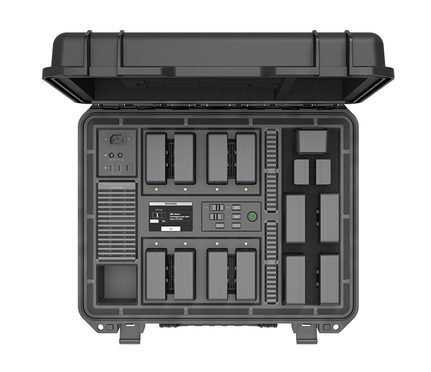
The shift toward a more secure domestic drone supply chain is forcing manufacturers to rethink components they once took for granted. In this guest post, Howard Alt, CEO of Micantis, argues that changing battery requirements present drone OEMs with more than a compliance challenge: they offer an opportunity to take greater control of battery design, performance, data and supply chain resilience. DRONELIFE does not accept or make payment for guest posts.
Drone Manufacturers Should Take Control of Battery Design as Supply Chain Rules Change
By Howard Alt, CEO, Micantis
For most of the drone industry’s short life, the battery was a part nobody had to think about. You bought a shrink-wrapped brick from China, it worked, and when it stopped working you bought another one.
That was a good deal, and the deal is over. The FCC’s domestic-end-product exemption sunsets on January 1, 2028. Defense customers face procurement bans on the biggest Chinese cell makers even sooner. If your aircraft flies on a Chinese cell, and most do, you have a pack redesign coming whether you planned one or not.
So here is the take-away, up front: you are going to redesign your pack. The only question is whether you own the result or your supplier does. Pick an allied cell from a supplier that is building the same cell in the US, design the pack yourself, contract out the assembly, and use the redesign to give your customers something they didn’t have before. Do that and the battery stops being a compliance problem and becomes part of your product. Hand it to a pack vendor and you have traded a Chinese dependency for a domestic one.
The rest of this is why, and how.
Why nobody will sell you an American cell this year
I spent this year’s Commercial UAV Expo walking the battery aisle. A growing list of companies are telling drone OEMs they will have American cells “next year.” A few will. The reason most won’t is not money. The cell business is littered with corpses, and you have probably never heard of most of them.
A123 took federal grant money, went bankrupt in 2012, and was bought by a Chinese parts maker. Britishvolt raised money on a $4.7 billion factory and never made a single cell. KORE Power announced a 12-gigawatt-hour plant in Arizona in 2021 and never broke ground. Freyr sold its Georgia site before it made anything. iM3NY filed for bankruptcy in New York last year. And Northvolt, the famous one, raised more than $10 billion, booked $50 billion in orders, hired 6,000 people to make an ordinary lithium-ion cell in Sweden, reached 70 percent yield after four years, and was sold out of bankruptcy to a California startup.
None of those were scams. Most had the money. What they didn’t have was people who had already taken a line to yield, and that is not something you can hire in a quarter or buy with a grant. A Chinese battery executive who visited Northvolt said his company gets a new plant to 96 percent yield in four months. That gap is the whole story.Every one of them announced a date. If you had planned your compliance around any of them, you would be out of business with them.
What’s hard and what’s easy
The drone industry is moving fast because its builders don’t wait for permission. Teams that were running construction or inspection businesses a few years ago are now shipping aircraft, and the aircraft work. That instinct, figure it out and build it, is the right one for most of what’s on the airframe. The battery is where the rules are forcing you to use it on a deadline, so it pays to know in advance which parts of the battery reward that instinct and which part will bury you.
Easy: assembling a pack. Cells, a BMS, a spot welder, a test bench, a fixture. At the volumes most drone OEMs ship, that is a bench and two people, not a factory. Every competent pack shop in the country does it.
Doable: designing a pack. Choosing the cell, the BMS, the telemetry, the connector, writing the spec and the test plan. Months of engineering, not years, and it takes a good electrical engineer, not a cell chemist.
Brutal: making the cell. Fifty-plus process steps, tolerances in microns, and a yield curve that takes years to climb with no textbook to climb it from. That’s where the graveyard is. Nobody in the drone business should go anywhere near it. Everybody in the drone business needs to know how to tell who is actually doing it.
Three questions for anyone selling you “American cells”
First, show me a production lot from a line you already run, in any country. If they don’t have a running line anywhere, they are asking you to bet your 2028 on a first attempt, and the graveyard is full of first attempts.
Second, which line will supply my cells in 2028, and is it the same cell I can buy from you today? If the answer is a different cell, you are qualifying twice.
Third, who on your team has taken a line to yield before, and where? Names and plants, not “decades of experience.”
The path: one cell, two plants
The suppliers I’d bet on share a shape. They already run a line in Korea, Japan or Taiwan that ships cells today, and they are building a US line that is meant to make the same cell. Design your pack on the allied cell now, buy from the allied line, and move your purchase order to the US line when it is producing real lots. Same cell, same pack, one qualification. The US plant is meant to be a copy of a working process, not a first attempt, which is exactly what the graveyard lacked.One caution. Korean and Japanese cells still carry Chinese material upstream, mostly graphite, which matters for the defense rules that reach into the cell after 2028. Silicon-dominant anodes cut that exposure, which is worth asking about. Know which rule your customers will hold you to before you spend money.
Own it
You are going to touch the pack. You are going to pick a cell, run it on a bench, and write down what passes. Since you are doing all of that anyway, own it. The alternative is to hand the problem to a pack supplier and buy whatever they design. Every pack supplier you might switch to is solving the same cell problem you are, on their timeline.
When they finish, they own the drawing, the BMS firmware, the cell qualification record, the state-of-health data, and your replacement channel.
Own the drawing and contract the build, and the supplier becomes a vendor you can change instead of a partner you can’t. Own the qualification record and you can put a second cell into the same footprint without starting over. Own the data coming off the BMS and you own something your customers will pay for.
Every competitor is about to redesign their pack. The ones who redesign for 2028 win twice.
Four things to build in while you have the hood open:
Battery health your customer can see. Your customer can see the fuel gauge. They can’t see the battery’s age. A smart BMS, or even the charger data, lets you estimate state of health per pack, which is a fleet feature you can sell and a warranty argument you can win.
Cycle life and cost per flight. In the comparisons I’ve run, allied cells in a pack you design can deliver two to three times the cycle life of the brick. The pack costs more and the flight costs less. Run that math before you argue about the price.
A quality story you can tell. A pack you designed is a pack you can explain: which cell, which lot, which plant, which test, which serial. When a government evaluator or a customer’s quality auditor asks for the story of one pack, the answer exists somewhere other than a purchasing email.
Two cells, one footprint. Two cell suppliers is a supply chain. One is a hope. Design the pack so a second qualified cell drops into the same bay, and the day a supplier slips its US line by a year, you don’t slip with them.
This quarter
Pick the cell. Ask the three questions. Start the qualification on real lots. Put your name on the drawing.The rule isn’t going to move, and nobody with a press release is going to save you from it. You are going to redesign the pack anyway. Own it, and the battery stops being your problem and starts being your product.
Read more:
 Howard Alt is co-founder and CEO of Micantis, a Boulder, Colorado company that builds battery data infrastructure and provides battery qualification services for manufacturers and test labs.

Miriam McNabb is the Editor-in-Chief of DRONELIFE and CEO of JobForDrones, a professional drone services marketplace, and a fascinated observer of the emerging drone industry and the regulatory environment for drones. Miriam has penned over 3,000 articles focused on the commercial drone space and is an international speaker and recognized figure in the industry. Miriam has a degree from the University of Chicago and over 20 years of experience in high tech sales and marketing for new technologies.
For drone industry consulting or writing, Email Miriam.
TWITTER:@spaldingbarker
Subscribe to DroneLife here.
