


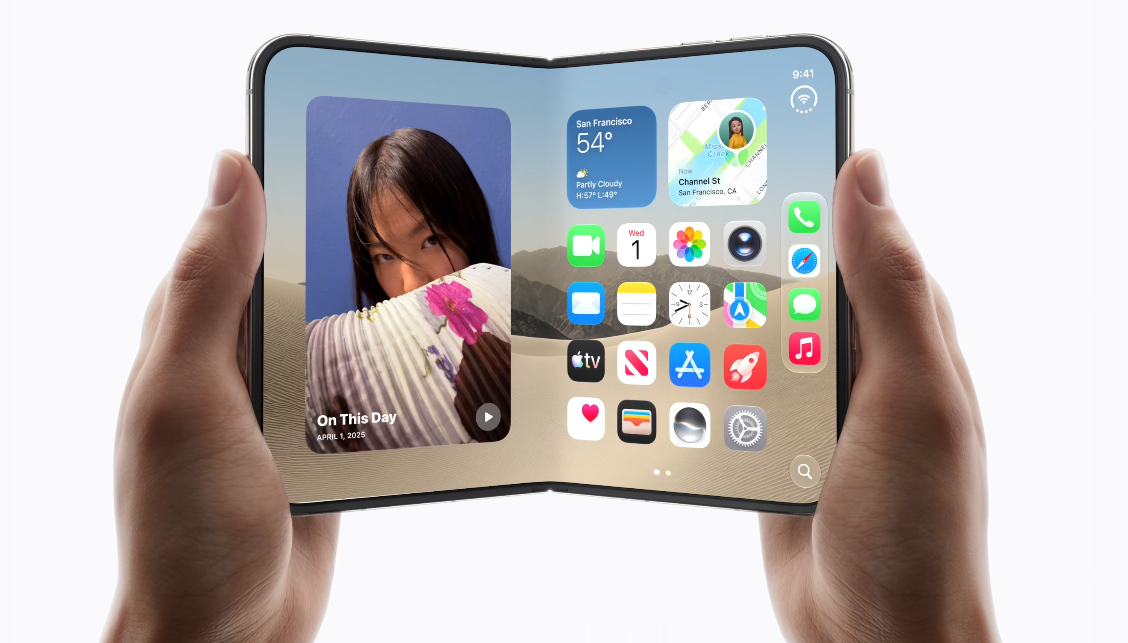
Global consumer electronics company Apple announced the iPhone Duo (rumored as iPhone Ultra) yesterday, its first foldable smartphone, priced at $1,999 and scheduled to ship October 23.
The device opens to a 7.6-inch inner display and closes to a 5.4-inch outer display, with both screens sharing the same aspect ratio so content scales proportionally between the two.
The hinge is engineered from more than 100 components, with a cover made from 3D printed recycled titanium with a micro-blasted finish. That finish contrasts with the mirror-polished grade 5 titanium used for the rest of the enclosure.
Apple also described additional manufacturing steps used for the hinge. “During manufacturing, we use AI algorithms to precisely match each individual hinge with its best-fit housing to ensure perfect alignment, and a confocal laser progressively scans the topology of every single unit and 3D prints up to 25 micro layers of a custom photopolymer to eliminate residual waviness,” said Johny Srouji, Apple’s chief hardware officer, during the company’s Surprise and Shine event yesterday, according to TechCrunch.
Inside the hinge assembly, support ribs reinforce the frame’s stiffness, and antenna splits with ceramic fiber inserts add further rigidity. Apple says the inner display panel is sandwiched between high-strength glass layers held together with custom adhesives designed to let the layers glide past each other, relieving bend stress.
The nano-textured inner display surface is made from a custom polymer Apple claims is up to 40% stiffer than “other materials used in the industry.” Ceramic Shield 2 covers the front, with Apple citing a 3x improvement in scratch resistance over the previous generation.
Apple Builds for Sustained Performance
Powering the device is the A20 Pro, the same chip found in the iPhone 18 Pro line. Apple is pairing it with a custom vapor chamber that connects directly to the chip package, a thermal design inspired by its M-series Apple silicon.
The company says sustained performance is up to 35% better than the iPhone 17 Pro. The GPU is up to 40% faster than the A19 Pro, and a new Dual 16-core Neural Engine offers twice the compute power to run on-device AI models.
To fit two displays into a foldable body, Apple uses a split battery design with one high-energy battery on each side of the device. Apple says a combination of Apple silicon and energy rebalancing algorithms allows the batteries to operate seamlessly as one. Apple rates the Duo at up to 44 hours of video playback on the outer display and 31 hours on the inner display.
On the camera side, the Duo carries a 48MP main sensor with sensor-shift optical image stabilization and a 2x optical-quality telephoto, alongside a 48MP ultra-wide capable of macro photography. A new FaceTime camera sits beneath the inner display panel and stays hidden when not in use. The outer display can show a live camera preview so subjects can see how they’re framed before a shot is taken.
The iPhone Duo runs iOS 27, which Apple has redesigned to place navigation controls along the side of the screen, freeing up vertical space on both displays. Split View, allowing two apps to run side by side, appears on iPhone for the first time. The device ships with an eSIM-only design and Apple’s in-house C2 cellular modem, which now supports mmWave in the United States.
Pre-orders open October 16.
3D Printing Takes Hold in Hinges
3D printed titanium hinge components have emerged as a notable application of additive manufacturing in foldable smartphones. OPPO used Chinese manufacturer Bright Laser Technologies to produce the structural titanium hinge in the Find N5, where the process reduced hinge thickness from 0.3mm to 0.15mm while increasing rigidity by 36%. For the Find N6, BLT iterated further, consolidating what had been 13 individually machined wing plate components into a single 3D printed structure.

Apple’s use of 3D printing for the Duo’s hinge cover is narrower in scope than what OPPO has done with structural hinge components, but it is not the company’s first application of the process to titanium consumer hardware. Apple has been building titanium cases for Apple Watch using laser powder bed fusion, a process that cuts raw material use by around 50% compared to earlier forged designs.
OPPO’s examples show how 3D printing can address constraints around component thickness, rigidity, and consolidation in foldable-phone hinge hardware. Apple has not said whether similar considerations, geometric complexity, material efficiency, or another manufacturing constraint drove its decision to 3D print the Duo’s hinge cover.
3D Printing Industry is inviting speakers for its 2026 Additive Manufacturing Applications (AMA) series, covering Energy, Healthcare, Automotive and Mobility, Aerospace, Space and Defense, and Software. Each online event focuses on real production deployments, qualification, and supply chain integration. Practitioners interested in contributing can complete the call for speakers form here.
To stay up to date with the latest 3D printing news, don’t forget to subscribe to the 3D Printing Industry newsletter or follow us on LinkedIn.
Explore the full Future of 3D Printing and Executive Survey series from 3D Printing Industry, featuring perspectives from CEOs, engineers, and industry leaders on the industrialization of additive manufacturing, 3D printing industry trends 2026, qualification, supply chains, and additive manufacturing industry analysis.
Featured image shows iPhone Duo features the largest display ever on iPhone, alongside a reimagined iOS experience. Photo via Apple.
