


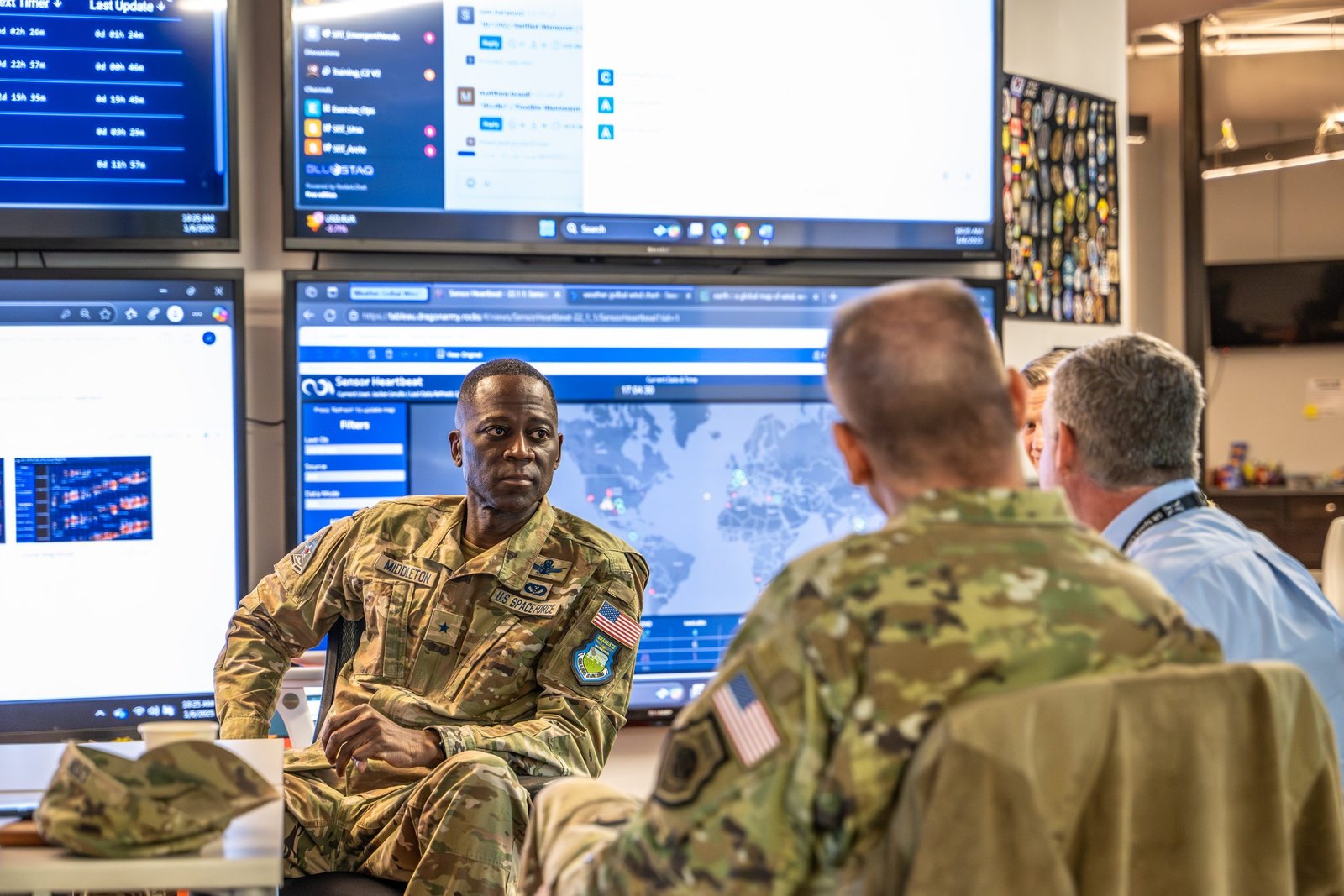
NATIONAL HARBOR, Md. — President Donald Trump has repeatedly pointed to the Space Force’s ability to monitor Iran from orbit.
“We see everything … because of Space Force,” Trump said in remarks earlier this month. In July, discussing activity at Iran’s Pickaxe Mountain nuclear site, he said the United States had “the greatest cameras in the world focused” on Iran and knew what was happening there.
Asked about Trump’s assertion that “we see everything” because of the Space Force, Gen. Douglas Schiess, the Space Force’s chief of space operations, pointed to the service’s close relationship with the National Reconnaissance Office, which operates the nation’s spy satellites.
“We can see a lot of things,” Schiess told reporters Sept. 15 at the Air & Space Forces Association’s annual conference. “We are providing the capabilities that not only the president needs, but the intelligence community and our combatant commanders.”
As military commands contend with growing volumes of satellite data, commercial imagery and other forms of geospatial information are also becoming available to a much broader range of users.
Industry executives say that is shifting the advantage from simply having access to the data to being able to make sense of it quickly.
“I think space-based intelligence is becoming way more accessible to the common person, both commercially and in government,” said Jesse Kallman, chief executive of Danti, an Atlanta-based company that provides AI tools to the Space Force and other government customers. “There has been tremendous change in this market over the last five years in the accessibility of it.”
Danti supported Pentagon analysts and operators during the conflict with Iran, according to Kallman, though he said he could not discuss details of that work.
“When you can take space-based information and intelligence, contextualize it and add it into all the other forms of intelligence, it’s no longer this one thing that, many years ago, was more of a niche, highly technical area for a small group of subject-matter experts,” Kallman told SpaceNews.
AI tools combine those collections with maritime tracking data, signals, weather information, news reports and other open sources, then identify what has changed and why it may be important.
“It goes way beyond imagery,” Kallman said.
He said one of the biggest changes over the past several years has been “how far down the operational workflow AI can go.”
Until recently, AI was primarily used for search and retrieval. An analyst could ask a question in plain language and have the system find relevant imagery, signals or other information. The technology can now perform more complex tasks, Kallman said, including following an event as it develops, finding new information and producing a report that can be handed to an operator.
Some military customers are also using Danti to automate parts of intelligence production.
Kallman described a commander’s morning intelligence briefing that traditionally could require analysts to work overnight or arrive hours early to determine what had changed and assemble a presentation. The software can now automate portions of that process by continuously assessing new information, taking a snapshot of developments and building a briefing that users can then query.
“It makes the space component so much more valuable,” Kallman said. “But space-based intelligence is just night-and-day more accessible now than it was several years ago.”
The Space Force has in recent years expanded its reliance on commercial remote sensing and analytics to support military commands.
The service’s Tactical Surveillance, Reconnaissance and Tracking program, known as TacSRT, was created to rapidly provide combatant commands with unclassified commercial sensing and analytics.
In May 2025, the Space Force and the intelligence community formalized how organizations would work together on TacSRT.
Danti is one of many vendors working under TacSRT. Kallman said the company recently received a $2.1 million Space Force contract expansion that will support more users across U.S. combatant commands.
The company says technology does not necessarily replace the analysts. Reports generated using AI are clearly identified as such and reviewed and approved by human analysts before being disseminated, Kallman said.
