


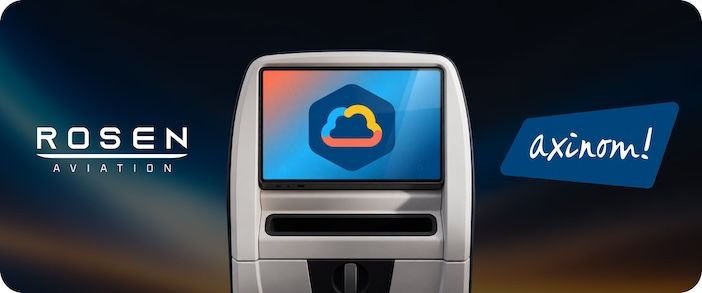
Rosen Aviation and Axinom have co-developed the Connected Seatback Platform, a lightweight, Cloud-powered wireless seatback platform with a screen that operates as the airline’s own ‘digital surface’, with use cases beyond in-flight entertainment (IFE).
The platform is designed to give airlines a single seatback environment for entertainment, commerce, loyalty, disruption management, and any other service they choose to build, with the Cloud serving as the brain.
The platform combines Rosen Aviation’s display technology with Axinom’s software platform, to create what the companies say is a “genuinely new approach” to the seatback in a LEO-connected world.
The project partners say the platform inverts the traditional embedded IFE architecture that airlines have used for decades. Many of today’s seatback systems are organised around in-flight entertainment, with proprietary on-board servers and wired screens acting as terminals that work only inside one vendor’s closed system.
In the lightweight Connected Seatback Platform, the seatback screen is a central entity that is connected to the Cloud. The Cloud holds the IFE content, the application logic, the commercial workflows, and the passenger data.
Applications of any kind, selected or built by the airline customer, would run on the same platform. The passenger would sign in to the platform from their personal device, using their own airline account, which would enable the system to access that person’s personal loyalty status, preferences, and flight context. Personalised commerce offers, upgrades, destination services, and advertising would then be sent to the screen.
The airline can stream any licenced entertainment and third-party OTT services directly from the Cloud, with edge-caching on the screens themselves. The software layer and the data generated on it stay with the airline.
“Move the brain to the Cloud and everything changes. The screen stops being an entertainment terminal and becomes a device the airline can build on, the catalogue stops arriving on a loading schedule, and the passenger at the seat is finally someone the airline knows rather than an anonymous session,” explained Ralph Wagner, CEO of Axinom.
The hardware
Axinom’s architecture requires no IFE head-end server, and the displays provided by Rosen Aviation are wi-fi-enabled, so they do not require wires to receive data – only for power. This means that the Connected Seatback Platform does not require cabin data wiring or a server rack, and each screen receives its data wirelessly over gate-to-gate LEO satellite connectivity, running the airline’s applications on its own processing power.
This equates to less aircraft weight, simplified installations and retrofits, and no IFE content loading cycle. Instead of a weekly or bi-weekly pre-load process, the IFE content, applications, and configuration would reach every seatback screen over the air, meaning they can be changed or updated at any time without a manual process on the aircraft.
The partners say that the platform can also decouple cabin layouts and in-flight entertainment, so seat layouts can be reconfigured without having to rework the IFE system, and any single display can be replaced and then registered from the ground.
“Taking the data wiring out of the cabin raises the bar for the display. Each screen has to run the airline’s applications on its own and hold up in a commercial cabin for years,” added Lee Clark, senior vice president strategy at Rosen Aviation. “That is the standard we have built to in business aviation for decades, and we are bringing it to commercial volumes. Axinom is the most disruptive software company in this field, and that is exactly what the screen needed.”
Try it for yourself
Rosen Aviation and Axinom will showcase the platform publicly at Aircraft Interiors Expo 2027 in Hamburg next April. A preview of the platform will be given at APEX FTE Expo in Singapore on 18-19 November, 2026.
