


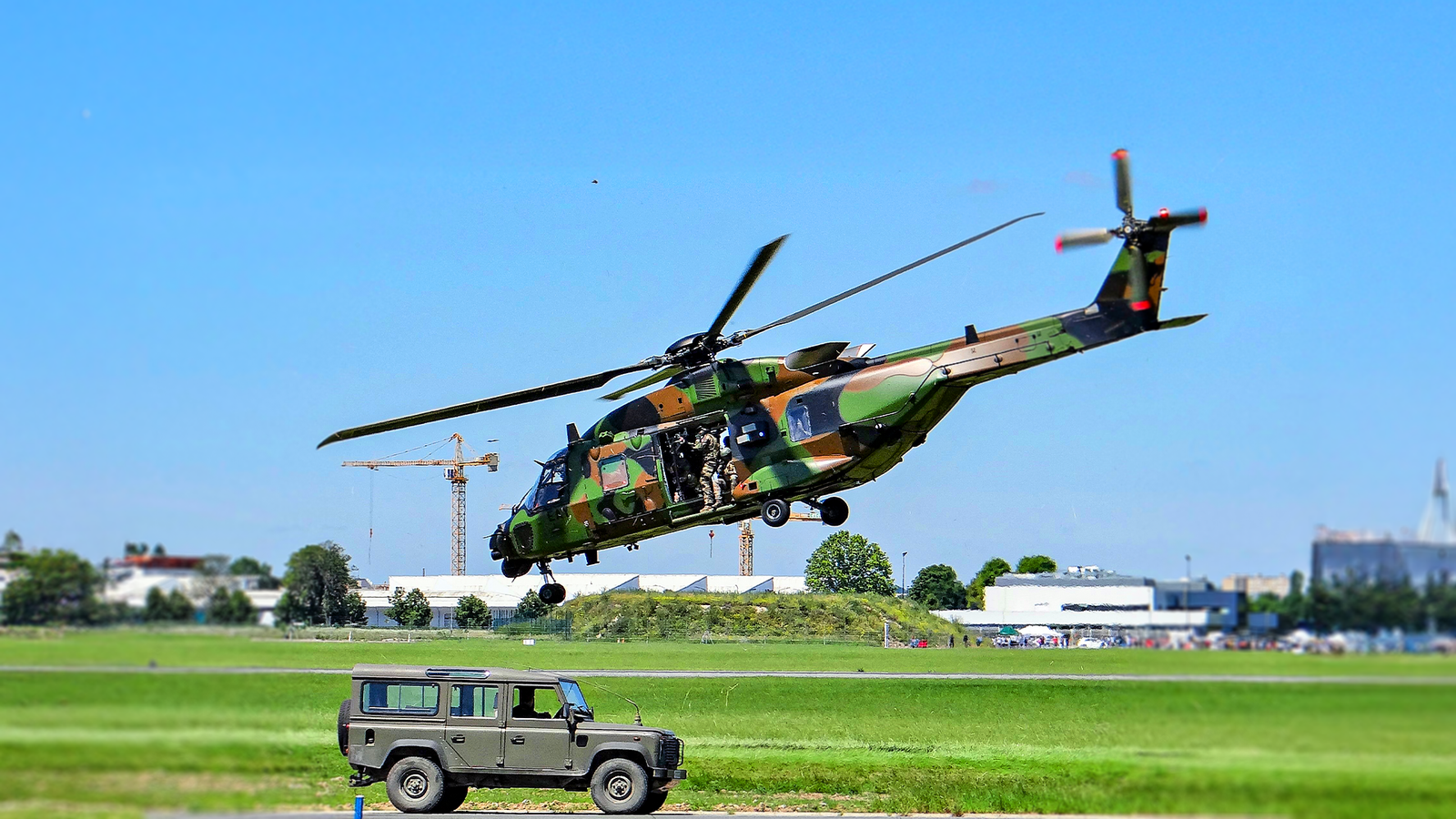
Eight helicopters just did something 46 could not: keep flying long enough to try. On August 26, 2026, a Royal New Zealand Air Force NHIndustries NH90 tagged TNZA002 became the first airframe anywhere in the world to pass 3,000 flight hours, according to Airbus. The milestone belongs to the Royal New Zealand Air Force’s (RNZAF) No.3 Squadron, which flies just eight of these helicopters out of Base Ohakea. Three years earlier, neighboring Australia, which bought 46 of the exact same helicopter, tore its entire fleet apart for spare parts a decade ahead of schedule. Same airframe, same twin engines, same fly-by-wire flight controls. One country got more than 20,000 hours out of eight machines; the other had a maintenance crisis out of 46.
The easy explanation, that New Zealand simply drew better airframes, does not survive contact with the numbers. What separates Ohakea’s eight helicopters from Australia’s 46 is an embedded Airbus maintenance team, a fleet serviceability rate that runs at roughly 75%, well above what most NH90 operators manage, and a squadron willing to fly extended over-water missions that few other customers of this helicopter have attempted. To understand how a fleet one-sixth the size of Australia’s ended up out-flying it, and what that record actually looks like in the cockpit, let’s start with what happened on a routine test flight along the Ohakea coastline.
What Actually Happened When TNZA002 Crossed 3,000 Flight Hours
TNZA002 was on what The Aviationist described as a normal test flight between RNZAF Base Ohakea and the New Zealand coastline when the clock ticked past 3,000 hours. That threshold had never been reached before by any of the roughly 530 NH90s in service worldwide, despite the type entering service in 2007 and the global fleet collectively logging more than 40,000 flight hours since then. NH90 Flight Commander Squadron Leader Lachie Johnston credited the achievement to a small team of maintainers, supply chains, and fleet planners.
That framing understates the numbers. New Zealand operates eight of these helicopters, nearly 1.5% of the global NH90 fleet by tail count, yet it produces the single busiest airframe on the planet. Those eight machines have collectively logged more than 20,000 flight hours flying alpine rescues, Pacific disaster relief missions, and the extended over-water sorties that make up the back half of this story. The NH90’s fully digital glass cockpit and four-axis autopilot also give its crews a high degree of automation, part of the broader shift toward glass cockpits that Simple Flying has examined in military aircraft.
But the 3,000-hour record is just the visible result. The harder question is why New Zealand has been able to accumulate that flying time when much larger NH90 fleets have struggled to generate comparable availability. For that, Australia provides the clearest comparison.
Why Eight Helicopters Are Outflying A Fleet Nine Times Their Size

Australia is the cleanest comparison available, because it bought the identical type in a far larger quantity and got close to the opposite result. In 2006, the Australian Defence Force ordered 46 NH90s, designated locally as the MRH-90 Taipan, to replace its Sikorsky UH-60 Black Hawks and Westland SH-3 Sea Kings. New Zealand’s eight-helicopter order, placed the same year to replace its aging Bell UH-1 Iroquois fleet, looked modest in comparison.
But it did not stay that way. Australia’s Taipans were repeatedly grounded over spare-parts shortages and configuration problems, and after a fatal 2023 crash during Exercise Talisman Sabre, the entire fleet was retired, according to ABC News, 14 years earlier than its planned 2037 withdrawal date, and replaced with UH-60M Black Hawks. New Zealand’s eight NH90s, meanwhile, continued accumulating hours until one became the first of the type to pass 3,000.
The contrast does not affect only fleet size. The US Army, for example, continues buying new Boeing CH-47 Chinooks six decades after the helicopter’s first flight, a longevity story Simple Flying has already documented. For New Zealand, the question is what allowed its small NH90 force to remain available when Australia’s much larger fleet could not. The answer begins with what happened on the ground between flights.
Inside The Embedded Maintenance Team That Keeps Ohakea’s Fleet Flying

Since 2015, Airbus Helicopters has kept a permanent workforce embedded directly inside the RNZAF’s own maintenance organization at Ohakea, working alongside Air Force mechanics. That team has grown from four people to ten, according to Vertical Magazine’s account of the milestone. Patrick Power, Airbus’ team lead for the New Zealand program, has worked continuously on the NH90 since training on the type in Marignane, France, in 2011, making him the only person in the country to have covered the platform’s entire service life.
That continuity feeds directly into the numbers. The joint Deeper Maintenance team performs major 600-flight-hour servicing that takes roughly three months per airframe, a cycle in which institutional knowledge, not just spare parts, determines how quickly a helicopter gets back in the air. Simple Flying has previously examined the same principle in the case of the Boeing B-52, an aircraft that has remained in service for decades beyond its original projections. The result at Ohakea is a fleet serviceability rate of nearly 75%, which Airbus and the RNZAF both describe as well above the global NH90 average.
When the November 2016 Kaikoura earthquake severed every road into the region, RNZAF NH90s built an emergency air bridge within hours. Patrick Power, then newly embedded with the squadron, flew into Christchurch that evening with three NH90s to deliver aid and evacuate stranded civilians, repeating the load-and-fly cycle for days on end. Maintainers reportedly had to wipe the windscreens after every return leg, since with so many helicopters flying rescue flights at once, even a small smudge could be mistaken for another aircraft on approach. What actually tests whether that number means anything is whether the squadron is willing to spend the extra airframe availability on missions other NH90 operators would not risk, and New Zealand has spent the past year doing exactly that.
How Eight NH90s Ended Up Flying This Far

The clearest evidence sits in New Zealand’s over-water flight record. In September 2025, two No.3 Squadron NH90s flew 453 nautical miles (839 km) from Cairns, Australia, to Port Moresby, Papua New Guinea, across the Coral Sea Basin. It was the first time RNZAF helicopters had flown between two countries, according to the New Zealand Defence Force. To make the trip, the NH90s carried two external 1,102-pound (500-kg) auxiliary fuel tanks.
A month later, two more helicopters made an even longer journey, leaving Royal Australian Air Force Base Amberley near Brisbane and eventually reaching RNZAF Base Auckland via Norfolk Island. That trip covered 1,765 miles (2,840 km) over two days. The longest leg, from Norfolk Island to Auckland, was about 660 miles (1,062 km) and took roughly four and a half hours, according to Airbus. Squadron Leader Johnston described the sequence, from the Papua New Guinea flight to the Tasman crossing, as a deliberate progression his crews needed to complete before the RNZAF might one day need to move helicopters into the Pacific Islands on short notice.
That puts the 3,000-hour milestone in a slightly different light. TNZA002 got there because the Ohakea team backed up those flights with a fleet-wide software upgrade, Software Release 2, completed locally in record time, according to Jane’s. The same tiny fleet has been doing disaster relief, training, rescues, and increasingly ambitious long-range missions. And somehow, there are still enough aircraft available to keep doing it. That is the part Australia makes difficult to ignore.
What New Zealand’s Milestone Means For The Rest Of The NH90 Program

Zoom out from Ohakea and the picture gets less flattering for the NH90 as a whole. More than 500 of these helicopters have been delivered to 18 customers in 14 countries, and the global fleet has accumulated hundreds of thousands of flight hours, proving that the design itself is perfectly capable of flying. The problem has been getting operators to keep enough of them available to fly consistently. Norway is the clearest example. In 2022, it walked away from its 14-helicopter NH90 program after 20 years, having received 13 airframes. The fleet was supposed to produce 3,900 flight hours a year but was managing barely 700, according to The War Zone. Australia reached its own breaking point with the MRH-90, retiring all 46 aircraft years ahead of schedule.
New Zealand’s experience doesn’t erase those failures, but it does make the idea that the NH90 is simply a bad helicopter much harder to sustain.
Norway’s Defense Minister, Bjørn Arild Gram, said in 2022 that further investment would not solve the NH90’s availability problems. Ohakea has effectively spent the same period doing the opposite: building the maintenance system around the aircraft instead of trying to fix availability after it became a problem. The embedded Airbus team has stayed with the fleet, technical knowledge has accumulated inside the squadron, and the RNZAF has been willing to keep using the aircraft rather than backing away from demanding missions. That doesn’t mean the New Zealand model would automatically work with a fleet of 46, but it does show that the airframe’s reputation is only part of the story.
That leaves Airbus with a much more interesting problem than simply celebrating a 3,000-hour milestone. If Ohakea has found a way to make the NH90 consistently available, the obvious question is whether any of that experience can be transferred to the operators that struggled with the type. Or is New Zealand’s advantage inseparable from having just eight helicopters, a small maintenance organization and a single squadron where the people flying the aircraft and the people keeping them alive are close enough to know exactly what the other side needs? The answer will probably come from Ohakea itself, as those same eight helicopters accumulate more hours and face the maintenance demands that come with them.
The Next Test For New Zealand’s Record-Setting Fleet

Interestingly, the milestone creates a problem of its own. New Zealand has shown that eight NH90s can be kept flying hard for 15 years, but it has also put an extraordinary amount of use through a very small fleet. At roughly 1,300 flight hours a year across the eight aircraft since entering service in 2011, No.3 Squadron is using its helicopters at a tempo that makes the next fleet decision very difficult to postpone. Eventually, New Zealand will have to decide whether eight aircraft are enough, whether more should be added, or whether the NH90s should begin moving toward replacement. The fact that one of them has now reached 3,000 hours makes that question more immediate.
The curious part is that Johnston has already pointed back to the systems established by the original project team when the NH90 first entered service. The same approach has now survived an earthquake response, years of routine flying, demanding Pacific operations, software upgrades, and the gradual accumulation of thousands of hours across the fleet. The challenge is whether those advantages survive as the aircraft themselves get older and the maintenance burden inevitably increases.
That is what makes TNZA002’s 3,000-hour mark more interesting than the number itself. New Zealand has spent years proving that a tiny NH90 fleet can be kept available, used heavily, and pushed into missions that once would have looked excessive for the type. Now the fleet has to prove that the same system works when the aircraft are no longer relatively young and the hours start piling up faster than the calendar can erase them. If Ohakea can keep doing that, its eight helicopters will have demonstrated something far more useful than a world record: that the NH90’s biggest weakness may have been less about what the helicopter could do than about whether an operator could keep it ready long enough to find out.
