


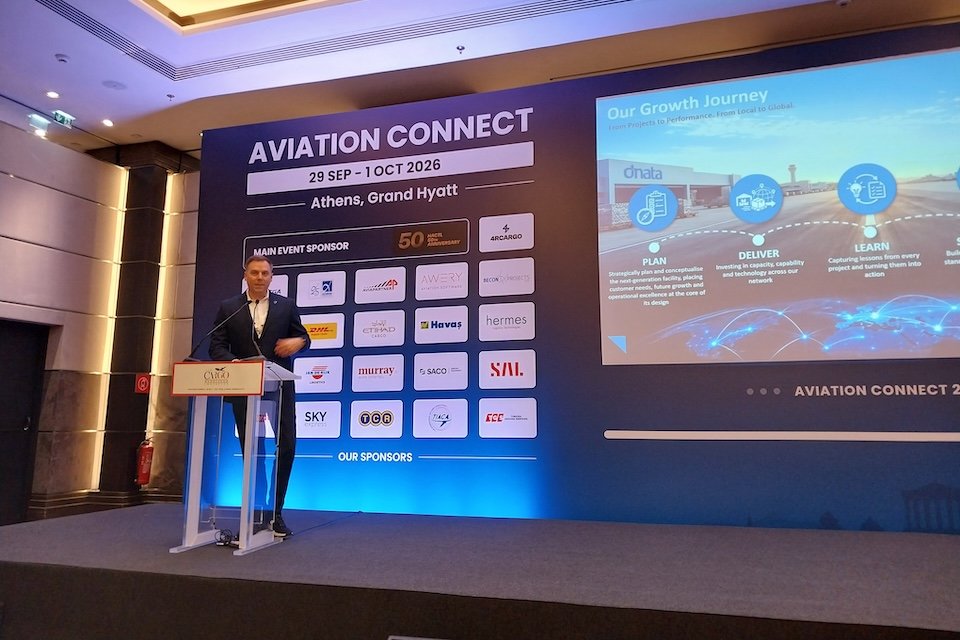
The need to manage the speed and phasing of the implementation of new technologies was one of dnata’s key learnings from the challenging opening of its highly automated facility at Schiphol Airport.
The highly automated and tech-based facility was opened in July 2025 and initially faced operational challenges with data issues across various systems.
Speaking at the Aviation Connect event in Athens, dnata chief cargo officer Guillaume Crozier said that the key challenges of moving to the new facility were the ramp-up of volumes, systems and people, and limited data visibility and performance insight.
The recovery involved stabilisation of operations and the transfer of all volumes from the previous facility, using data and dashboards to drive decision-making, improving end-to-end collaboration and establishing KPIs.
On the key lessons learned, Crozier highlighted the importance of early operational readiness through the use of simulations, having data from day one, having clear governance and working closely with key stakeholders.
Providing more detail, Crozier said that it is perhaps not always best to implement too much automation and new technology at the same time and instead take a phased approach.
“It sounds right in terms of planning,” he said. “It will be a big leap, so to have all of that together, it makes sense.
“As it is an end-to-end process, you think end to end – if you start automating one thing, you want to cover it throughout the process.
“Reflecting on the situation, maybe not always. [Management of the] pace of innovation you are delivering, especially when it is something that has not been seen in the market, is potentially better.”
He highlighted the use of Automated Guided Vehicles (AGVs) and the need to make sure that companies understand the flow around them before they are put into use.
Another learning point was the timeline of the project and making sure there is enough buffer built in for unexpected setbacks.
Elsewhere, Crozier highlighted the importance of local market knowledge, as there is a lot of local specificity that cannot be managed from overseas.
Contingency planning, change management and training were also key to making large automation projects a success, he said.
Overall, he said the facility is now “ticking nicely” with good feedback from the local market.
He added that automation of handling facilities is becoming increasingly important as recruitment becomes more challenging.
The 61,000 sq m facility is highly automated with automated storage and retrieval, AGVs, Elevated Transfer Vehicles (ETV), smart gates, weight and dimension systems, automated storage and retrieval, forklift guidance systems and truck management systems.
