


Hear from the experts shaping additive manufacturing software. Join 3D Printing Industry on 22 October for AMA: Software 2026, featuring exclusive presentations, panels and live Q&A!
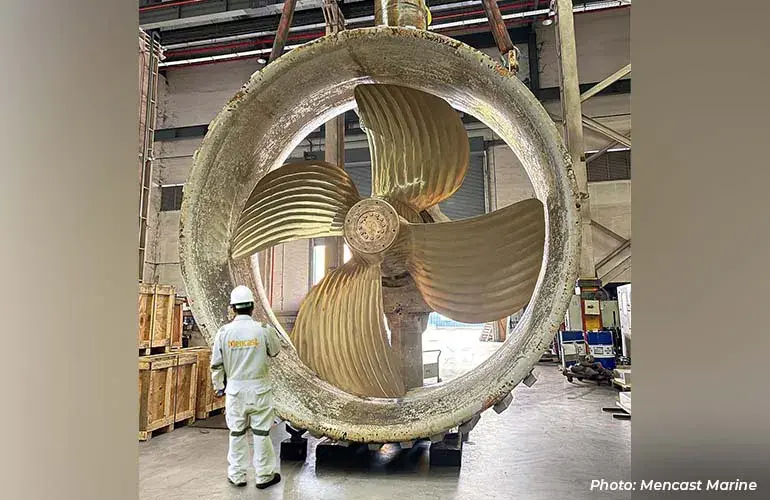
Singapore propeller maker Mencast Marine has secured certification from Lloyd’s Register and the American Bureau of Shipping (ABS) for what the two classification societies recognize as the world’s first fully additively manufactured propeller. The milestone was achieved with the Agency for Science, Technology and Research (A*STAR), and it confirms that the company’s wire arc additive manufacturing (WAAM) process meets class standards for marine deployment.
The certification builds on a 2023 pilot in which Mencast produced Singapore’s first 3D printed marine propeller. That pilot was a collaboration with the National Additive Manufacturing Innovation Cluster (NAMIC), a national platform hosted by A*STAR, and the Singapore University of Technology and Design.
Printing Bronze, Layer by Layer
Mencast’s production system uses robotic arms to deposit bronze alloy in successive layers until a complete propeller takes shape. The company says the method cuts manufacturing time in half compared with its previous approach. It also lowers the carbon footprint of a 200 kg propeller by 36 per cent, a saving of 1,743 kg of CO2. That is roughly the output of driving an electric vehicle 9,500 km, about the distance from Singapore to London.
Before switching, Mencast relied on traditional sandcasting, which involves pouring molten metal into fixed sand molds. The process was labor-intensive and depended on imported bronze ingots. The company has been Singapore’s only designer, manufacturer and repairer of propellers since 1981, serving tugboats and fast boats in the region’s busiest maritime hub. Customer demand for greener and more customized propellers pushed it to rethink that workflow.
CEO Glenndle Sim said the change also reshaped the workforce: “With A*STAR’s support, we removed several labour-heavy steps and reskilled our engineers and technicians in robotics, advanced design tools, and digital process control.”
Across its operations, the integration of AI and additive methods has raised productivity by up to 30 per cent.
AI Takes Over the Design Loop
On the design side, Mencast worked with A*STAR on algorithms that generate more than 10,000 propeller iterations within days. Its engineers previously needed several weeks to produce around 20 variants. Candidate designs can now be simulated for performance and refined before any metal is deposited. The company is also exploring generative AI to push propeller efficiency further.
Mencast now plans to build manufacturing capacity overseas and secure customers beyond its current base in Southeast Asia and Europe. It is targeting higher-value work, including propellers for larger offshore vessels and specialized military platforms. The company also sees its digital and additive capabilities as a possible route into adjacent industries such as aerospace.

Class Approval Opens the Door for Printed Propellers
For Mencast, getting its WAAM propellers certified by class societies is what turns a manufacturing experiment into something it can sell abroad. Ship operators and naval buyers need classification approval before a propeller can go into service. Holding both Lloyd’s Register and ABS approval lets the company bid for work outside its home market.
The closest precedent comes from the Netherlands. The WAAMpeller was a venture between Damen, RAMLAB, Promarin, Autodesk and Bureau Veritas, in development since April 2017. It was printed in Nickel Aluminum Bronze using WAAM and then CNC milled to its final finish, producing a propeller 1.35 metres across and weighing 400 kg. RAMLAB unveiled it that year as the world’s first class-approved 3D printed ship propeller. Mencast’s claim is therefore a narrower one: its propeller is recognized as the first to be fully additively manufactured.
More recently, the UK’s D.E.E.P project printed a propeller blade section in Nickel Aluminum Bronze using WAAM during a seven-month feasibility program. Project partner DEEP Manufacturing says the process can reduce lead times by up to two thirds compared with conventional casting, and the next phase will focus on scaling to a full-size propeller. Defense demand is also growing: the U.S. Navy has projected 400 WAAM components from AML3D in 2026, rising to 1,600 by 2030.
With certification secured, the question for marine WAAM is no longer whether printed propellers can pass inspection. It is who can produce them at commercial volume first.
Register now for AMA: Software 2026. Join 3D Printing Industry on 22 October for expert presentations, panel discussions and live audience Q&A exploring the software shaping additive manufacturing. Register here.
To stay up to date with the latest 3D printing news, don’t forget to subscribe to the 3D Printing Industry newsletter or follow us on LinkedIn.
Explore the full Future of 3D Printing and Executive Survey series from 3D Printing Industry, featuring perspectives from CEOs, engineers, and industry leaders on the industrialization of additive manufacturing, 3D printing industry trends 2026, qualification, supply chains, and additive manufacturing industry analysis.
Featured image shows Home-grown firm Mencast Marine partnered with A*STAR and the National Additive Manufacturing Innovation Cluster (NAMIC) to produce Singapore’s first additively manufactured marine propeller in 2023, marking a breakthrough for the local marine sector. Photo via EDB Singapore.
