


Hear from the experts shaping additive manufacturing software. Join 3D Printing Industry on 22 October for AMA: Software 2026, featuring exclusive presentations, panels and live Q&A!
Engineers at the University of Glasgow and the University of Sydney have made 3D printed metamaterials that can show where they are being damaged and follow that damage as it spreads, in real time. The work adapts electrical impedance tomography (EIT), a hospital imaging technique, to printed lattice structures containing carbon nanotubes. The team says it is the first reported use of in situ EIT to monitor damage in 3D printed architected metamaterials. The study, “Full-Field Damage Monitoring in Architected Lattices Using In situ Electrical Impedance Tomography,” was published on 28 September 2026 as an Early View paper in Advanced Functional Materials.
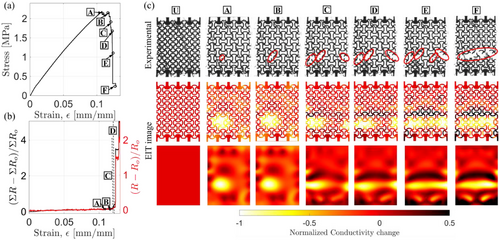
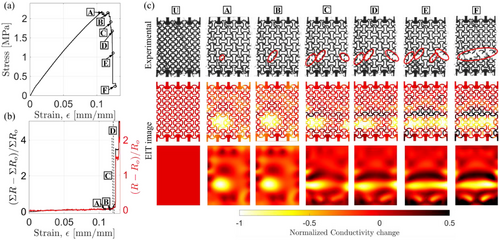
In tests, the system located each fracture to within one unit cell, about 12 millimetres, of where it actually occurred. It also identified areas where damage was building up before the lattice failed, which the researchers see as a possible basis for early-warning systems in future engineered parts.
How the Lattices Sense Strain
The specimens are resin lattices printed by DLP with carefully arranged struts and gaps, with carbon nanotubes mixed into the material so that it conducts electricity. The rectangular samples measured 48 by 60 millimetres. Electrodes attached to the outside of each lattice passed current through the structure and measured the resulting voltage differences while the specimens were pulled until they broke.
As a lattice stretched, the conductive pathways inside it shifted. This changed how current moved through the structure and what voltages appeared at its surface. An algorithm converted those voltage readings into continuously updated maps of electrical conductivity, showing where the structure was deforming and where it was starting to fail. The maps also picked up damage far from the electrodes, which is difficult for surface-mounted sensors to see.
Professor Shanmugam Kumar of the James Watt School of Engineering, who leads Glasgow’s Sustainable Multifunctional Materials and Additive Manufacturing (SM2AM) Lab, compared the output to medical scanning: “The output is somewhat like an MRI scan: just as an MRI can show what is happening throughout the body, our approach allows us to see how different parts of the lattice are responding while it is under strain.”
From Point Readings to Full-Field Maps
In clinical settings, EIT is used to monitor lung function in hospital patients. Electrodes take continuous measurements of how electricity passes through body tissue, and from those measurements an image of the interior is reconstructed without any invasive procedure.
The team adopted the approach to address a limitation of conventional sensing in printed lattices. Standard methods measure changes in resistance or conductivity at specific points. That works for simple parts but gives little insight into complex metamaterials, where damage can start anywhere in a dense network of struts.
According to Kumar, the lattice design is part of what makes the method work. “The engineered lattice architectures enable control over sensing fidelity,” he said. In other words, how the struts are arranged affects both the part’s mechanical behaviour and how well it can report its own condition.
Architected metamaterials let engineers adjust internal geometry to balance properties such as weight, strength, impact resistance and flexibility. With built-in sensing, such lattices could eventually be used in medical implants, aircraft components or car body panels, giving ongoing feedback on how they are wearing over time or responding to impacts.
The researchers say the technology is not yet ready for that. All tests so far have used flat 2D lattices pulled in slow tension, with 16 electrodes attached to each specimen by hand. Resolution is also limited: a single strut is the smallest unit the system can resolve, and two fractures closer than about two to three unit cells appear as a single damage zone. The lattice design also involves a trade-off, letting the brittle resin stretch further before breaking but reducing its strain sensitivity, measured as gauge factor, from 4.2 in the solid composite to 1.02. “This technique could open up potential applications in areas such as structural health monitoring and other advanced engineering systems, although further work is needed to develop and scale the technology for practical applications,” Kumar said.
Co-authors from Glasgow include Akash Deep and Professor Andrew McBride. Dr Andrea Samore and Professor Alistair McEwan contributed from the University of Sydney. Funding came from the University of Sydney–University of Glasgow Ignition Grants and from a Vaibhav Fellowship awarded to Kumar by the Indian National Academy of Engineering and India’s Department of Science & Technology.
From Single Readings to Full Damage Maps
The EIT study builds on several years of self-sensing research at Glasgow’s SM2AM Lab. In an earlier study, the SM2AM Lab developed a 3D printable plastic filled with carbon nanotubes that could sense its own structural health. Later work showed that adjusting the lattice geometry and the amount of nanotube filler gave control over stiffness and damage response, letting the material act as both structure and sensor. Those parts could signal that damage was happening, but not where it was.
Most other self-sensing work shares this limit. At Rey Juan Carlos University in Madrid, researchers used DLP to print self-sensing composites from resin containing 0.03 to 0.15 per cent carbon nanotubes by weight. They measured the current through each sample as a whole during tensile and three-point bending tests.
The Brightlands Materials Center in the Netherlands embedded continuous carbon fibres into a thermoplastic matrix on an Anisoprint Composer A4 printer and found a clear link between applied load and electrical resistance. The fibres could be placed along stress-critical regions, but sensing was limited to wherever they ran, not the whole part.
Self-sensing printed parts already exist. The new capability is showing where damage is forming inside them before they fail.
To stay up to date with the latest 3D printing news, don’t forget to subscribe to the 3D Printing Industry newsletter or follow us on LinkedIn.
Explore the full Future of 3D Printing and Executive Survey series from 3D Printing Industry, featuring perspectives from CEOs, engineers, and industry leaders on the industrialization of additive manufacturing, 3D printing industry trends 2026, qualification, supply chains, and additive manufacturing industry analysis.
Featured image shows Simultaneous end-to-end electrical and in situ EIT measurements under tensile loading. Image via University of Glasgow and the University of Sydney.
