


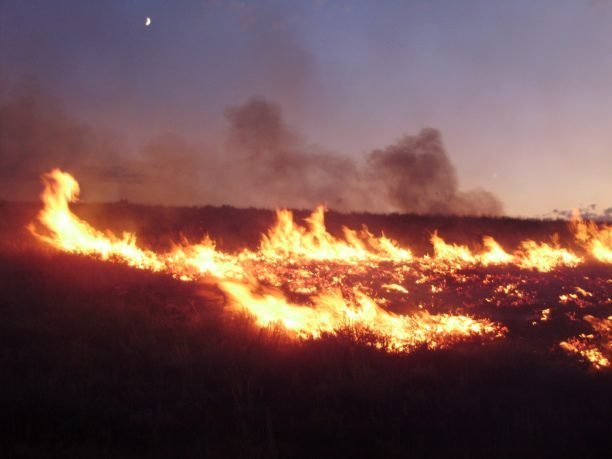
Unauthorized drone flights are rising sharply in 2026, disrupting aerial firefighting operations and increasing enforcement efforts.
By DRONELIFE Features Editor Jim Magill
As the unusually severe wildfire season in the western U.S. continues unabated, the number of incidents of drone incursions interrupting aerial firefighting operations continues to rise.
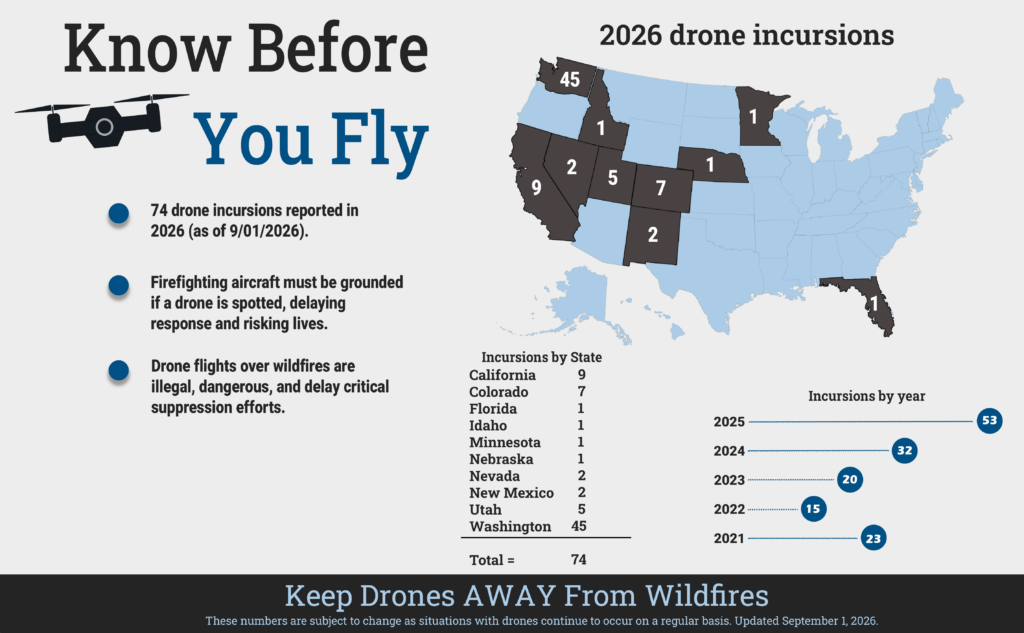
According to data from the U.S. Wildland Fire Service, as of September 1, a total of 74 drone incursions had been reported this year. This compares with 53 incursions in 2025, and 32 incursions in 2024. The WFS, an agency of the U.S. Department of the Interior, defines an incursion “as a non-participating UAS operating over or near an incident that intrudes into an area with a temporary flight restriction (TFR) or interferes with incident/mission operations.”
Such incursions resulted in firefighting aircraft being diverted 78% of the time, based on data from the interagency Aviation Safety Communiqué, which includes incursion data gathered across the Interior Department, USDA Forest Service, and state jurisdictions.
The majority of the 2026 incursions, 45, occurred in Washington state, which has seen a number of wildfires impact highly urbanized areas, such as the Spokane region. The next highest number of reported incursions, seven, took place in California.
Brad Koeckeritz, division chief for the WFS Uncrewed Aircraft Systems Division, said that drone incursions that result in disruptions to aerial firefighting operations can have a far-reaching impact on the ability of firefighters to battle the blazes affecting a large segment of the country.
“When we don’t have air support, we’re less effective fighting the fire on the ground as well, because that air support is there directly to support the firefighters on the ground trying to stop the fire,” he said. “And if the aircraft can’t drop retardant or water or deliver logistical support, it’s going to make our overall firefighting effort less effective.”
Koeckeritz pointed to the growing number of people able to afford and fly small UAVs, as well as the number of wildfires that have broken out near highly populated areas, as two reasons for the rising number of drone-incursion incidents.
“What we’ve seen over the past several years is when we get large fires that happen in the urban interface, we typically then see a cluster of UAS activity around those fires,” he said. He commented that a large number of the drone incursion incidents occurred in the Spokane area, where the blazes this year destroyed about 650 homes and damaged more than 2,500 other buildings.
“When you have more people, the probability of somebody having a drone increases because there’re just more people around. It’s fairly intuitive that we would have more people with drones on hand that could take off and go take a look at something they’re interested in looking at,” Koeckeritz said.
“But, it’s an ongoing problem. Some years are better than others, but as more and more people have drones available to them it can drive the problem for sure.”
Federal and state agencies and local firefighting organizations are working together to present a united front in combatting the problem of drone interference with wildland firefighting operations, Koeckeritz said.
“We’ve had an ongoing public education campaign for several years. We’re in discussions with our partners at the Forest Service on additional messaging. We’re also partnering with other law enforcement agencies, the FBI and the FAA, on referring folks for some enforcement actions.”
He also said the WFS is working with state and local law enforcement agencies, some of which have acquired drone-detection capabilities, to help them identify and track down the pilots involved in unauthorized drone incidents.
One such recent incident took place on June 29, near Beaver Utah, when a DJI Phantom 4 flying in a flight restricted area near wildfire operations at Face Canyon caused aerial firefighting operations to be shut down for about an hour. The owner of the drone was identified and contacted, and he told the responding agency that his juvenile son who was flying the drone was unaware of the fire-related TFR or the need to have a Part 107 operator’s permit.
County officials, after explaining that flying a UAS in such a manner could disrupt firefighting operations and endanger personnel, seized the drone.
If you fly, we can’t
For the past several years, federal state and local wildland fire management agencies, working in conjunction with the FAA have conducted the “If you fly, we can’t” campaign to warn drone pilots not to fly within the restricted airspace around wildland fires.
In an email statement, the FAA said that when drones are flown near wildfires, fire response agencies often have to ground their aircraft to avoid the risk of a midair collision
“The FAA often puts Temporary Flight Restrictions (TFRs) in place during emergencies to protect aircraft involved in response operations. Unless specifically authorized, all other aircraft, including drones, are prohibited from operating within a TFR,” the FAA said.
Interfering with firefighting efforts on public lands is a federal crime punishable by harsh penalties, including up to two years in prison, the agency noted.
“The FAA reviews all reports of unauthorized drone operations and investigates when appropriate. Drone operators who conduct unsafe operations that endanger other aircraft or people on the ground may also face fines of up to $75,000. In addition, the FAA may suspend or revoke drone operators’ pilot certificates.”
Read more:

Jim Magill is a Houston-based writer with almost a quarter-century of experience covering technical and economic developments in the oil and gas industry. After retiring in December 2019 as a senior editor with S&P Global Platts, Jim began writing about emerging technologies, such as artificial intelligence, robots and drones, and the ways in which they’re contributing to our society. In addition to DroneLife, Jim is a contributor to Forbes.com and his work has appeared in the Houston Chronicle, U.S. News & World Report, and Unmanned Systems, a publication of the Association for Unmanned Vehicle Systems International
