


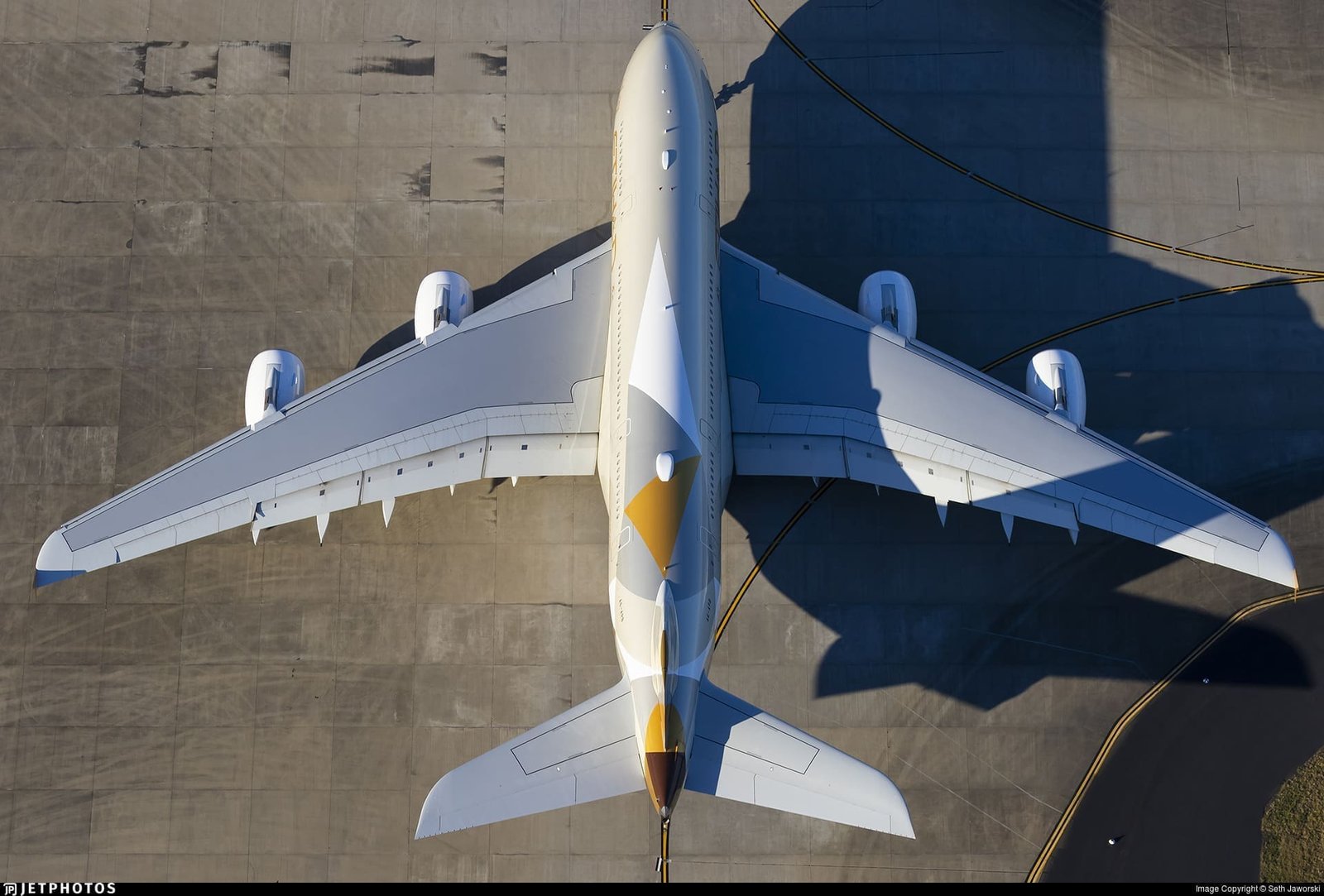
On September 17, Etihad Airways (EY/ETD) brought back its last remaining grounded Airbus A380-800, which had been parked at Lourdes-Tarbes Airport since December 2020. The aircraft spent nearly six years at the French airport before flying to Abu Dhabi just a few days ago, where it is expected to resume commercial operations shortly.
Before continuing with this post, check out the video we recorded for our YouTube channel at Etihad Engineering, which shows what it takes to bring an A380 back into service after extended storage.
The beginning
Etihad Airways, then a five-year-old airline, made a historic announcement at the 2008 Farnborough Airshow: an order for ten Airbus A380-800s. The airline’s goal was to compete with leading Middle Eastern carriers and strengthen its international hub in Abu Dhabi, challenging the dominance of Doha and Dubai—hubs of Qatar Airways and Emirates, respectively.
On June 16, 2014, the Airbus A380-861 with serial number 166 made its maiden flight after rolling off the production line in Toulouse. Its initial flights were conducted under the French test registration F-WWSS, and it was assigned the registration A6-APA prior to delivery.
The aircraft, along with the subsequent nine Airbus A380s, featured a total of 486 seats across four classes: the ultra-exclusive “The Residence” suite (for one or two passengers), nine First Class apartments, 70 Business Class seats, and 405 Economy Class seats. These state-of-the-art configurations redefined luxury travel, with “The Residence” and “First Apartments” serving as the pinnacle of the airline’s premium offering.

First A380
On Tuesday, December 16, 2014, Etihad’s inaugural Airbus A380 took off from Hamburg on its delivery flight to Abu Dhabi, landing in the Emirati capital that same evening. The official unveiling occured two days later in one of the airline’s hangars, marking a milestone in its history.
The delivery of the first A380 coincided with that of the Boeing 787-9 Dreamliner—also brand-new—which arrived from Charleston on a ferry flight on December 17 under the registration A6-BLA. The unveiling event featured both aircraft in the hangar, ushering in a new era for Etihad Airways and its intercontinental hub at Zayed International Airport.

Over the following 10 days, the first A380 conducted test flights around Abu Dhabi and the UAE before officially entering service on December 27, 2014, on the Abu Dhabi–London Heathrow route as flight EY11. With a 100% load factor, the aircraft departed at 02:54 local time and landed at 06:33 local time after a seven-hour flight.
Etihad Airways added four Airbus A380s in 2015, three in 2016, and the final two in 2017, completing its initial order for ten Super Jumbos. In addition to the British capital, these aircraft regularly served global gateways such as Paris Charles de Gaulle, New York John F. Kennedy, Sydney, Melbourne, Seoul, and Mumbai.

COVID-19
In March 2020, amid the onset of the COVID-19 pandemic, global aviation ground to a halt under sweeping travel restrictions. Nearly all airlines operating the Airbus A380—including Etihad Airways—decided to ground their Super Jumbos, despite having all ten in regular service.
All of them—from registrations A6-APA through A6-APJ—remained parked at Abu Dhabi International Airport until late 2020, before being ferried to Lourdes-Tarbes (France) or Teruel (Spain) for long-term storage. By then, heavy skepticism loomed over whether the A380s would ever return to service with the Emirati airline.
A year after the fleet was grounded, in March 2021, Etihad’s then-CEO publicly declared that the A380s faced an uncertain future and would most likely never fly for the airline again.

The return
However, on December 9, 2022, Etihad issued a press release on its website titled “Etihad Airways set to reintroduce its much-loved A380 fleet after a surge in demand from customers,” marking the beginning of the Super Jumbos’ return to the UAE flag carrier.
Etihad reported that the return of the Airbus A380 was a direct response to three market conditions. Chief among them were significant delays in new aircraft deliveries from Airbus and Boeing, coupled with an unprecedented boom in luxury and corporate travel. Additionally, airport congestion had reduced available slots, making the use of larger aircraft essential to meet passenger demand.

Following months of heavy maintenance, thorough structural inspections, software updates, and a complete recertification of systems by Etihad Engineering, the airline’s Airbus A380s began returning to service in the summer of 2023. Abu Dhabi–London Heathrow was the reinaugural route, with other intercontinental destinations gradually added over time.
The last Airbus A380 to be back in service—and the only one to remain in storage since the pandemic—was A6-APB, the second Super Jumbo added to the airline’s fleet back in April 2015. After being parked at Lourdes-Tarbes from December 3, 2020, until September 17, 2026, extensive restoration work began earlier this year to prepare it for its return to flight.
As can be seen in our database, the aircraft departed from the French city at 09:36 local time and arrived in Abu Dhabi at 18:27 after a flight of 6 hours and 51 minutes. At the time of writing, it remains parked at Zayed International Airport awaiting its return to commercial service.

Etihad’s Airbus A380 fleet
| Registration | Config | Delivered | Age |
|---|---|---|---|
| A6-APA | P2F9C70Y405 | December 2014 | Retired |
| A6-APB | P2F9C70Y405 | April 2015 | 12 years |
| A6-APC | P2F9C70Y405 | May 2015 | 12 years |
| A6-APD | P2F9C70Y405 | August 2015 | 11 years |
| A6-APE | P2F9C70Y405 | October 2015 | 11 years |
| A6-APF | P2F9C70Y405 | March 2016 | 11 years |
| A6-APG | P2F9C70Y405 | April 2016 | 11 years |
| A6-APH | P2F9C70Y405 | March 2017 | 10 years |
| A6-API | P2F9C70Y405 | May 2017 | 10 years |
On March 23, 2020, the Airbus A380-861 with registration A6-APA was grounded in Abu Dhabi, along with its nine sister ships. Nearly seven months later, on November 5, 2020, it took off from the country’s capital bound for Lourdes-Tarbes, marking the final flight of its operational life before being permanently retired and later dismantled for parts.
In 2022, Etihad announced the reintroduction of the Airbus A380 for the following year, with the fleet gradually returning to service. By 2025, the airline decided to scrap one of its ten Super Jumbos to harvest spare parts for the remaining aircraft. The carrier selected A6-APA—the flagship aircraft that had marked the very beginning of Etihad’s A380 operations.

Etihad’s Airbus A380 routes
In accordance with our database, London, Paris, Tokyo, and Toronto are the current destinations served by Etihad Airways to and from Abu Dhabi using its Airbus A380-800s. The main destination is the British capital, followed by the French capital, and then the Japanese capital and the Canadian city, both with the same schedule.

| Destination | Flight(s) | Seats | Flight |
|---|---|---|---|
| London Heathrow (LHR) | 7 weekly | 3,402 weekly | EY61/62 |
| London Heathrow (LHR) | 7 weekly | 3,402 weekly | EY63/64 |
| London Heathrow (LHR) | 7 weekly | 3,402 weekly | EY67/68 |
| Paris Charles de Gaulle (CDG) | 7 weekly | 3,402 weekly | EY31/32 |
| Paris Charles de Gaulle (CDG) | 7 weekly | 3,402 weekly | EY33/34 |
| Tokyo Narita (NRT) | 7 weekly | 3,402 weekly | EY800/801 |
| Toronto Pearson (YYZ) | 7 weekly | 3,402 weekly | EY21/22 |

Cover photo: © Henry Howard – JetPhotos (Sydney, Australia)
The post Etihad returns its final A380 to service appeared first on Flightradar24 Blog.
