


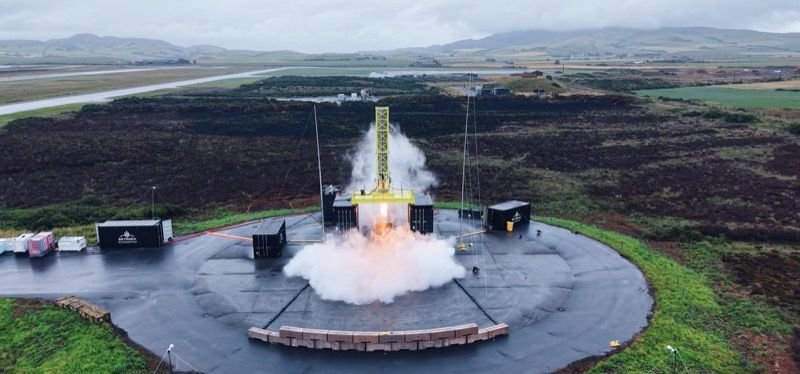
Scotland-based rocket developer Skyrora has advanced its XL orbital launch vehicle with a 45-second static hot-fire test of some of the rocket’s key systems.
The test, at Machrihanish on Scotland’s west coast, used a scaled-down vehicle built to validate subsystems and components similar to those planned for the full Skyrora XL. It gathered data on the vehicle’s pressurization system and key engine characteristics, including propellant flow rate and chamber pressure.
Skyrora said initial data showed the subsystems worked throughout the test, and its engineers are analyzing the results before a second firing.
According to the company, its approach is to test early, repeatedly and in combination before scaling up, identifying engineering issues sooner and cutting technical risk ahead of progressively larger trials and integration into the full vehicle.
Dr Jack James Marlow, Skyrora’s chief operating officer, said, “You don’t build confidence in an orbital launch vehicle by waiting until the finished rocket is on the launchpad. You build it through thousands of decisions, measurements and tests along the way.
“This scaled-down XL system lets us test and validate the technology, subsystems and components together, understand how they perform and make improvements before scaling up to the full vehicle.”
Skyrora, based in Cumbernauld, Scotland, is developing Skyrora XL as a three-stage light launcher to place small satellites of up to 700lb (315kg) into low Earth orbit, powered by its in-house 70kN Skyforce engines – nine on the first stage and one on the second.
Two of the rocket’s three stages are complete, and the company is targeting a first orbital launch in 2027.
The 70kN Skyforce engine, which Skyrora produces using additive manufacturing, has been through a test-qualification campaign to European space standards.
Skyrora’s also produces the Skylark L suborbital launcher.
In 2025 Skyrora became the first UK-based launch vehicle manufacturer to secure a launch operator license from the UK Civil Aviation Authority, clearing the way for a suborbital launch of its smaller Skylark L vehicle from SaxaVord Spaceport in Shetland. The company says it is working toward sovereign UK access to space.
