


Hear from the experts shaping additive manufacturing software. Join 3D Printing Industry on 22 October for AMA: Software 2026, featuring exclusive presentations, panels and live Q&A!
Sinto Advanced Ceramics Europe, a contract manufacturer specializing in additively manufactured technical ceramics, has added aluminum nitride (AlN) and silicon nitride (Si₃N₄) to its material portfolio for ceramic 3D printing.
Both non-oxide ceramics have undergone internal evaluation and have already been processed in initial projects. Their formal addition to Sinto’s portfolio makes them available for development projects, prototypes and industrial applications.
The materials expand a portfolio previously centered on high-purity oxide ceramics, including alumina, zirconia, alumina-toughened zirconia (ATZ) and zirconia-toughened alumina (ZTA). According to Sinto, the additions are intended to give engineers access to different combinations of thermal, electrical and mechanical properties when developing 3D printed ceramic components.
“Every ceramic material exhibits a characteristic property profile,” said Dr. Malte Hartmann, Head of Research & Development at Sinto Advanced Ceramics Europe. “With aluminum nitride and silicon nitride, we are expanding the range of materials that we can offer for additive manufacturing.”
Expanding ceramic 3D printing beyond oxide materials
Aluminum nitride combines electrical insulation with high thermal conductivity. Sinto is targeting applications including thermal management, power electronics and semiconductor manufacturing, where heat must be transferred while maintaining electrical isolation.
Silicon nitride instead provides high mechanical strength, fracture toughness and resistance to thermal shock. These properties make it suitable for components exposed to mechanical loads and repeated temperature changes.
Depending on the shaping method and component geometry, Sinto may also use silicon aluminum oxynitride (SiAlON), or silicon nitride. In SiAlON ceramics, some silicon and nitrogen atoms are replaced by aluminum and oxygen. Sinto says this can improve chemical resistance compared with conventional silicon nitride.
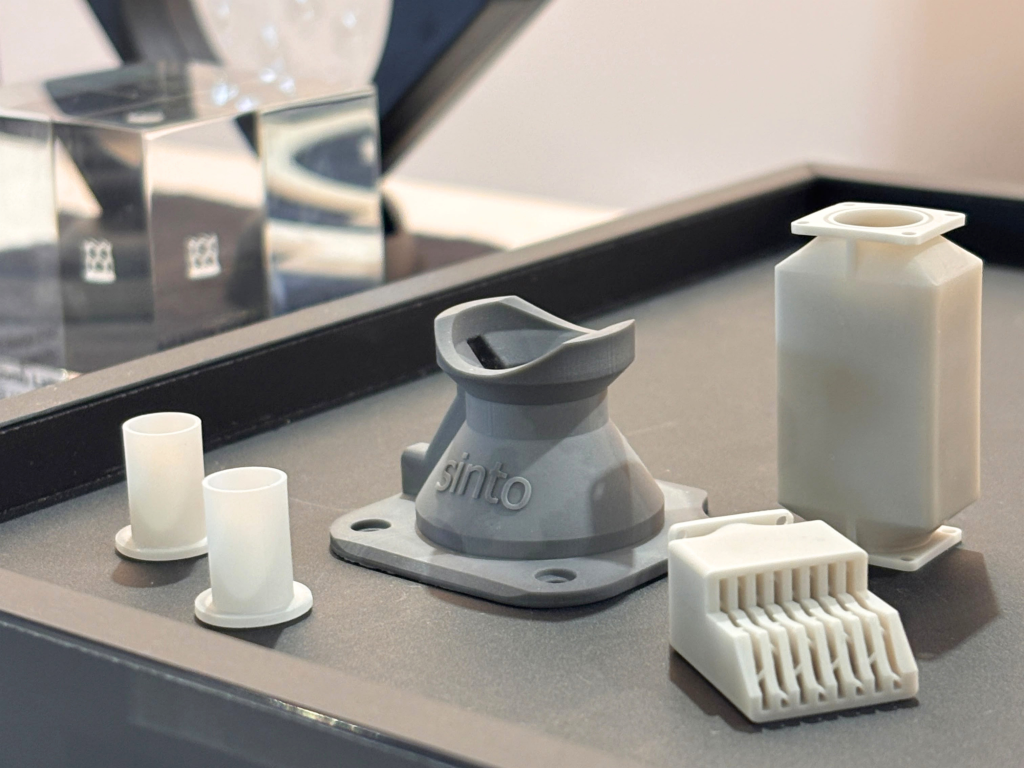
The company has already publicly displayed components produced from the new materials. At ESA Industry Space Days 2026, Sinto showed aluminum nitride sleeves and a heat exchanger alongside a silicon nitride hold-down component.
Evaluating materials for industrial manufacturing
Sinto says introducing a new ceramic into an additive manufacturing workflow involves more than demonstrating that the material can be printed.
Before adding a material to its portfolio, the company evaluates its printing behavior, thermal post-processing, resulting component properties and overall process stability. Quality assurance and reproducibility are also considered as part of the process.
Hartmann said the company investigated whether the intrinsic properties associated with the materials could be reproduced reliably in finished components before making them available to customers.
“We evaluate new materials not only in terms of material properties but also with regard to process-related metrics,” added Dejan Licinovic, Quality Manager at Sinto Advanced Ceramics Europe. “A material is only added to our portfolio once component quality, process stability, and reproducibility meet the requirements of industrial manufacturing.”
From material selection to ceramic series production
The expansion forms part of Sinto’s strategy to work with customers from early-stage product development through manufacturing.
Frohwald Heller, Head of Sales at Sinto Advanced Ceramics Europe, said projects frequently begin with a technical problem rather than a predetermined material. The company then works with customers to identify potential material and manufacturing approaches.
Formerly known as Bosch Advanced Ceramics, Sinto Advanced Ceramics Europe is part of the Sintokogio Group. The German company provides services ranging from material selection and design optimization to industrial series production of customized ceramic components. It says its team has more than ten years of experience in industrial ceramic 3D printing.
Reproducibility remains a constraint in ceramic 3D printing
Sinto’s material expansion follows its recent ISO 9001:2015 recertification, which covers quality management for the additive manufacturing of technical ceramics. The company’s production chain extends beyond printing to component design, debinding and sintering, with each stage requiring controlled and reproducible processing.
Process control remains a broader challenge for ceramic additive manufacturing. Researchers at the US National Institute of Standards and Technology (NIST) are developing a zirconia reference slurry to address inconsistencies in ceramic feedstock measurements. Because these slurries are non-Newtonian, their flow behavior can change during measurement and processing, complicating reliable characterization. The project illustrates how variability can enter ceramic AM before printing begins, providing broader context for Sinto’s emphasis on process stability and reproducibility when introducing new materials.
Register now for AMA: Software 2026. Join 3D Printing Industry on 22 October for expert presentations, panel discussions and live audience Q&A exploring the software shaping additive manufacturing. Register here.
To stay up to date with the latest 3D printing news, don’t forget to subscribe to the 3D Printing Industry newsletter or follow us on LinkedIn.
Explore the full Future of 3D Printing and Executive Survey series from 3D Printing Industry, featuring perspectives from CEOs, engineers, and industry leaders on the industrialization of additive manufacturing, 3D printing industry trends 2026, qualification, supply chains, and additive manufacturing industry analysis.
Feature image shows aluminum nitride sleeves, a silicon nitride hold-down component and an aluminum nitride heat exchanger displayed by Sinto Advanced Ceramics Europe at ESA Industry Space Days 2026. Photo via Sinto Advanced Ceramics Europe.
