


Where can AI actually help your print workflow? Find out at AMA: Software, online on October 22nd.
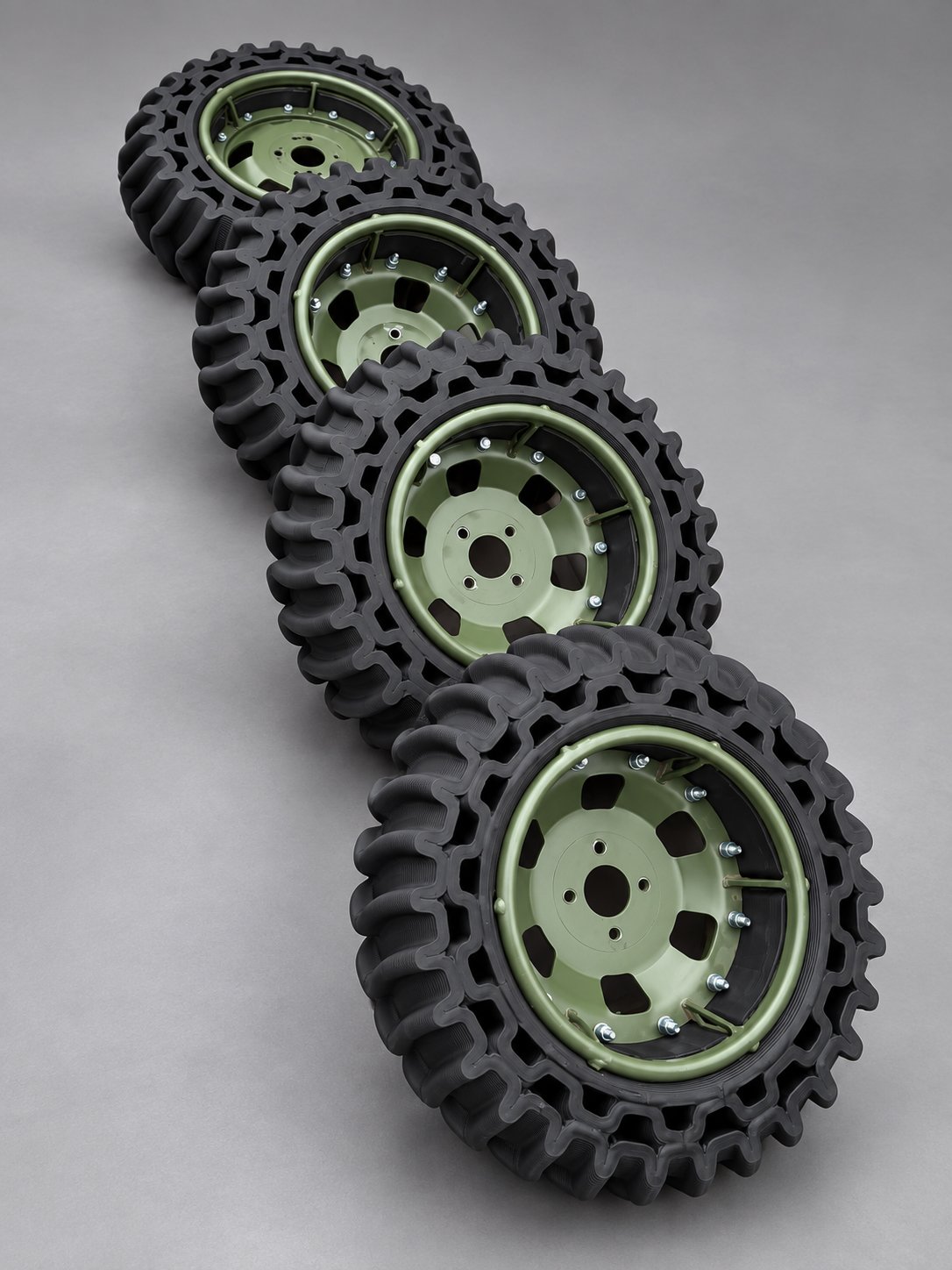
Ukrainian developer Print&Live UA and iSCALE 3D have completed field and combat trials of 3D printed airless wheels for unmanned ground vehicles (UGVs). The wheels are already being produced in small batches and delivered regularly to combat units. Made on large-format additive manufacturing equipment, they combine a rounded tread, fully enclosed sidewalls and a patented two-piece rim. A full set costs about €680, a small fraction of the US$3,000-4,000 or more charged for comparable airless wheels from overseas suppliers.
With research and development complete, the partners are building additional printing equipment. The extra capacity is meant to serve UGV makers moving into series production as well as combat brigades.
Tested Under Load in Winter Combat
The wheels were trialled with units of the Ukrainian Defence Forces across all seasons, including directly on the front line. The most extensive data comes from the 3rd Separate Assault Brigade, which fitted them to a TARGAN 3K 244 EVO 1 UGV. The vehicle logged 210 km on a test range, then 151 km across 11 combat missions in winter, with temperatures between 0 °C and −15 °C. Over those missions it moved 1,825 kg of cargo and evacuated a wounded person. The tread showed moderate wear, but the wheels stayed fully functional throughout.
A second trial with the 49th Separate Assault Battalion “Karpatska Sich” put the wheels on a Rys Pro UGV over boggy and frozen ground. The robot weighs roughly 600 kg empty and up to 800 kg fully loaded, and during testing it was also towing another UGV. Every wheel kept its load-bearing capacity, with no delamination and no structural cracking.
Those results address what is typically the weakest point on a combat UGV. Robots used for casualty evacuation, ammunition resupply and logistics regularly cross ground littered with shell fragments, blast debris, rubble, barbed wire and frozen earth. Pneumatic tyres puncture, lose pressure or jam, and a vehicle stranded under fire can mean both the loss of an expensive platform and added danger to the troops relying on it.
Enclosed Sidewalls Instead of Open Cells
Inside, the wheel is a digitally designed adaptive lattice printed from high-load elastomers and polymer composites. It needs no inflation or routine maintenance, and Print&Live says it continues to carry load even after partial structural failure or heavy mechanical damage.
The exterior is what sets it apart from most airless wheels on the market. Many existing designs, the Michelin Tweel among them, use a flat tread or an exposed cellular structure. In combat terrain those open cells pack with the same debris that punctures pneumatic tyres, adding weight and changing how the wheel behaves mid-mission. Print&Live closed off the sidewalls entirely and gave the tread a rounded profile, which keeps material out and holds the wheel’s weight steady from start to finish.
The rounded profile also shrinks the contact patch and lowers rolling resistance on rough ground. By the developer’s estimate, this can extend a UGV’s operating range by up to 30% compared with imported airless alternatives, largely by reducing battery drain.
Weight is the other half of that efficiency argument. A set of the printed wheels weighs between 32 and 56 kg. Western airless sets come in at 88 to 144 kg, and conventional pneumatic tyres at 30 to 72 kg. That puts the printed design close to pneumatic tyres on mass while removing the puncture risk, and the lighter load also eases strain on gearboxes and electric drive units.
Digital Tuning and Repairs Without a Workshop
The partners describe their approach as Defence 3D Printing, and its main advantage is flexibility. Because the wheel is defined digitally, stiffness, damping and geometry can be adjusted to suit a particular vehicle weight or mission profile without retooling a production line. The same process can therefore serve several UGV platforms rather than a single design.
Maintenance was designed around conditions in theatre as well. The patented two-piece rim means fitting or swapping an airless tyre does not require a tyre-changing machine or press. Operators or technicians can complete the job on site with basic hand tools instead of sending the vehicle back for repair.

Additive Manufacturing Targets the UGV’s Weakest Link
Print&Live is going after a clear gap: unmanned ground vehicles handle more and more evacuation and resupply work, yet they still depend on pneumatic tyres that debris can disable. The company designs each wheel digitally for a specific platform and prints it on large-format equipment, which keeps costs low and allows supply to combat brigades.
iSCALE 3D tackled that problem earlier with Ukrainian startup Lemki Robotix and Czech firm Zeykan Robotics. Together they built a 3D printed off-road autonomous robot with wheels printed in recycled PU and rims in carbon-fiber-reinforced PA. Lemki described pneumatic tyres as a weak point for UGVs working in rough, debris-filled terrain.
The wider push to keep Ukrainian vehicles moving also relies on printing. In 2025 the UK Ministry of Defence gave Babcock a proof-of-concept contract, with QinetiQ as a partner, to create CAD files of key military components so Ukrainian forces can 3D print replacement parts locally.
Print&Live is now taking printed running gear from concept to combat-tested supply.
Register now for AMA: Software 2026. Join 3D Printing Industry on 22 October for expert presentations, panel discussions and live audience Q&A exploring the software shaping additive manufacturing. Register here.
To stay up to date with the latest 3D printing news, don’t forget to subscribe to the 3D Printing Industry newsletter or follow us on LinkedIn.
Explore the full Future of 3D Printing and Executive Survey series from 3D Printing Industry, featuring perspectives from CEOs, engineers, and industry leaders on the industrialization of additive manufacturing, 3D printing industry trends 2026, qualification, supply chains, and additive manufacturing industry analysis.
Featured image shows 3D printed airless wheels for unmanned ground vehicles. Photo via Print&Live.
