


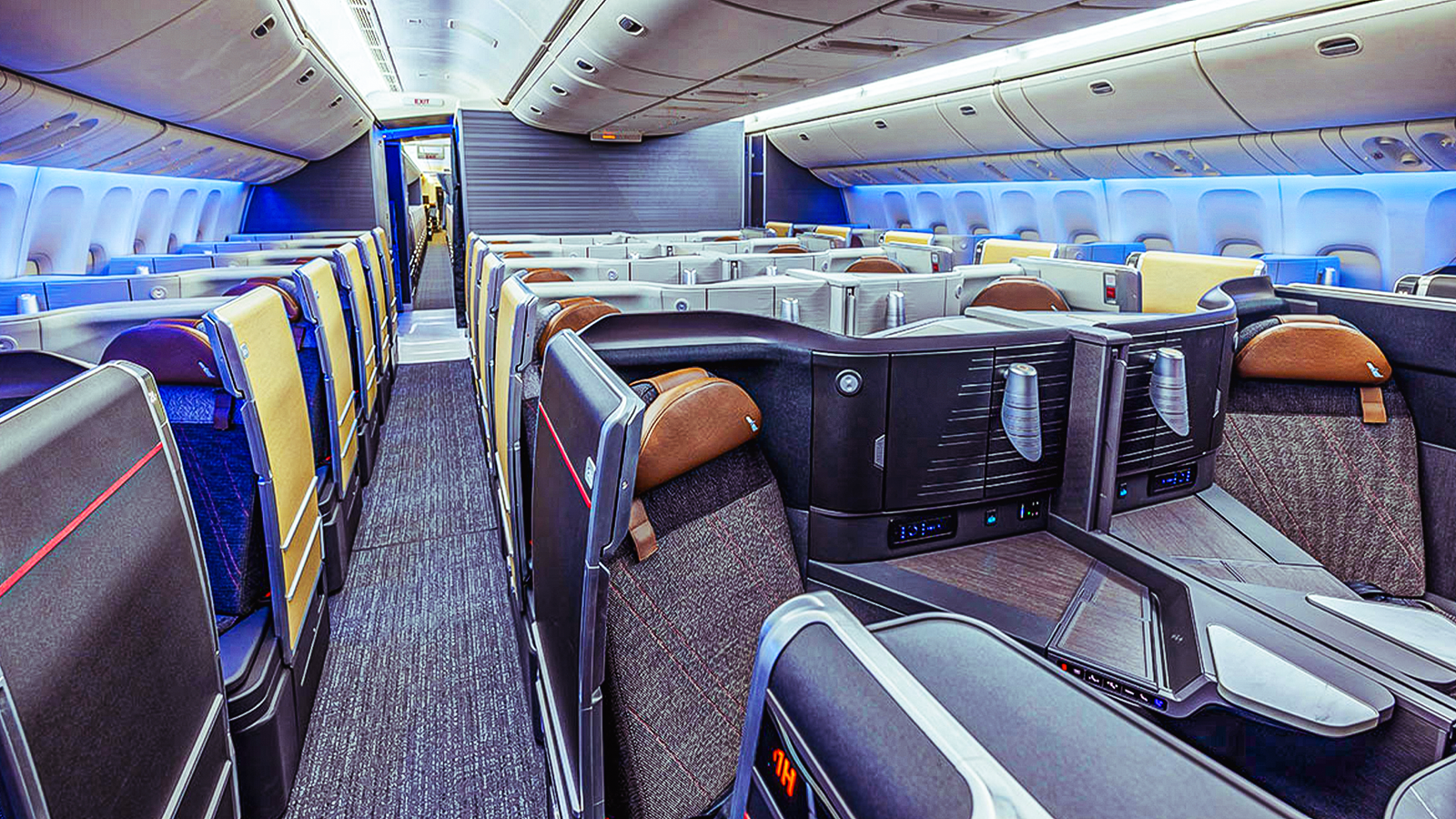
American Airlines has just completed the first example of one of the most dramatic cabin overhauls in its history. Its refreshed Boeing 777-300ER, a full retrofit conducted under its much-vaunted ‘Project Olympus,’ has 70 enclosed Flagship Suite business class seats, 44 premium economy seats and 330 seats overall, compared with 304 seats in the prior configuration.
American says the aircraft now contains more business and premium economy seats than any other US carrier’s aircraft, while Reuters describes the investment as part of a wider effort to attract higher-spending travelers and close the profitability gap with  Delta Air Lines and
  United Airlines. One number, however, has not increased: the number of flight attendants.
American’s 777-300ER fleet routinely operated with 13 flight attendants before October 2020, when the carrier cut the complement to 11. While the change was made almost six years before the first Project Olympus retrofit entered service, what began as a pandemic-era staffing reduction has survived the recovery of international travel, restoration of full premium service, and now the transformation of American’s largest aircraft into its most premium-heavy jet. But does it undermine the premium experience that American is trying to sell?
Why American Cut Its 777-300ER Crew From 13 To 11

In the summer of 2020, as the global pandemic raged and airlines were in a state of paralysis, American’s management warned that it had substantially more employees than required if depressed demand continued. By September of that year, the airline informed the Association of Professional Flight Attendants (APFA) that staffing levels would change from the October bid month, just as the first US government payroll-support program expired. American ultimately began furloughing around 19,000 employees on October 1, after voluntary departures and furloughs were expected to reduce its pre-pandemic workforce of more than 140,000 to below 100,000.
Catch what other flight trackers miss
Emergency squawks, holds, NOTAMs — live signals, no signup.
Open tracker
Catch what other flight trackers miss
Emergency squawks, holds, NOTAMs — live signals, no signup.
Open tracker
The 777-300ER suffered the biggest individual reduction among the aircraft covered by the change, falling from 13 to 11 bid positions. APFA said the purser, previously assigned to First Class, would provide that service through the table-linen stage and then flex into Business; galley positions would also work the aisles. American made similar changes elsewhere: Boeing 777-200 staffing fell from ten to nine, the Boeing 787-9 lost one attendant on affected international flying, and the premium transcontinental Airbus A321T dropped from six to five.
Aircraft / Operation | Pre-October 2020 | Post-October 2020 | Reduction |
|---|---|---|---|
Boeing 777-300ER international | 13 | 11 | 2 |
Boeing 777-200ER international | 10 | 9 | 1 |
Boeing 787-9 international | 10 | 9 | 1 |
Airbus A321T premium transcontinental | 6 | 5 | 1 |
At the time, APFA strongly opposed the move and indicated that it would take the issue to arbitration, saying:
“The Company has notified APFA of their intention to change the staffing levels on specific equipment and routes, beginning with the October bid month. APFA strongly objects to any staffing changes during this challenging time, and we did not participate in any discussions related to the staffing level changes.”
However, despite the union’s opposition, the economic logic was straightforward. Long-haul demand had collapsed, onboard service had been greatly simplified, and American was trying to stop an extraordinary cash drain. Contemporary reporting from One Mile At A Time noted that First and Business Class service was severely curtailed, and most 777-300ER departures had only a fraction of their 52 Business seats occupied. American ultimately only restored all Flagship First and Business service elements in late 2021, so the 11-person crew model was introduced for an airline operation that looked radically different from today’s.
What Do 11 Flight Attendants Actually Do On American’s 777-300ER?

The crew reduction ultimately led to combining jobs that had previously been more specialized. The arbitration record shows that the three-class 777-300ER previously divided its 13 flight attendants broadly as two in First, five in Business, and six in Main Cabin. After October 2020, that became two, four, and five respectively, but with attendants increasingly moving between functions. Dedicated galley positions were generally removed, with galley attendants also working aisles, and some crewmembers even flexing between cabins.
Cabin | Staffing | How The Work Changed |
|---|---|---|
Flagship First | 2 | Purser worked First through table linens, then flexed to Business; former dedicated First galley position also worked the aisle |
Flagship Business | 4 | Reduced from five; galley/aisle duties increasingly combined |
Main Cabin | 5 | Reduced from six; former dedicated galley work combined with aisle duties |
Total | 11 | Greater use of flexing between functions and cabins |
That distinction is important. American did not simply remove two people while preserving 13 separate assignments; it redesigned the entire workflow so that fewer attendants could cover multiple responsibilities. One consequence is that service speed increasingly depends on when galley work is completed and when attendants are able to move into an aisle or another cabin. However, American was satisfied that its staffing levels were adequate, with View From The Wing saying that it had “spent well over a million dollars” on consultants to document that they didn’t need higher staffing levels to meet the service standards they require.
Why The Two Flight Attendants Never Came Back

What was initially understandable as an emergency response became more contentious as passengers returned. By 2024, APFA said that demand had not merely recovered but had exceeded pre-pandemic levels, while the staffing reductions remained. The union’s grievance, originally filed in October 2020, sought restoration of the previous staffing formulas and compensation for flight attendants that it said had been subjected to unreasonable workloads. The case eventually went through four days of arbitration in April 2024, with experienced flight attendants testifying about delivering premium service with smaller crews.
Date | Development | Why It Matters |
|---|---|---|
September 2020 | American tells APFA it will reduce staffing on the 777-300ER, 777-200ER, 787-9, and A321T. | Establishes the staffing changes as a pandemic-era response. |
October 2020 | New staffing formulas take effect; 777-300ER drops from 13 flight attendants to 11. | Creates the staffing model still used years later. |
December 2020 | APFA files a Presidential Grievance challenging the staffing reductions. | Begins the formal union effort to restore pre-COVID staffing. |
November 2021 | Premium onboard services return while reduced staffing remains. | APFA argues that the justification for lower staffing has disappeared as service and passenger demand recover. |
2022-2023 | Reduced staffing continues as international demand normalizes | The 11-person 777-300ER crew increasingly shifts from temporary pandemic measure to established practice. |
April 2024 | APFA and American present the staffing dispute during four days of arbitration in New York. | APFA seeks restoration of pre-COVID formulas and compensation for affected flight attendants. |
August 2024 | Both sides submit closing briefs. | Marks the final stage before the arbitrator’s decision. |
December 2024 | Arbitrator denies APFA’s grievance and upholds American’s staffing changes. | Effectively preserves American’s authority to continue the 11-person 777-300ER staffing model. |
September 2026 | First Project Olympus 777-300ER enters service with 70 Flagship Suites and 330 total seats. | The significantly redesigned aircraft continues operating under the reduced staffing model created six years earlier. |
American ultimately won the case. In December 2024, the arbitration board ruled that the collective bargaining agreement allowed management to establish new staffing formulas and concluded that the company had not abused its discretion by assigning an unreasonable workload. The arbitrator also distinguished the dispute from an earlier 777 staffing case in 2003, noting that today’s flight attendants were not given rigid task-completion times or disciplined when service took longer.
APFA sharply disagreed with the outcome, saying the decision failed to reflect attendants’ experiences concerning workload, service and employee wellbeing. But that decision helps explain why the 13-person crew complement never returned when COVID-era restrictions disappeared. By the time American prepared to retrofit its 777-300ERs, the battle over restoring the two positions had already been fought for more than four years, and the company’s 11-person model had survived.
Project Olympus Changed Almost Everything Else About The 777-300ER

American first unveiled the Flagship Suite concept in 2022, announcing that all 20 777-300ERs in the fleet would ultimately receive 70 suites and 44 premium economy seats. The first completed aircraft, N718AN, entered commercial service between  New York JFK Airport (JFK) and Buenos Aires’ Ezeiza International Airport (EZE) earlier this month, and American expects the fleet-wide retrofit to be completed during 2027. The suites include privacy doors, extra storage, and a chaise-lounge position, while eight Preferred suites provide additional space.
Cabin | Legacy 777-300ER | Retrofitted 777-300ER | Change |
|---|---|---|---|
Flagship First | 8 | -8 | |
Flagship Business / Flagship Suite | 52 | 70 | +18 |
Premium Economy | 28 | 44 | +16 |
Main Cabin Extra | 28 | 30 | +2 |
Main Cabin | 188 | 186 | -2 |
Total | 304 | 330 | +26 |
The most notable change is that Flagship First disappears entirely, while total capacity actually rises from 304 to 330 seats. At the same time, the refurbished 777-300ER has 114 premium-cabin seats — 70 Flagship Suites and 44 premium economy seats — meaning 35% of the aircraft is now dedicated to premium cabins.
By comparison, United’s 350-seat 777-300ER has 84 premium-cabin seats (60 Polaris, 24 Premium Plus) or about 24% of capacity, while Delta’s 306-seat Airbus A350-900 flagship configuration has 80 premium-cabin seats (32 Delta One Suites, 48 Premium Select), equal to about 29%. American has therefore managed to make its 777-300ER flagship both larger and the most premium-focused of the legacy US carriers, sacrificing a tiny eight-seat First Class cabin with a much broader premium proposition aimed at a larger pool of high-yield travelers.
Commercially, that matters enormously. Reuters reported that premium customers generated nearly half of American’s ticket revenue in the second quarter despite representing around 30% of seats. Small wonder then that the airline has been steadily adding the Flagship Suite concept to new Boeing 787-9s and Airbus A321XLRs before extending it to existing widebodies.
How Does American’s 11-Person Crew Compare With Other 777-300ER Operators?

Despite having a massive fleet of over 1,000 aircraft, American is actually a relatively small 777-300ER operator globally, with its 20 examples placing it tenth-largest by fleet count.  Emirates is the largest operator of the type with 117, followed by
  Qatar Airways with 57, and
  Air France with 43. So how do these other operators compare in terms of crew count?
Operator | 777-300ER Fleet | Documented Cabin Crew |
|---|---|---|
Air France | 43 | 13-15 |
American Airlines | 20 | 11 |
Emirates | 117 | 15 |
Qatar Airways | 57 | 15 |
Singapore Airlines | 22 | 15 |
United Airlines | 22 | 11 |
It turns out that American’s 11-person complement looks lean compared with several major international 777-300ER operators, with premium carriers such as Emirates, Qatar Airways, and  Singapore Airlines typically operating with a 15-person crew for their highly service-intensive long-haul products. Air France does reduce its 777-300ER crews to 13 on some of its schedules.
However, it is United that provides the most useful counterpoint. Its 350-seat 777-300ER is larger by seat count, yet United’s union identifies 11 flight attendants as the Established Staffing Guideline for a full international operation. Longer duty periods can require extra augmented crew, but the baseline shows that American’s 11-person complement is not uniquely low compared to its most direct peer.
Can 11 Flight Attendants Deliver American’s New 777-300ER Premium Experience?

While American may be in line with United’s cabin crew levels on the 777-300ER, there is clearly still a staffing gap to the premium international competitors. So will that gap become apparent to passengers in terms of the onboard service?
There is a strong argument that the remodeled 777-300ER should be easier to operate in some respects. Eight highly individualized Flagship First seats disappear, leaving one large premium business product instead of separate First and Business cabins. New galleys and revised workflows can improve efficiency, while American’s 11-person model was specifically designed around attendants moving between galleys, aisles and cabins as tasks are completed.
But Project Olympus is selling more than an attractive seat. American promises Flagship Suite passengers a multi-course dining experience, curated wines, upgraded bedding, and a more refined journey with attentive service. That requires human interaction: taking orders, preparing and delivering meals, replenishing drinks, clearing tables, responding to passengers and providing differentiated service, all while the same attendants retain their operational and safety responsibilities.
The union’s argument throughout the staffing dispute has been that doing those tasks with fewer dedicated positions makes it considerably more difficult to consistently deliver the experience that American now wants passengers to pay a premium to receive. Almost everything else has changed since the staffing formula was devised in 2020: the aircraft carries 26 more passengers, Business has become 70 enclosed suites, and premium economy has expanded substantially. Yet the number of crew members remains rooted in one of aviation’s deepest crises. So whether the service can match the ambition of the new cabin may prove just as important as the seats themselves.
