


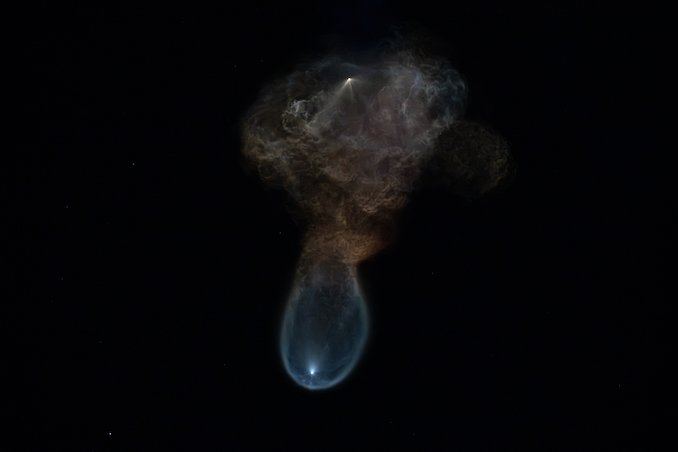
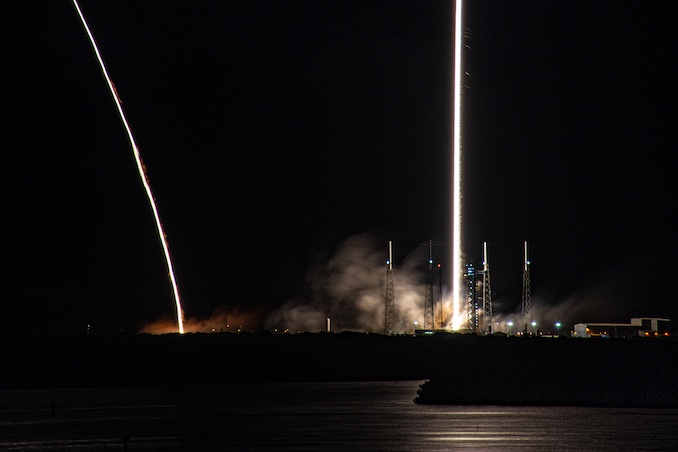
Under the soft glow of sunrise Tuesday morning, SpaceX’s Falcon 9 rocket roared away from pad 40 at Cape Canaveral Space Force Station at 6:33 a.m. EDT (1033 UTC) to begin a cargo run to the International Space Station.
The 35th Commercial Resupply Services (CRS-35) is carrying more than 6,300 pounds of science and supplies to the orbiting outpost when it docks to the space-facing port of the Harmony module on Thursday morning.
Fewer than 7.5 minutes after leaving the launch pad, the first stage booster, tail number B1096, wrapped up its eighth trip to space and back with a landing at Landing Zone 40 adjacent to the pad. A thunderous sonic boom rang across the spaceport and beyond, signaling its return.
Two minutes later, the Cargo Dragon spacecraft, tail number C211, separated from the Falcon 9 rocket’s upper stage to begin a two-day journey to the space station. Onboard cameras showed views of two Roll-Out Solar Array (ROSA) wings, nestled inside Dragon’s unpressurized trunk, that will be installed to augment the power of the ISS.
Built by Redwire Space, these were the fourth and final pair of ROSAs bound for the space station. Each are capable of providing more than 20 kW of power for more than 10 years. NASA has been preparing for their installation with a series of spacewalks.
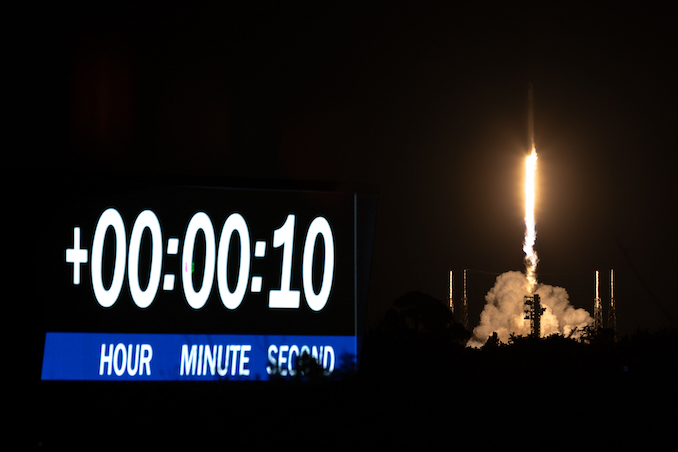
“It’s been quite the journey. Folks may remember back in 2017 when we launched the ROSA on CRS-11 and that’s really where we demonstrated this innovative approach to deploying a solar array,” said Gaurang Patel, NASA’s operations integration manager of its Low Earth Orbit Program, during post-launch remarks on the agency’s broadcast.
“Once we were able to prove that technology, we were trying to understand how we could leverage this for the ISS and apply that. The legacy arrays are not outfitted to have standard upgrades and so, teams had to go look at ways we could attach these arrays. And there were non-standard interfaces where we had to put these modification kits, to safely mount these arrays.”
A version of the ROSA will be used to help power NASA’s Space Reactor 1 Freedom (SR-1 Freedom) when it launches in 2028.
Also onboard the Dragon spacecraft is the equipment necessary to support more than 40 different scientific studies. That includes a range of biological and plant science experiments as well as testing a new type of glass.
“Most ordinary glass forms from silica, the main component in sand. Unconventional glass is made from heavier elements that aren’t traditionally used to form glass. These unconventional glasses could have remarkable properties, including refractive indices higher than diamond, greater resistance to breaking, and even the ability to contract rather than expand when heated,” said Dr. Liz Warren, NASA’s deputy chief scientist within its ISS Office, during a prelaunch press conference.
“New types of glass like these could advance optics and electronics on Earth and supports space exploration with stronger, lighter, radiation-resistant, or higher-performing glass. This could potentially be used in lunar rovers and lunar habitats.”
Dragon C211 will spend about a month docked to the International Space Station. NASA astronaut Anil Menon and Canadian Space Agency (CSA) astronaut Joshua Kutryk will monitor the spacecraft’s arrival on Thursday.
