


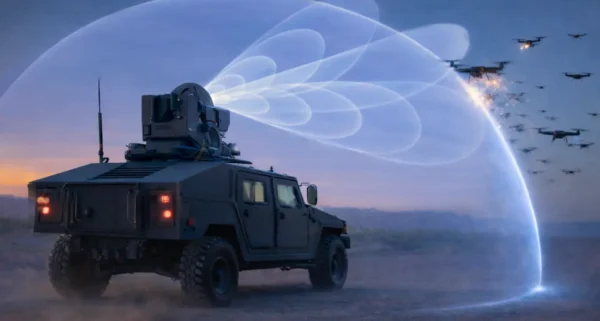
The Austin company enters the market with $2 million in signed purchase orders. Its first commercial focus is MW-class high-power microwave systems for counter-drone defense and industrial applications.
Stellios Technologies emerged from stealth on October 20, 2026 with an oversubscribed $5 million pre-seed financing. The Austin, Texas company develops high-power microwave, directed-energy, compact-fusion and advanced-propulsion technologies. Investors in the round included Shervin Pishevar’s Sofreh Capital, Wave Function Ventures, Cubit Capital, Mana Ventures, Atoms & Bits, Output Capital, Erik Bruckner and other strategic investors.
“Stellios is on a mission to ensure that the United States dominates the next generation of high-energy power systems,” said Richard Starson, founder and chief executive of Stellios Technologies. “The ability to generate, deliver, and harness extreme levels of power will be critical to American technological and military leadership in the 21st century. From counter-drone defense and directed energy to advanced propulsion, compact fusion, and grid-scale power, the future will belong to nations that lead in power systems. Now is the time to rebuild that capability in America, addressing urgent defense needs today while laying the foundation for compact fusion and entirely new propulsion systems for supersonic, hypersonic, and space flight.”
Purchase orders and use of funds
Stellios secured $2 million in signed customer purchase orders before raising outside capital. According to the company, the round then closed above its target within weeks. Stellios plans to use the funding to build and deliver its first contracted high-power microwave systems and to establish domestic research and pilot manufacturing facilities. It will also expand its engineering, leadership and sales teams, accelerate government business development and advance Stellios Genesis, its AI-native engineering and digital-twin platform.
“At Cubit Capital, we look for founders with firsthand knowledge of a critical problem, the technical experience to address it, and early customer traction,” said Philip Carson, partner at Cubit Capital. “Stellios brings all three. With signed customer purchase orders, ongoing defense customer discussions, and plans for US-based manufacturing, the company is building a commercially grounded business with the potential to strengthen American and allied defenses and lay the foundation for compact fusion power and advanced propulsion.”
High-power microwave systems for counter-drone defense
Starson, who holds a Caltech doctorate, founded Stellios in 2026 with a team experienced in plasma physics, high-power microwave systems and aerospace. He previously co-founded Escape Dynamics, a microwave-powered space launch company. There, members of the Stellios team designed and operated a 100 kW-class gyrotron, a high-power microwave source.
Stellios designs and builds the core hardware behind high-power microwave systems. That hardware includes vacuum-electronic devices such as klystrons and gyrotrons, along with the high-voltage power generation, conditioning and control systems that drive them. By pairing that hardware with modern power electronics, software-defined controls and AI-native engineering, the company aims to make the systems smaller, cheaper and faster to develop than legacy designs.
The company’s first commercial product line is MW-class high-power microwave systems. In defense, Stellios designs these systems for counter-electronics and counter-drone missions, where cheap drones are driving demand for systems that can engage multiple targets quickly at a low cost per engagement. The U.S. military has already selected its first bases for a directed-energy counter-drone program. Industrial uses include geothermal drilling, advanced materials processing and plasma heating for fusion research.
“The United States pioneered high-power microwave technology, and we must lead its next generation,” said Edl Schamiloglu, distinguished professor of electrical and computer engineering at the University of New Mexico and adviser to Stellios. “Rebuilding this capability in America is critical to national security and industrial leadership. Stellios is combining advanced vacuum electronics, modern power systems, controls, and manufacturing to advance HPM today while laying the foundation for compact fusion power and fusion-powered propulsion.”
Stellios is also running a compact aneutronic fusion research program, Stellios Core, which shares many subsystems with its microwave hardware. The company aims to develop fusion systems compact enough to power remote military bases and industrial sites, and eventually to enable supersonic, hypersonic and space flight.
More information is available at Stellios Technologies.
