


For the last two decades, Cirrus Aircraft has been at the forefront of bringing new technology to the cockpit. One of its latest offerings is Mission Ready—a training and safety program specifically for SR owners to experience in a flight simulator environment.
The program, launched in March, lives within the manufacturer’s official pilot training curriculum, Cirrus Approach. This library of real-world flight training sessions paired with video learning takes a Cirrus pilot from their first flight all the way through their pilot’s certificate and instrument rating.
If you're not already a subscriber, what are you waiting for? Subscribe today to get the issue as soon as it is released in either Print or Digital formats.
Subscribe Now
Cirrus recognized that using advanced aviation training device (AATD) simulators can deliver experiences that can be flown deeper into a maneuver or scenario, past what is typically flown in the real airplane.
Although simulator training at flight schools around the country is expanding beyond recurrent instrument training, Mission Ready is a series of 24 individual cross-country flights with both VFR and IFR learning goals, so the scenario can be tailored to the pilot’s level of
experience.
Cirrus Standardized Instructor Pilots (CSIPs) build the missions and include realistic ATC communication prompts for the instructor, integrated decision points, and instructor guidance to create a purposeful training scenario. The program transfers the weight of scenario creation away from the instructor, freeing them to better brief and deliver training to the student pilot.
Firsthand Look
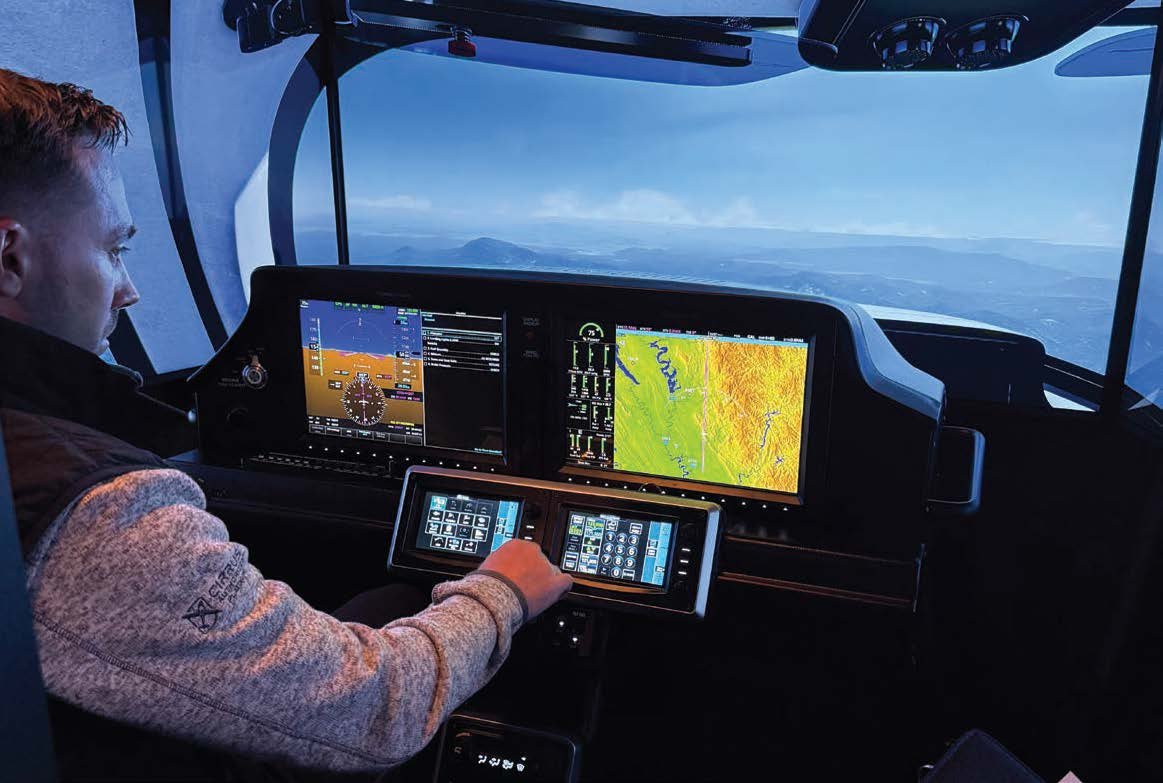
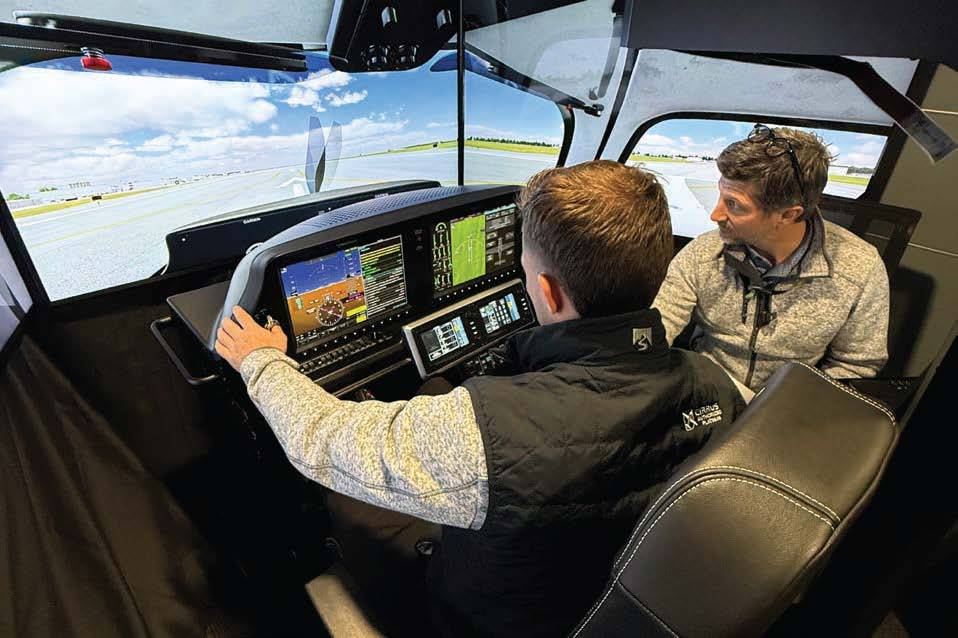
On an appropriately windy and rainy spring IFR day, I visited Mike Goulian Aviation’s Cirrus Training Center at Hansom Field (KBED) outside of Boston, as it had recently equipped the school with a new RealSimGear SR7x Pro. The SR7x Pro is a switch-for-switch replica of the SR22 G7, complete with the Garmin Perspective Touch avionics system.
- READ MORE: Sim Lab: Silence Can Be Golden in Microsoft Flight Simulator
- READ MORE: Alaska Awaits Flight Sim Pilots on MSFS2024
Training on the SR7x, the pilot can reinforce the same flows and procedures used in the real airplane, making the flight time loggable.
Though the program is still new, Marc DeRose, Mike Goulian Aviation’s director of flight operations, has already seen the benefits of this training with both his students and instructors alike.
“It’s really about being more prepared before you ever get in the aircraft,” said DeRose, an experienced CFII and CSIP. “And our sim lets you practice real-world scenarios multiple times to help build improved decision making.”
Allowing me to observe a Mission Ready scenario, DeRose selected a student pilot from Mike Goulian Aviation to act as the pilot flying the sim. The student, a private pilot with hundreds of hours of flight time, was working on his Cirrus transition training.
DeRose and the student briefed on the scenario in the classroom before hopping into the sim. DeRose then selected the “Over the Hills” scenario, with the flight departing from McGhee Tyson Airport (KTYS) in Knoxville, Tennessee—home of the Cirrus Vision Center—to Asheville, North Carolina (KAVL).
Aptly titled, the scenario would cross some of the highest mountains in the Appalachian range with a planned cruising altitude of 9,000 feet. The RealSimGear SR7x uses a commercial license of X-Plane 12, so the weather simulated in the scenario and in the scenery below the airplane were very high quality, allowing the pilot to look out the windows to spot real-world landmarks.
Three 55-inch 4K TVs on the SR7x provide 180 degrees of peripheral vision, helping the pilot get into the zone and tune out distractions. Before the scenario, I flew a short test flight in the SR7x and was given an unexpected engine-out after takeoff. The triple screen setup enabled me to turn my head to the right and effectively look through the turn to sight the runway. I did not take my sight off my landing spot and was able to stay in the scenario without adjusting the sim camera, preserving my concentration.
Back in the simulator, with flight planning finished, the student received clearance to climb up to 9,000 feet from the approach controller (DeRose). Headed out over the Appalachians, the clearance between the mountains and the clouds seemed less than the forecasted conditions, but this was a flight under IFR, and both DeRose and the student settled into a comfortable conversation, reminiscent of the kind one might hear on any normal cross-country flight.
The light chatter was designed to set the student at ease and keep him lightly tasked while DeRose activated the first electrical issue with Alternator 2. Getting his attention, the student assessed the situation and began using the on-screen checklist. Keeping the autopilot on while running the checklist, he soon had to deal with the loss of the multi-function display (MFD). Next, yellow CAS messages appeared on the PFD, prompting him to go deeper into the SR22’s Abnormal Procedures checklist.
DeRose sat patiently watching the student from his instructor’s station. His many years of coaching college rowers at the highest levels helped him know what to say, but more importantly, how and when to say it. It served as a reminder that too much assistance in the moment would detract from the learning opportunity that the Mission Ready scenario was creating. DeRose let the student work out the next moves for himself.
Still on the way to Asheville, the electrical issue had not risen to an immediate emergency, but no sooner was the appropriate checklist completed than DeRose discreetly activated a slow but cascading engine power loss. Layered on top of the partial power loss were a few ATC instructions, consisting of small course corrections, adding to the student’s task load.
A few minutes into the partial power loss, it became apparent that a complete power loss was in the offing. The student decelerated to best glide speed and was now fully concentrating on looking for a potential landing location. But, as the scenario was designed, he was over mountainous terrain with very few options.
Starting a gentle series of turns and holding onto his decaying airspeed, he searched quickly for a landing spot. Terrain was rising on both sides of the SR22 as it was losing altitude, now just above the mountain ridges. With the MFD function restored, he used the navigation display to locate a potential airport ahead of his position about 8 miles away. But to make it to the airfield, he would have to coax the airplane over the final ridge. It was a difficult decision that had to be made quickly.
The SR22’s propeller was windmilling, as the engine was still technically running, but the airspeed was getting closer to stall speed. Until this point in the flight, saving the airplane seemed like a realistic option, but it was going to be close.
As the airplane neared the ridge, the student did his best to manage the situation. Other than acting as ATC, DeRose stayed mostly quiet, letting the student do the hard work on his own, simulating the challenge of being pilot in command.
In the time that it took to balance the challenges of the critical situation, including the running of an emergency checklist by memory, the SR22 had fallen below the 600 feet agl minimum for pulling the CAPS handle and activating the parachute. Adding to the difficulty was the changing height as the airplane flew over the dynamic terrain of the mountain range.
As the SR22’s stall warning sounded, the student reached above his right shoulder for the red CAPS handle, which requires the realistic 45 pounds of force, just like the real airplane.
Unfortunately, the airplane had descended to just a few hundred feet over the tree-lined ridge, giving the SR22 time to bob back and forth under the parachute before hitting the trees. There just was not enough altitude to effectively slow the airplane to a controlled landing under the partially deployed chute, reinforcing the importance of the 600-foot minimum agl for CAPS deployment.
The flight debrief was one of the most effective components of the
Mission Ready scenario. DeRose discussed the challenges and takeaways with the student. From my observer’s perspective, I didn’t question the pilot’s decision to try to clear the ridge. Sympathetic to his plight and the challenges he had to deal with, I believe I would have also attempted to clear the ridge, too, had I been flying.
Clearly designed to test a pilot’s decision making, the Mission Ready scenario proved to be an effective reminder of how a worsening series of aircraft failures over the mountains can further reduce the options from which a pilot has to choose.
“The combination of staying in front of the airplane, managing the airplane and terrain was really tough,” the student said. “It was task saturation for me. What I was called upon to do felt very realistic, even down to the graphics.”
DeRose said the feeling of being overwhelmed is a common outcome of the program’s design, intended to mirror the high-stress environment of an actual in-flight emergency.
“Instructors and students typically practice emergencies in a laboratory, with things happening quickly, but in order,” he said. “In a scenario like this, no one realistically has time to squawk 7700. The pilot has to focus on controlling the airplane. Pilots typically fall to their level of training in an emergency, and these scenarios allow Cirrus Flight Instructors the chance to evaluate where gaps exist in a pilot’s responses.”
Mission Ready accomplished the goal of pushing a pilot through their comfort zone, but productively, allowing time for the postflight debrief of the scenario to extract maximum value.
Another important theme of the Mission Ready program is continuous proficiency rather than periodic recurrency. Cirrus’ goal is to keep growing its overall training program.
“These scenarios allow the pilot to become the diagnostician, as they are pushed to assess the clues in real time,” DeRose said.
Raising the Bar
As a top-awarded Cirrus Training Center, Mike Goulian Aviation has shown a commitment to sim training, which was evident by the updates to the simulation rooms at both of its Massachusetts locations. Instead of shoehorning the sim equipment into an empty corner space, it installed blackout window blinds, dimmable ceiling lights, and dark wall paint to create a distraction-free classroom environment where immersion can be created when the pilot is behind the controls of the SR7x.
In addition, Mike Goulian Aviation instructors have been pooling their SR platform knowledge to provide feedback to RealSimGear to aid in the development of the platform.
Encouragingly, the Mission Ready program brings professional pilot-level simulator training to Cirrus pilots who reside near participating Cirrus Training Centers. When delivered in the ideal simulator classroom environment and with excellent instruction, the program can train in both VFR and IFR scenarios that pilots can add to their logbooks, providing an important incentive to justify the instructor and simulator rental costs.
Although I only observed one Mission Ready lesson, Cirrus noted that in many scenarios “pilots are given choices in how the mission is completed. This introduces an element of strategy and autonomy, encouraging experimentation, reflection, and engagement rather than rote execution.”
If you are interested in this training, contact your local Cirrus Training Center to see if it has an AATD flight simulator that is booking Mission Ready scenarios. Non-Cirrus pilots can schedule a Mission Ready sim lesson, too. All you need is a complimentary Cirrus Approach account to get started.
As a flight sim enthusiast, it is encouraging to see a forward-looking OEM like Cirrus embrace simulator training for private and instrument-rated general aviation pilots. Regardless of the challenges faced in a given Mission Ready scenario, there is an ideal starting point in the curriculum for pilots of all experience levels.
Read more about Cirrus’ Mission Ready scenarios here.
New Cirrus App
Earlier this summer, Cirrus announced a new experience called Let’s Go Fly that debuts on the Apple Vision Pro as an app for the mixed/extended reality headset.
Free to download, the app’s main feature is a seven-minute demonstration flight in the SR22T, designed to introduce the viewer to personal aviation by way of a sightseeing adventure over the American Southwest. Filmed in ultra-high-resolution, 180-degree, 3D video with spatial audio, the viewer will be brought into the flight in a novel and immersive way.
The experience serves as an entry point for curious potential pilots who are tech savvy and own an Apple Vision Pro.
In addition to the demo flight, Let’s Go Fly includes a full-size, built-to-scale, digital rendering of the SR Series and Vision Jet airplanes intended for the viewer to virtually explore from within the headset. Cirrus intends for this tool to assist its global sales team in introducing the manufacturer’s airplanes digitally when a real-world aircraft can’t be made available.
This column first appeared in the August Issue 973 of the FLYING print edition.
