


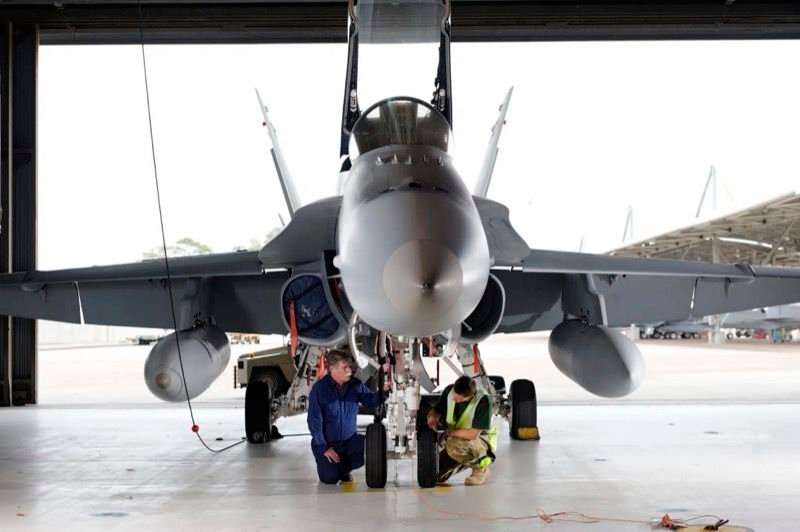
Australian researchers and industry are working to certify the use of laser additive manufacturing to repair high-value components on military aircraft, including fighter jets, rather than replacing them.
The two year project will develop a certifiable laser directed energy deposition (L-DED) repair process for high-value aerospace alloys. The aim is to shift aircraft sustainment from costly, long-lead-time component replacement to in-country repair.
The work targets precipitation-hardening materials widely used in defense aviation – including Inconel, titanium and 15-5PH stainless steel – with the goal of repairing an advanced military aircraft component to original-equipment-manufacturer (OEM) and NASA-STD-6030 requirements.
At the project’s core is a laser rescanning technique that controls microstructure during the repair itself. By tailoring heat input locally, the team aims to meet the required material properties without post-process heat treatment, a major barrier to qualifying additive repairs in aerospace.
The project, which is supported by Australia’s Additive Manufacturing Cooperative Research Centre (AMCRC), brings together researchers Rosebank Engineering, the RMIT (Royal Melbourne Institute of Technology) Centre for Additive Manufacturing, and the Swinburne University of Technology in Melbourne
Rosebank Engineering will lead process development and validation, using its Adaptive Monitoring and Control of Laser Additive Deposition (AMCLAD) system to ensure consistent, repeatable repairs.
Jarrod Watts, senior manager of engineering and projects at Rosebank Engineering, said, “These types of high-value components are currently sourced – in the sustainment environment – from complex international supply chains with long lead-times. We know laser offers the opportunity to repair in-country with significant cost and lead-time reductions.”
Researchers at RMIT and Swinburne will generate the qualification evidence, including tensile strength, fatigue life, residual stress, corrosion and wear performance, forming a material property suite aligned with the NASA standard.
Professor Milan Brandt of the RMIT Centre for Additive Manufacturing, who is overseeing laser process optimization, said, “Laser rescanning allows us to refine microstructures in ways conventional heat treatment cannot achieve in repair scenarios. By controlling phase transformations during deposition, we can unlock performance levels that meet aerospace standards.”
Professor Suresh Palanisamy of Swinburne, which will carry out detailed material characterization and mechanical testing, said, “Certification is evidence-driven. Our role is to produce the data that proves the process is robust, repeatable and capable of meeting aerospace requirements.”
The project will also explore repair pathways for in-demand F/A-18 engine components, offering a near-term commercial opportunity while supporting wider adoption across other aircraft. Certifying the process could cut lifecycle costs, improve aircraft availability and strengthen supply-chain resilience as the Royal Australian Air Force sustains high-value platforms over long service lives.
