


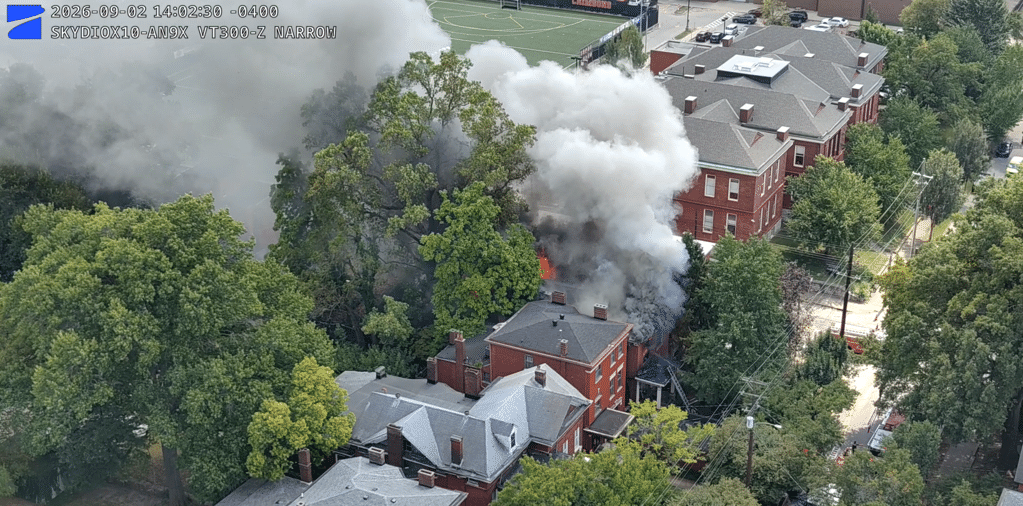
New integration gives fire departments access to drone locations, live video, and thermal imagery within their existing incident command software.
By DRONELIFE Features Editor Jim Magill
An incident commander at the scene of a major fire must be able to rapidly collect and coordinate multiple pieces of intelligence in order to effectively direct various fire-fighting assets, including manned and unmanned aerial vehicles as well as units of human firefighters on the ground.
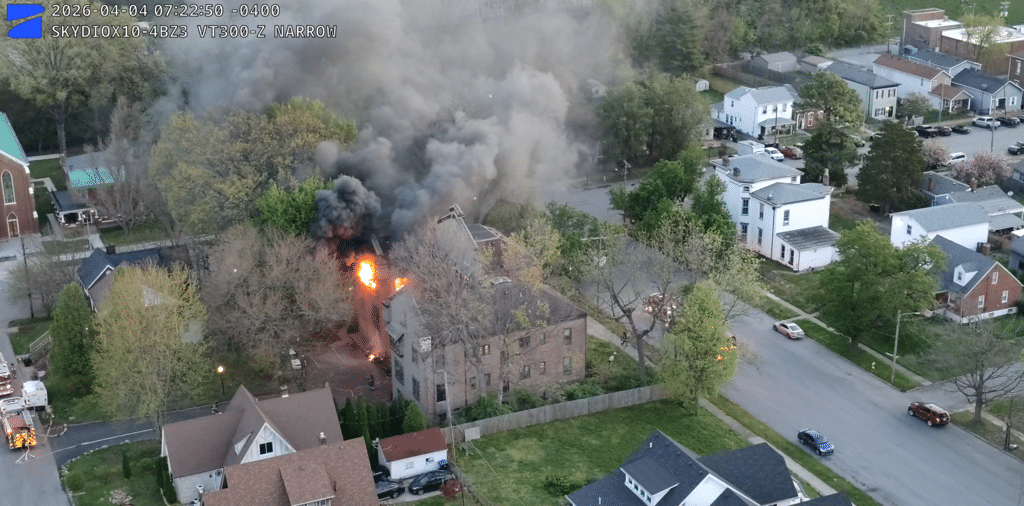
A new partnership between Tablet Command, a mobile incident command and tactical software company, and autonomous drone systems producer Skydio, is designed to make it easier for incident commanders to manage their scenes, allowing them to see every drone’s position and its telemetry data and to seamlessly tap into each drone’s live video feed, all within a single screen.
In an interview, Tablet Command cofounder and CEO William Pigeon said the collaboration with Skydio will allow the firefighting agencies that comprise his company’s customer base to seamlessly tap into the video and other data streams they need to do their jobs in real time.
“It allows Skydio drones to be seen by our customers, by our users, with a location of the drone on the map, just like they would see a fire engine location. And they can tap on that drone and get a truly real-time video feed with no delay,” he said.
Pigeon said the partners unveiled the proof of concept for the new product at the recent Skydio Ascend users conference in Summerlin, Nevada. “What we’re doing right now is just finalizing it into a production-based infrastructure that’s fault-tolerant, resilient and ready for use in mission-critical environments,” he said.
Tablet Command, which provides its services to between 1,500 and 2,000 fire-fighting agencies it the U.S. and Canada, initially is rolling out the new integrated technology to its “pioneer” customer, the city of Louisville Fire Department. Later on, the partners plan to introduce the product to the large number of fire departments that are mutual customers of both Tablet Command and Skydio.
For those customers, the value of the new technology is obvious, Pigeon said.
“There’s no other application, there’s no exchanging usernames or passwords, there’s no looking at some other video screen to see the drone video. We’re bringing it to them in a single pane of glass, the real-time video, so that they can make decisions while they’re responding,” he said.
Tablet Command’s origin story
Pigeon said he and cofounder Andy Bozzo were inspired to form Tablet Command following an incident that occurred while both were serving as firefighters at the fire academy of Contra Costa County in California in 2007.
“On July 21, 2007, the Contra Costa County fire department suffered two line-of-duty deaths. Matt Burton and Scott Desmond, a captain and an engineer, perished in a fire trying to rescue an elderly couple in a 1,000-square-foot house,” he recalled. The tragedy greatly impacted the two young firefighters, and made them want to use their skills to develop tools to make fire-fighting operations safer.
The two future entrepreneurs were working together on a project for the fire department in 2009, the year the first iPad came out when Bozzo suggested that they pool their talents to develop an incident command application for the iPad, to give firefighters an enhanced level of intelligence of what was going on at their scenes.
“I thought that was an amazing idea. I had a technology background. So, we raised some money with friends and family, and we contracted with a development firm,” Pigeon said. The partners launched the Tablet Command app in 2013, and offered it for sale on the Apple App Store.
“And we quickly realized within about half a year, to a year, that selling an application on the App Store for $39.99 is not a great business model,” he said. At about the same time, the young company began getting feedback from fire chiefs that the Tablet Command app should be connected to the 911 computer-aided dispatch system, “so, it’s just a quick drag and drop of assigning resources like engines and trucks to the fire. So, we did that and launched that in 2014.”
Tablet Command eventually evolved into a software-as-a-service business, “where we do the integration to the 911 data center, get the data out as quickly as possible — preferably in real time — and then provide that to our users,” Pigeon said. “Over the years, we’ve added additional features and products. Most notably in 2016 we launched TC Mobile, which was a companion phone application that brings firefighters the same live real-time data and advanced notifications for structure fires.”
Skydio develops its own firefighting tech
As Tablet Command was developing its incident command software system to allow incident commanders to track their assignments, personnel and assets within a single software stack, Skydio was busy developing its own fire-fighting capabilities.
These largely involved following the drones-as-first-responder paradigm, siting drone docking stations strategically around firehouses in order to respond to a 911 call for service, or using transportable drones that can be deployed tactically in the field at the sites of wildfires, structure fires, building collapses or hazmat incidents.
However, the aerial intelligence guiding these Skydio systems was siloed from the incident command software used by fire-fighting agencies. “I think both companies saw a gap from different angles,” a Skydio official told DroneLife. “And with the help of a few joint customers who really pushed us to talk and to collaborate together, we built a custom integration between our two platforms.”
Using the two companies’ integrated software system, incident commanders can see the live video feed produced by the drone, both the color and the thermal, within Tablet Command, they have a full picture of that incident.
“Where they’re flying their Skydio drones, that live telemetry and video feed pipes directly into Tablet Command, where an incident commander can see their incident, their assignments, and then they have a map view of where all their apparatuses are so they can track their assets,” the official said.
The incident commander will be able to see all the Skydio drones flying in the area as icons on a map. He will not only be able to determine spatially where each drone is located, and by tapping on that icon, he will have the feed from that drone pop up on his screen.
In addition, he can then have the option of viewing either the full-color or the thermal video feed from that drone in real time. In large-scale wildfires or other disasters each incident commander operating within the Tablet Command system can determine which perspective, which drone and which feed they want to look at without having to try to communicate with the drone operator.
Pigeon say the new technology is likely to prove to be a game-changer in the way that fires are fought. “If the drone operator is doing a point-of- view over a structure fire, the incident commander can place the drones in the screen that they’re running the incident on, and be able to visualize anything that they want, in whatever way that they want.”
Read more:

Jim Magill is a Houston-based writer with almost a quarter-century of experience covering technical and economic developments in the oil and gas industry. After retiring in December 2019 as a senior editor with S&P Global Platts, Jim began writing about emerging technologies, such as artificial intelligence, robots and drones, and the ways in which they’re contributing to our society. In addition to DroneLife, Jim is a contributor to Forbes.com and his work has appeared in the Houston Chronicle, U.S. News & World Report, and Unmanned Systems, a publication of the Association for Unmanned Vehicle Systems International
