


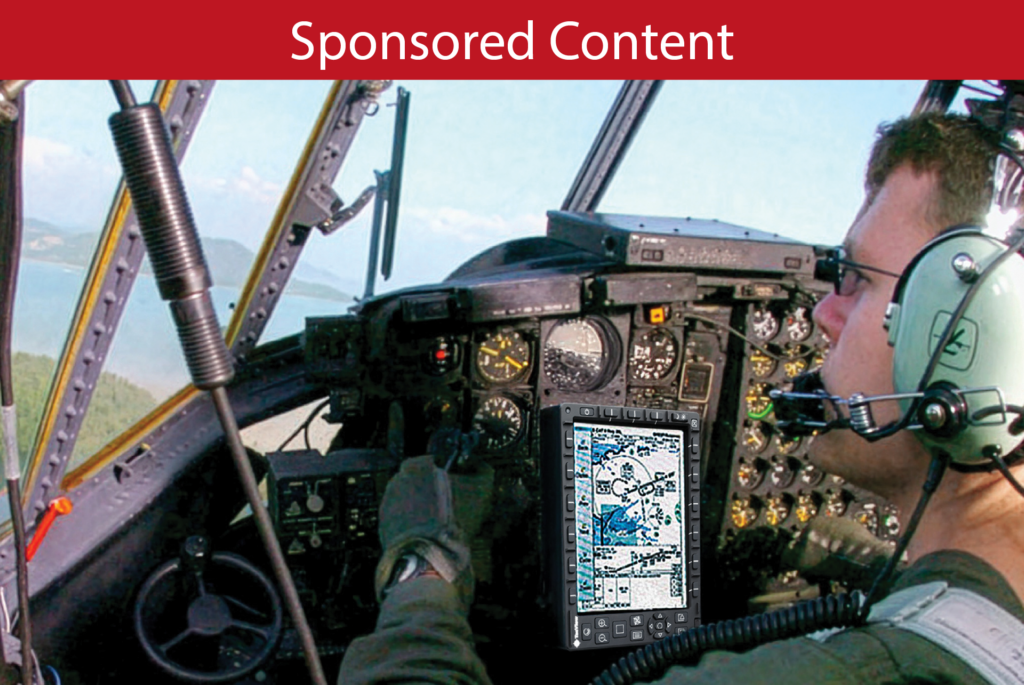
As helicopter operations become increasingly data-driven, purpose-built portable mission displays offer operators new and complementary ways to display necessary information to the pilots, support crews and therefore enable extended aircraft capabilities.
Helicopter operators are increasingly relying on digital technologies to support complex missions, improve situational awareness and provide crews with timely access to critical information. From search and rescue (SAR) and emergency medical services to offshore operations and aerial work, the ability to access and share mission information can make an important difference to operational effectiveness.
Portable displays have become a familiar feature in aviation, particularly through the widespread adoption of Electronic Flight Bags (EFBs). However, as the role of digital devices expands beyond charts and documentation to include sensor feeds, aircraft data and mission applications, the limitations of consumer-grade adapted tablets become more apparent.
The demands of helicopter operations call for something more purpose-built as a seamless extension to the existing onboard avionics.
Beyond the Electronic Flight Bag
The introduction of tablet computers transformed cockpit workflows. Pilots could replace heavy flight bags filled with paper charts, manuals and checklists with a compact digital device. Their intuitive interfaces and portability made the transition to paperless operations relatively straightforward.
But an electronic flight bag is only one application of portable technology in the cockpit.
Modern helicopter missions increasingly require access to continuous evolving real-time information, external sensor feeds, mission-specific software and connectivity with onboard systems. These requirements place demands on hardware that consumer tablets were never designed to meet.
Shock and vibration, electromagnetic interference, secure data handling and night-vision compatibility are all important considerations. Connectivity is another challenge. While Wi-Fi and Bluetooth offer convenience, they cannot always replace dedicated wired interfaces, particularly where secure communications or integration with aircraft systems is required.
Lifecycle support also deserves consideration. Consumer electronics typically follow short replacement cycles, whereas helicopters can remain in service for decades. Operators need equipment that can be supported over the long term and adapted as mission requirements evolve.
Equally important is flexibility. With support for Windows or Linux environments, TacView gives operators scope to develop and deploy mission-specific applications according to their needs. This can help accommodate evolving operational requirements without tying every new capability to a complete cockpit redesign.
 Purpose-Built for Tactical Advantage
CMC Electronics, as a native airworthy avionics designer, developed its TacView Portable Mission Display (PMD) to address these requirements. Rather than adapting a consumer tablet for cockpit use, TacView was designed natively specifically for aviation and the mission in hand, combining portable display functionality with mission computing, aircraft connectivity and security capabilities.
The system comprises the TacView PMD and an Expansion Module Unit (EMU), which provides power management and interfaces for seamless integration with aircraft systems, including MIL-STD-1553B and ARINC 429.
Its compact portrait-oriented design helps minimize cockpit space requirements, while a dedicated mounting arrangement provides secure installation. A built-in keyboard and physical controls offer tactile alternatives to touchscreen operation, an important consideration in environments where vibration and aircraft movement can make touchscreen interaction less practical.
TacView also incorporates night-vision-compatible functionality, with night mode designed to support cockpit lighting requirements.
Reliability is central to the design. Unlike consumer devices, which typically undergo relatively limited production testing, individual TacView units are subjected to extensive testing, including their interfaces under load.
The Portable Mission Display has a Mean Time Between Failures (MTBF) of 10,000+ hours, while the Expansion Module Unit has an MTBF of 41,000 hours.
Security features include hardware-based encryption and a zeroize function that can erase stored information when required. A removable storage drive provides additional flexibility for data management, backups and device transfers. TacView also supports Windows and Linux environments, giving operators flexibility to develop and deploy mission-specific applications.
One TacView. Every Mission.
The real value of a portable mission display lies in its ability to support different applications across a range of operational environments.
One example is electro-optical/infrared (EO/IR)-assisted search and rescue. Helicopters equipped with EO/IR sensor systems can use TacView to receive and display compatible sensor video feeds, bringing visual and thermal information directly to the crew through a dedicated mission display.
Through its EMU, TacView provides the interfaces needed to connect with compatible aircraft equipment and sensor systems. This allows relevant information to be presented without necessarily requiring an additional permanently installed cockpit display.
The applications extend beyond SAR. In landing operations, portable displays can provide personnel with access to landing-zone information before disembarking. Sensor imagery and mission data can also be made available to crew members in different areas of the aircraft, supporting information sharing beyond the pilot’s primary display.
TacView can also support the integration of additional capabilities into existing aircraft. For example, compatible sensor video feeds can be routed to the display, potentially reducing the need for modifications to existing cockpit displays. Its computing capabilities and flexible software environment also provide opportunities for operators to introduce applications tailored to specific missions.
The precise integration approach will depend on aircraft architecture, available interfaces and operational requirements, but the underlying principle is to make additional information and capabilities accessible without automatically undertaking extensive cockpit modifications while preserving platform avionics integrity.
 Extending the Value of Existing Aircraft
For operators managing ageing fleets or looking to introduce new mission capabilities, portable mission displays offer another approach to modernization.
Traditional avionics upgrades can involve significant engineering, installation costs and aircraft downtime. While replacing obsolete equipment remains necessary in some cases, not every new capability requires a complete cockpit redesign.
A portable mission display can provide an additional interface for information and applications, helping operators introduce selected capabilities while retaining suitable existing equipment.
This flexibility is particularly relevant as helicopter missions become increasingly connected and operators seek ways to integrate new sensors, data sources and operational applications. Rather than treating every capability enhancement as a standalone aircraft modification, operators can consider how portable computing and display technology can complement the existing avionics architecture.
TacView is designed to support this evolving environment, combining aviation-specific hardware, secure connectivity and flexible computing in a single portable system.
As helicopter operations continue to evolve, the need for accessible, reliable and adaptable mission information will only grow. Purpose-built portable mission displays provide a way to bring these capabilities into the cockpit and beyond, supporting crews and helping operators make more effective use of their existing aircraft.
For more information, visit
Images: CMC Electronics
