


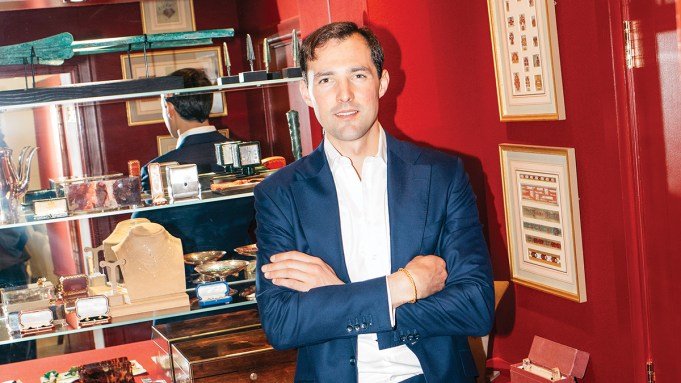
Charlie Barron has a habit of transforming curiosity into obsession. He once showed a 32-year-old tech investor a Cartier clock with no expectation of making a sale, just to share an object he found unusual. A year later, the client had already assembled a collection of 11 of them, dating from 1905 to 1925. Today, they sit arranged behind his minimalist glass desk in Mayfair: a small Belle Époque Cartier museum presiding over the spoils of the digital age. Barron sparked a fascination he never knew he had.
That conversion has become something of a specialty for Barron. His customers are largely under 40 and, until recently, have never considered buying vintage jewelry or historic clocks.
“We are engaging and educating young collectors on these wonderful, magical old pieces,” says Barron, the 31-year-old dealer whose combination of connoisseurship, access, and old-world charm is attracting a new clientele to the rarefied world of antique jewelry and objects.
It helps that most of what he’s selling has never been seen on the secondary market. Barron is a voracious buyer of fine jewels and gemstones—supplying both private collectors and the trade—and most of his inventory comes from estates across Europe. He says he deliberately avoids auction houses. “Anyone can look up what something sold for,” he says. “I prefer pieces that haven’t been seen in public.”
Cartier blue guilloché-enamel and gold clock, circa 1920.
Leo Bieber
That access is central to his business—and his reputation. “I’ll pay more than others for private collections and rare jewels, because I’m not trying to make a fortune in the short term,” he explains. “I’m interested in building long-term relationships.” Word of mouth does the rest.
Sometimes the rarities find him. In July, a young man visited Barron’s Mayfair salon hoping to buy an engagement ring. He offered his grandmother’s brooch as a trade-in. Barron immediately recognized its significance: a late-19th-century brooch with an important Colombian emerald and diamonds. He offered him 220,000 pounds (almost $300,000 at current exchange).
“People have these hidden treasures,” he says. “It’s amazing.”
Barron operates from a particularly storied perch. Although he has been dealing in jewelry through his company since he was 22, he opened his Mayfair salon on Bruton Street in 2024, taking over the former upstairs space of the late dealer Harry Fane, a celebrated authority on Cartier watches, clocks, and jewelry. The two had been doing business together before Fane’s death in 2023 at age 70.
Recently, Barron sourced another remarkable emerald, a 30-carat stone with Russian-imperial provenance, which he sold to what he describes as “one of the great contemporary jewelers.”
Some of his stock can feel like a particularly glamorous archaeological dig. His broader inventory ranges from a 12-carat emerald-cut-diamond ring by Cartier Paris and a 35-carat Colombian emerald carved as Medusa’s head from about 1800 to a Mesopotamian bead necklace and a woven-gold necklace set with 28 carats of old-mine-cushion-cut diamonds.

Cartier rose-quartz and gold clock, circa 1950.
Leo Bieber
Rarity alone isn’t enough. In fact, he often repurposes some of his most beloved pieces into his own By Barron collection, which is full of extraordinary antique diamonds and gemstones set in deliberately restrained designs to let the stones take center stage in more contemporary, highly wearable styles.
“Charlie has great taste,” says friend Joe Spiro, of jeweler Glenn Spiro. “He’s looking for pieces with a soul—objects that have life—not buying them simply because they’re old.”
Barron was 9 when he first understood how much jewels would become part of his life. His grandfather and great-grandfather were pearl merchants in Australia and Europe. On a family trip to Sydney to visit the Paspaley offices, the legendary source of luminous South Sea pearls, he was captivated by the company’s vault. It was there that he decided he wanted to follow in his family’s footsteps.
After leaving boarding school at 18, Barron traveled the world working with pearls in Japan, Australia, the Philippines, and Tahiti. He subsequently earned a gemology degree, learned diamond cutting at Royal Asscher in Amsterdam, and was later employed at a large jewelry factory in Bangkok. During that period, he shifted focus.
From left: A 1930 French-made diamond and platinum necklace; a 19th-century 35-carat Colombian emerald carved in the form of Medusa’s head.
Leo Bieber
“I used to wake up at 5 a.m. every morning, seven days a week, and I used to read books on jewelry until the factory opened at 7 a.m.,” he says. “I quickly realized that the best jewelry in the world was created a long time ago, and many of the finest stones came from antique jewelry.”
Pearls, however, remain a lifelong passion. In 2024, Barron and a few partners acquired the multimillion-pearl inventory of New York–based Assael. Today, he says, major American and European houses come to him when they need exceptional 17-to-19-millimeter South Sea pearls.
Yet it is the stories behind the jewels that seem to fascinate him most, and that enthusiasm is contagious.
“It’s incredible to think that an emerald may have traveled from Colombia to Spain, then along ancient trade routes, changing hands over centuries,” he says. “It may have belonged to a maharaja or someone in the French court. Then somehow it survives and ends up here.”
For Barron, the appeal of these pieces isn’t simply where they’ve been, but where they might go next.

