


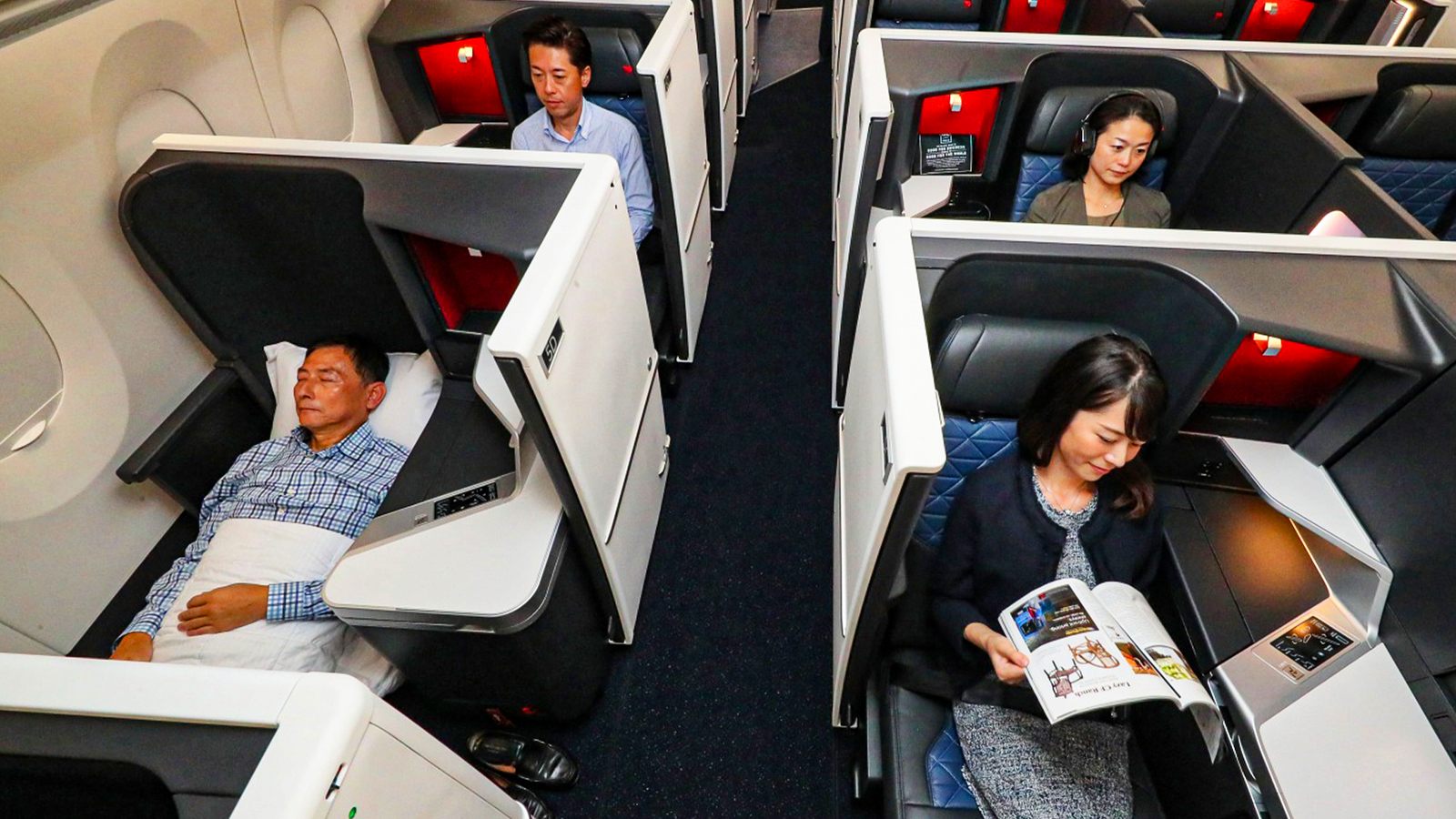
You can now buy a business class seat without buying the full package traditionally associated with business class. Delta Air Lines,  United Airlines, and JetBlue Airways have introduced lower-priced premium fares that preserve the physical seat while separating benefits once bundled into the ticket. A passenger may still receive a lie-flat seat and premium meals, but could lose advance seat selection, lounge entry, generous baggage allowances, or the ability to change plans without a fee.
The shift reflects a broader airline strategy: sell the same onboard seat at several price points, then charge according to how much flexibility and ground service a traveler wants. Delta launched Basic fares across Delta One, Premium Select, and First in July 2026. United announced Base Polaris in April, while JetBlue introduced Mint Base and is preparing its BlueFirst domestic first-class product for December. Their rules differ, and BlueFirst is a recliner product rather than a true lie-flat business class. Still, all three carriers are moving toward a model in which cabin and fare bundle are separate decisions.
Premium Cabins Are Being Unbundled

Delta Air Lines | Simple Flying
For decades, airlines generally sold business class as a package. The fare bought the seat, but also included services such as advance seat selection, lounge access, multiple checked bags, flexible changes, and higher mileage earnings. Customers could expect the most expensive cabin to include a broad set of privileges. The new structure divides that package into tiers. A base or basic fare offers a lower entry price, while standard, classic, or flex options restore extras for a higher amount. Two passengers can occupy adjacent lie-flat seats while receiving different ground benefits and ticket conditions.
The model follows unbundling in economy, where basic fares often exclude advance seat selection, checked luggage, or flexibility. Applying it to premium cabins gives airlines another way to compete on the initial price displayed in search results without discounting every component of the experience. For travelers, the headline fare is less informative than it once was. A low business-class price may suit a short trip with fixed plans and little luggage, but prove less compelling for an international journey involving connections or schedule uncertainty. Travelers must compare the fare conditions rather than rely on the cabin name.
Delta Separates Delta One From Its Fare Benefits

Delta began selling expanded premium Basic options on July 8, 2026, covering Delta First, Premium Select, and Delta One, which the airline calls Basic Business. Delta First Basic began flying on select domestic and Latin American routes in July, while Premium Select Basic and Basic Business became available for purchase for travel beginning in September. Basic Business retains the Delta One onboard experience, including a lie-flat seat, premium dining, and cabin amenities. Restrictions apply mainly to booking and airport benefits. Seats are assigned after check-in, changes and cancellations are subject to fees, and the fare is not refundable to the original payment method after the risk-free cancellation period. Customers are also ineligible for complimentary upgrades and same-day confirmed or standby changes, including those with Medallion status.
General SkyMiles members earn two miles per eligible dollar on Basic Business, compared with five on Delta One Classic and seven on Delta One Extra. Basic fares also include one fewer checked bag than the comparable Classic fare where complimentary baggage applies. Restrictions also vary between Delta’s three premium cabins. See Delta’s fare rules here.
Lounge access has a transition period. Basic Business tickets retain Delta Sky Club and Delta One Lounge access, as well as Delta One check-in, through January 18, 2027. For travel beginning January 19, those benefits are no longer included. Customers may still enter a Sky Club through a separate qualifying membership or card benefit, but Delta One Lounge access will be reserved for Delta One Classic or Extra.
United Polaris Base Keeps The Seat, Not The Full Ground Experience

United announced its premium fare tiers on April 3, 2026, introducing Base, Standard, and Flexible options for Polaris and Premium Plus on long-haul international flights, transcontinental services, and selected longer Hawaii routes. The rollout extends the tiered approach already used in Economy. Polaris Base retains the lie-flat business-class seat, but removes several benefits associated with the standard product. Advance seat selection costs extra, the fare includes one checked bag rather than two, and changes or refunds are restricted. United also excludes Base customers from its dedicated Polaris Lounges. United Club access remains available.
Standard restores complimentary seat selection, two checked bags, and the ability to make changes, while Flexible adds a fully refundable ticket. The tiers separate the onboard product from the ground experience and ticket flexibility. Travelers who mainly want a flat bed on an overnight flight may find Base sufficient, particularly if they do not need lounge access or expect to change their itinerary. Those connecting internationally with several bags may find the higher fare more practical.
United’s structure illustrates why “business class” no longer describes a single set of entitlements. Polaris Base and Polaris Flexible passengers share the cabin, but not the same airport access or ability to recover a ticket’s value if plans change. The value depends on the cost of adding each feature separately. The table below from NerdWallet breaks down the comparison well:
Amenity | Base | Standard | Flexible |
|---|---|---|---|
Seat selection | For a fee. | Included. | Included. |
Checked bags | 1 included. | 2 included. | 2 included. |
Lounge access | United Clubs. | Polaris lounges and United Clubs. | Polaris lounges and United Clubs. |
Flight changes | No. | Yes. | Yes. |
Seat upgrades | No. | Yes, to Polaris Studio for a fee. | Yes, to Polaris Studio for a fee. |
Refunds | No. | No, but eligible for travel credit. | Yes, to original method of payment. |
JetBlue Makes Mint More Modular, While BlueFirst Adds Another Tier

JetBlue’s Mint Base is a lower-priced version of its lie-flat business-class product. The fare includes the Mint seat, premium dining, early boarding, priority security, and one checked bag. Standard Mint and Mint Flex include two checked bags. Mint Base does not include complimentary advance seat selection or BlueHouse lounge access at New York’s JFK and Boston Logan (BOS) airports.
Seat selection on Mint Base begins 24 hours before departure. Changes and cancellations also carry fees; cancellations produce a travel credit minus the applicable charge. Standard Mint provides advance seat selection and a travel credit for eligible cancellations, while Mint Flex adds a refund to the original form of payment and more generous same-day flexibility. JetBlue lists one TrueBlue point per dollar for Mint Base, against three per dollar for Mint and Mint Flex, before applicable booking bonuses.
JetBlue is extending the same fare architecture to BlueFirst, its new domestic first-class product. BlueFirst is not Mint and does not have a lie-flat seat. It uses wide recliners in a two-by-two layout, with additional legroom, complimentary food and drinks, and priority airport services. The first revenue service is scheduled for December 8, 2026, between Boston and Fort Lauderdale, with additional routes planned. BlueFirst Base includes one checked bag, while standard and Flex versions include two. Seat selection is complimentary within 24 hours of departure on Base, whereas advance selection is included in the higher tiers. Changes and cancellations are subject to fees on Base; Flex adds refunds to the original payment method and fee-free same-day switches or standby. JetBlue is extending fare segmentation across its premium portfolio.
The Real Price Depends On The Benefits A Passenger Needs

The three airlines have adopted a similar commercial idea, but their restrictions differ enough that comparing fares by the word “Base” can mislead. Delta Basic Business reduces mileage earnings, removes advance seat selection, restricts same-day changes, and eventually excludes lounge access. United Polaris Base preserves United Club entry but removes Polaris Lounge access, charges for seat selection, and reduces the baggage allowance. JetBlue Mint Base removes BlueHouse access and advance seat selection, while keeping priority security and one checked bag.
A passenger who values a specific seat may need to add the selection fee. Someone traveling with two checked bags should account for the extra bag charge, while a traveler with uncertain plans should compare potential change or cancellation fees against the price difference for a more flexible fare. Delta also says certain eligible SkyMiles American Express cardholders retain baggage benefits, and JetBlue Mosaic members and other eligible cardholders continue to receive applicable benefits.
The strategy changes how premium cabins compete. Rather than lowering every business-class ticket, airlines can advertise a cheaper entry point while protecting higher-yield fares from customers who need flexibility, lounge access, or additional baggage. This may make premium seats accessible to more price-sensitive travelers, but it also risks disappointing customers who interpret the cabin label as a promise of the traditional package. Booking disclosures must clearly explain those differences.

JetBlue Airways, Simple Flying
Delta, United, and JetBlue are reshaping premium travel around a separation between the seat and the services attached to it. The lie-flat bed or wide recliner remains the central product, while lounge access, baggage, seat selection, and flexibility become fare-level choices. For passengers, value depends on itinerary, loyalty benefits, and the likelihood that plans will change.
The next competitive test will be whether airlines make these differences clear enough for customers to compare total value before paying. Booking platforms may need clearer comparisons of lounge eligibility, refund rules, seat assignment, and baggage allowances. Airlines that make the trade-offs transparent can sell a lower-priced premium experience without undermining trust. Those that emphasize the cabin while obscuring restrictions risk turning an attractive fare into an expensive surprise.
RIGHT NOW
Follow the sky’s most interesting moments, live
Holds, diversions and rare aircraft, spotted as they happen. Free, no signup.
Open the tracker
