


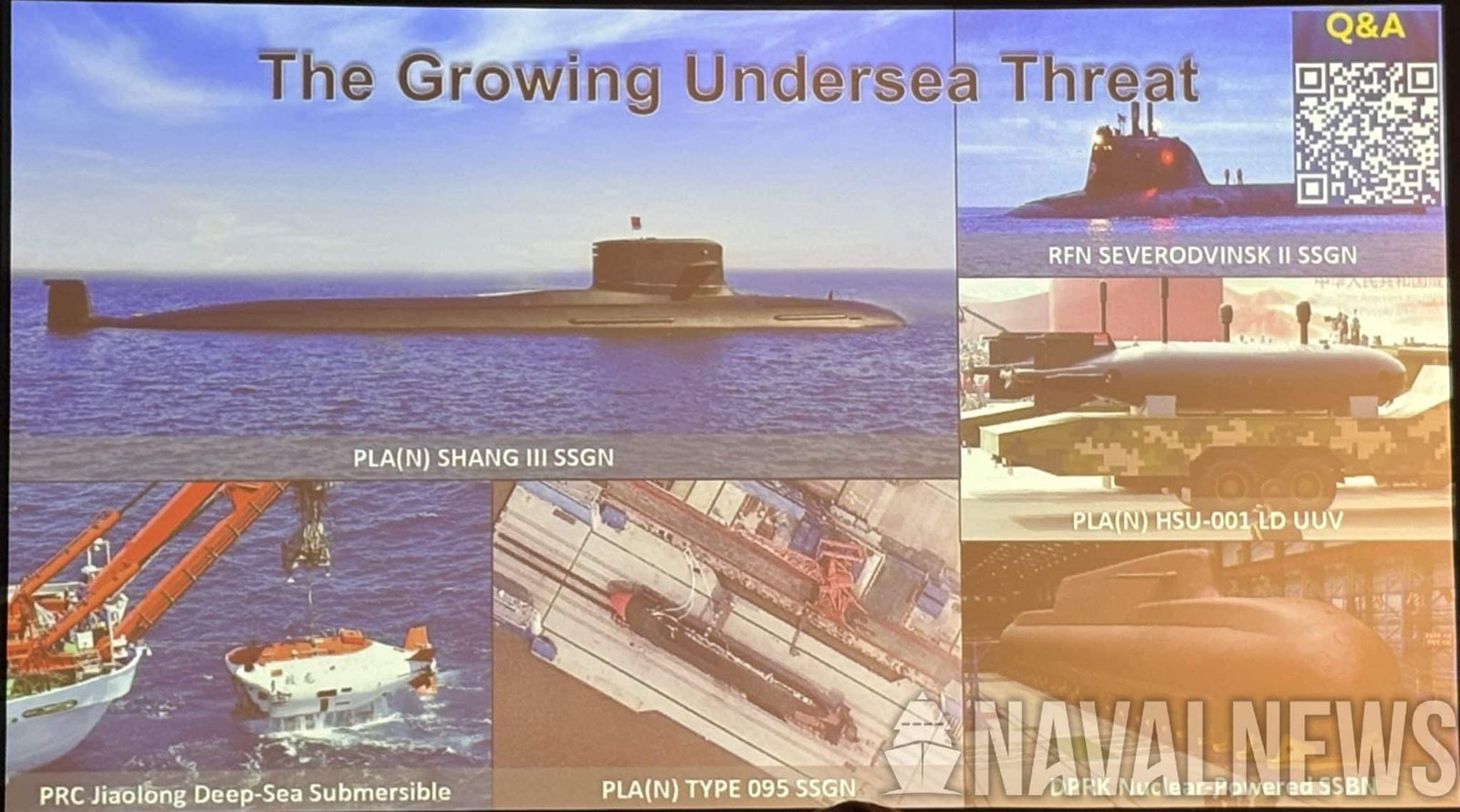
In a series of talks at the Navy Submarine League’s 2026 Annual Symposium, Rear Admiral Chris Cavanaugh (Commander, Submarine Forces, U.S. Pacific Fleet – COMSUBPAC) spoke on the state of adversary developments and activities in the Pacific, highlighting the critical threats facing the U.S. Navy’s submarine fleet.
PLAN Submarines

RADM Cavanaugh reaffirmed the People’s Republic of China’s People’s Liberation Army Navy (PLAN) position as the top threat in the Indo-Pacific region when considering challenges to America’s undersea dominance, representing the one of most innovative forces facing down the U.S. Navy. However, in this instance, the Cavanaugh shed greater light on the reasoning behind China’s appraisal as the primary adversary in the undersea domain.
A large element of China’s threat picture stems from the sheer rate at which the PLAN is able to put hulls in the water, with 8 Type 093B (Shang III) type Nuclear Fast Attack Submarines (SSNs) entering service in under 4 years. RADM Cavanaugh also gave credence to U.S. assessments regarding Chinese SSN production, which stipulate that a similar rate of production is sustainable by PLAN yards for at least a decade, with 20-40 Shang III or improved SSNs potentially reaching service in that timeframe.
Cavanaugh further stated that the Shang III represents a serious qualitative improvement over previous Chinese SSNs, featuring advanced quieting techniques, a Vertical Launch Cell bank of 24 cells, and significant changes to the propulsion method. These improvements produced a qualitative jump to such an extent that the Shang IIIs could be considered an entirely new class of submarine.
“It points to the idea that China is ready to iterate. They build Shang, they build Shang III, and they’re onto the next thing. And I would argue that iteration itself has a quality on its own.”
– Rear Admiral Chris Cavanaugh, Commander, Submarine Forces, U.S. Pacific Fleet.
In regards to further developments, the U.S. sub force closely monitored processes surrounding the Type 095, China’s prospective nuclear guided missile submarine, pointing to its addition of X-form rudders and pump jet propulsion not as complete upsets, but as demonstrative of a tangible trend of innovation and risk absorption by the Chinese submarine force. Alongside the 095, the U.S. also follows the development of the Type 096 and Type 094 classes of nuclear ballistic missile submarines (SSBNs), representing key developments in China’s nuclear triad and second strike capability.
Perhaps most critical, the U.S. sub force assessed the continual buildup of supporting infrastructure needed to build out and support an increasingly large and qualitatively advanced Chinese nuclear fleet. Cavanaugh also noted improvements in doctrine match any build outs of supporting infrastructure and the fleet itself, with the Chinese continually improving in their usage of nuclear submarines at a strategic and tactical level.
Other PLAN Activities
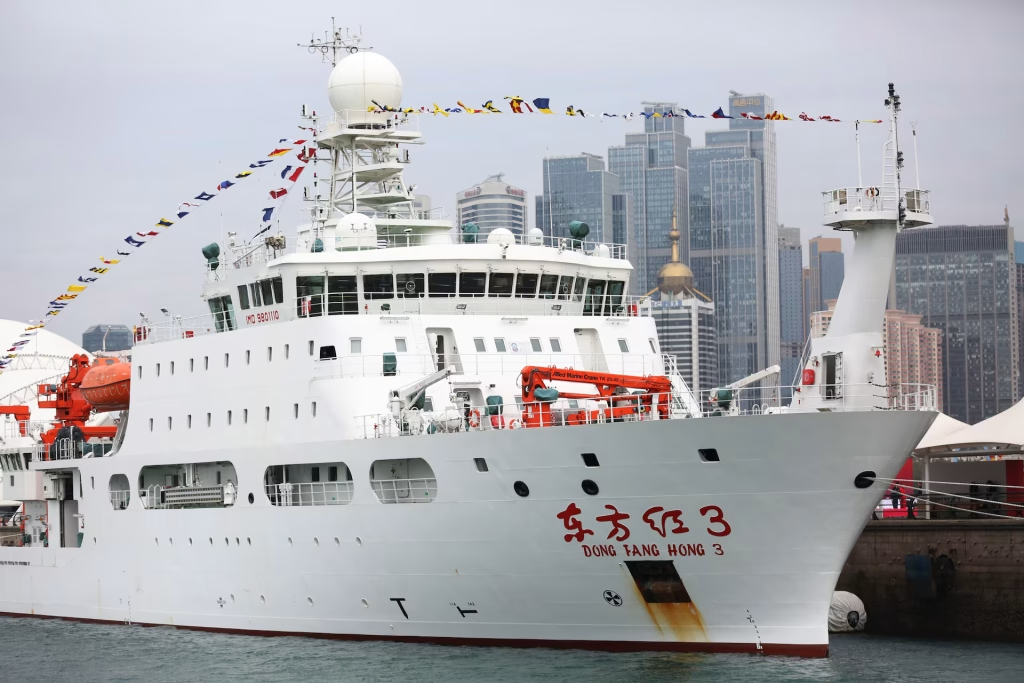
Following his assessment of the PLAN submarine threat, RADM Cavanaugh further highlighted PLAN efforts to better prepare its undersea force for any potential conflict, with oceanographic research, surveying, and mapping playing a large part of this component in PLAN preparations for any potential conflict with the United States or its allies.
In particular, Cavanaugh confirmed a Reuters report which detailed Chinese undersea research efforts dedicated in part to mapping key operational areas near the Philippines, Taiwan, Guam, and Hawaii, including ingress and egress routes near large submarine bases in the latter two locations. Whilst these mapping efforts and the Chinese-linked vessels conducting them possess valid scientific rationale for their presence under international law, the Navy assesses this research as a vital step in preparing any undersea battlefield.
Combined with increased Chinese investments across the board in Unmanned Underwater Vehicles (UUVs), their support ships, and other submersibles, the Navy assesses the Chinese approach to be more holistic in nature, identifying, laying out, and executing key steps in an organized manner to improve the sub-sea force in all aspects. The U.S. Navy assesses that all of these steps, including mapping efforts, expansion of the Chinese submarine industrial base, and continual iteration coalesce into a methodical approach designed to eventually level the playing field in the undersea domain.
Russian Efforts

After the PLAN, Cavanaugh highlighted Russia as the next key adversary facing America under the Pacific’s waves, presenting a somewhat different threat profile. At the top of the list includes Russia’s continual investment into its at-sea strategic deterrent, presenting mostly in the form of newer Project 955 Borei-class (also known as the Yury Dolgorukiy-class) of SSBNs, with both baseline Project 955 and newer Project 955A standard boats under Russian Pacific Fleet operation.
“If you saw a graph of undersea defense threats, they’re growing rapidly. I’m talking about SSGNs, SSBNs, with Russia and China combined. And so that has significant implications for our ability to maintain domain awareness with our own force structure.”
– Rear Admiral Chris Cavanaugh, Commander, Submarine Forces, U.S. Pacific Fleet.
Cavanaugh also briefly highlighted another leg of Russia’s undersea strategic deterrent in the Poseidon nuclear XLUUV (also known as Status-6) as an unconventional threat profile that the U.S. Pacific submarine force would have to grapple with. Amongst the slides, alluded to was the threat presented by Russia’s Yasen or Severodvinsk-class of SSGNs, presenting an extremely quiet class of boats capable of carrying dozens of hypersonic or cruise missiles within close proximity to the U.S.’s coast.
Combined with continued and dedicated Russian undersea efforts, Cavanaugh stressed that Russia’s consolidation of newer sea-based nuclear deterrents and continued investments into its submarine fleet still makes it a potent threat, especially when considered in conjunction with the Chinese fleet. Additionally, even as the Russian surface fleet continues to succumb to aging vessels and budget constraints, the Russian sub force will likely remain an important consideration for the threats facing U.S. undersea dominance.
Last but Not Least: North Korea

North Korea’s threat profile came at the tail end of Cavanaugh’s remarks on the threats facing the U.S. submarine force and sub-sea efforts. Whilst North Korean advancements were of note, in the eyes of the U.S. Navy and its top brass, the substance backing Pyongyang’s claims remains to be seen. Despite this, any potential North Korean advancements list as increasingly consequential, especially considering the domain of at-sea nuclear capabilities.
The recently revealed North Korean SSBN as well as suspected claims of advancement in torpedo and propulsion technology depict the main subjects noted in Cavanaugh’s remarks. Whilst the U.S. Navy currently withholds any final judgements on validity of the claims surrounding North Korean improvement, Cavanaugh noted that these developments represent part of an increasingly dense under-sea threat environment coming from three different countries, each with their own intricacies.
