


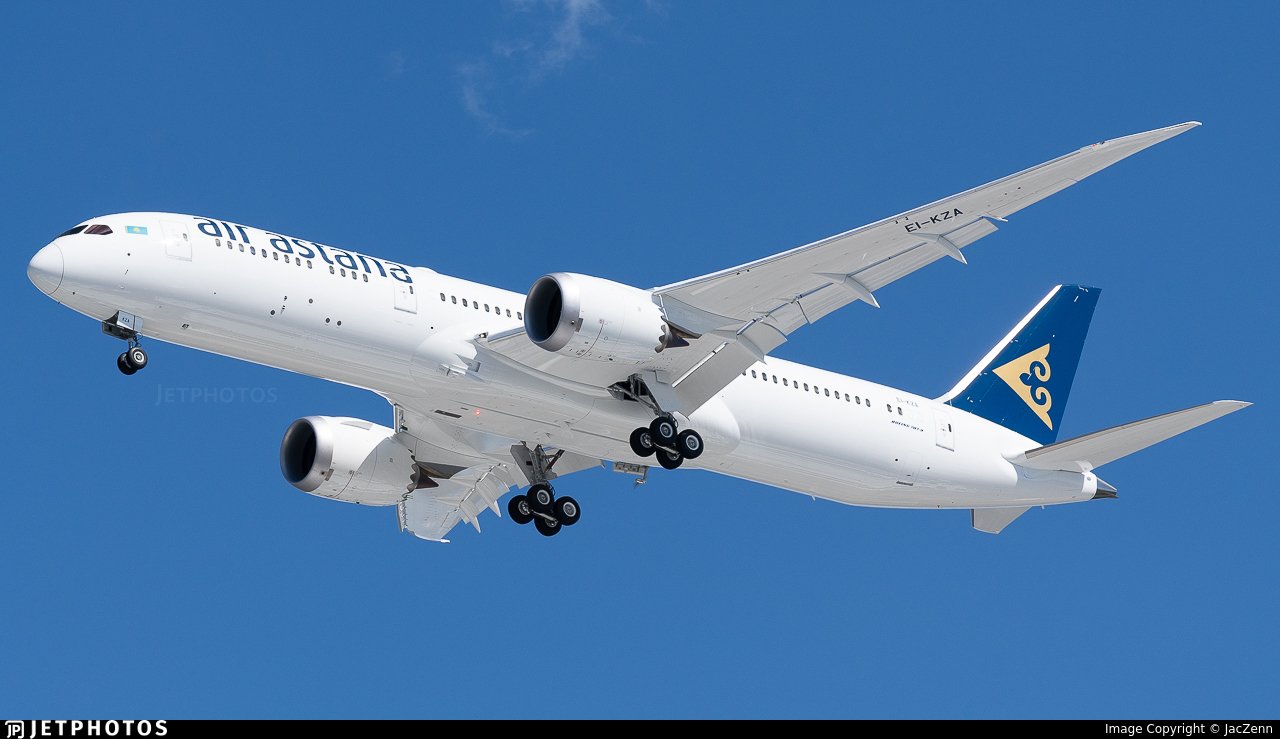
Air Astana (KC-KZR) has ushered in a new era in its history: the Boeing 787 Dreamliner. With a primary hub in Almatý and a secondary base in Astana, the Kazakh flag carrier will soon add its first Dreamliner to its fleet. The aircraft has already made its maiden flight in the United States and is awaiting its delivery flight bound for Kazakhstan. This marks the second wide-body model in the airline’s history, following the Boeing 767, and it is set to enter scheduled service in early 2027.
A new airline
In late 2001, the Kazakh government, in partnership with the British company BAE Systems, founded Air Astana, an airline that would eventually become the country’s flag carrier. By then, the existing national carrier, Air Kazakhstan, was facing a severe financial crisis that would force it to cease operations in February 2004. Established by the government in March 1997, Air Kazakhstan had itself succeeded Kazakhstan Airlines, the original post-Soviet carrier formed from the local assets of Aeroflot following the dissolution of the USSR.
Although Air Kazakhstan was still in operation, Air Astana made its first-ever flight on May 15, 2002, between the economic capital, Almaty, and the country’s capital, Astana. The carrier launched with an initial fleet of just two six-month-old Boeing 737s—a 737-8Q8 (P4-BAS) and a 737-7Q8 (P4-CAS)—both previously operated by US-based Sun Country Airlines.
Air Astana ended 2002 with three aircraft in its fleet, following the addition of another nearly new, two-month-old Boeing 737-700. In 2003, the introduction of its first Boeing 757-200s enabled the carrier to expand into Russia, the Middle East, and Europe, establishing its Almaty hub as a primary gateway connecting Europe and Central Asia.

New routes and aircraft
Moscow and London were two of its main early international destinations—the Russian capital due to deep historical and commercial ties, and the British capital because of the equity stake held by BAE Systems alongside strong interest from British oil investors in Kazakhstan. Amsterdam, Beijing, Dubai, and Frankfurt were added shortly thereafter, and all remain part of its network today with the exception of Amsterdam. Beyond these key long-haul links, the airline’s core network remains heavily focused on Asia.
The Boeing 757-200s had already enabled Air Astana’s international expansion, but the arrival of its first wide-body aircraft—two Boeing 767-300ERs—allowed the airline to further strengthen its network. Registered as P4-KCA and P4-KCB, these aircraft joined the fleet in early 2007 and were retired in 2014. However, the type was not retired from service, as the carrier took delivery of three brand-new 767-300ERs between 2013 and 2014, which continue to operate for the airline today.

Short-haul fleet
Starting in 2007, the Boeing 737-700 and Boeing 737-800 were replaced by the Airbus A320 and Airbus A321, which became the workhorses of its short-haul network. Over the years, the carrier also operated several other narrow-body and regional types, including the Airbus A319, Fokker 50 turboprop, Embraer 190, and Embraer E190-E2—the latter arriving factory-new between 2018 and 2020 but was finally phased out in 2024.
Since 2014, Air Astana has operated the same wide-body fleet, making it the last airline in the world to take delivery of brand-new passenger Boeing 767s. Even though plans to introduce a newer wide-body type were already under discussion at the time, the airline opted to induct Airbus A321LR aircraft into its fleet beginning in 2019. These narrow-body jets took over most of its long-haul network, including all of its services to Europe and several routes across Asia.

The first Dreamliner
Air Astana is set to add its first Boeing 787-9 Dreamliner to its fleet, marking the arrival of the first aircraft of its type in Kazakhstan. However, the airline’s history with the Dreamliner began more than a decade ago—specifically in 2012—when it placed an initial order with Boeing to acquire 787s. Due to internal restructuring, shifting market conditions, and production delays at Boeing, deliveries were repeatedly postponed until now.
Following an initial commitment announced in November 2025, Air Astana finalized an order in February 2026 for up to 15 Boeing 787-9 Dreamliner aircraft. This deal became the largest single aircraft purchase in the airline’s history, as well as in Kazakhstan. The carrier is set to take delivery of its first leased 787-9 before the end of the year.

The first 787 flight
On October 1, the Boeing 787-9 Dreamliner bearing Manufacturer Serial Number (MSN) 66876 completed its first flight, marking the start of a new era for the Kazakh airline. The jet departed from Charleston and landed back at the same airport after a two-and-a-half-hour test flight. Six days later, the aircraft, with registration EI-KZA, flew its second leg—and its last as of this writing—from Charleston to Kelly Field in San Antonio, where Boeing operates dedicated completion facilities for its 787 Dreamliners.
The arrival of the state-of-the-art Boeing 787-9 Dreamliners will allow Air Astana to gradually retire its aging Boeing 767-300ER fleet, which currently averages 13 years of age. Combined with the three aircraft secured through lessors, the 15-jet Boeing deal brings the airline’s total Dreamliner commitment to 18 aircraft, all of which are expected to join the fleet by 2035—with the bulk of deliveries taking place over the next five to nine years.
Air Astana plans to expand its route network with the introduction of the Dreamliners, both in its existing markets—Asia, Europe, and the Middle East—and potentially in North America, particularly the United States, which would consolidate Kazakhstan’s position as a logistical bridge between continents. As of this writing, Kazakhstan has no nonstop flights to the Americas.

Routes
Astana and Almaty are Kazakhstan’s two largest cities, with Air Astana operating a hub in each. Almaty, the country’s economic center, serves as Air Astana’s primary base and the nation’s busiest international gateway. Meanwhile, Nursultan Nazarbayev International Airport, located in the Kazakh capital, Astana, plays a key strategic role as the carrier’s secondary hub.
According to our database, Air Astana operates 31 scheduled routes to and from Almaty and 22 to and from Astana, deploying its Airbus A320 and A321neo aircraft at both hubs. The Boeing 787-9 Dreamliners are expected to be based in Almaty, as is the case with its current Boeing 767-300ERs, although flights from Astana remain a possibility.
Almatý

| Country | City | Flight(s) | Aircraft |
|---|---|---|---|
| Azerbaijan | Baku (GYD) | 2 weekly | A320 / A321 |
| China | Beijing (PEK) | 5 weekly | A320 / A321 |
| Guangzhou (CAN) | 5 weekly | Boeing 767-300 | |
| Shanghai (PVG) | 3 weekly | A320 / A321 | |
| Urumqi (URC) | 7 weekly | Airbus A320neo | |
| Egypt | Sharm-el-Sheikh (SSH) | 1 weekly | Airbus A321neo |
| Georgia | Tbilisi (TBS) | 7 weekly | Airbus A321neo |
| Germany | Frankfurt (FRA) | 2 weekly | Airbus A321neo |
| India | Delhi (DEL) | 11 weekly | A320 / A321 |
| Mumbai (BOM) | 3 weekly | A320 / A321 | |
| Kazakhstan | Aktau (SCO) | 7 weekly | A320 / A321 |
| Aktobe (AKX) | 7 weekly | A320 / A321 | |
| Astana (NQZ) | 84 weekly | A320 / A321 | |
| Atyrau (GUW) | 12 weekly | A320 / A321 | |
| Kyzylorda (KZO) | 7 weekly | Airbus A320 | |
| Oral (URA) | 3 weekly | Airbus A320 | |
| Oskemen (UKK) | 9 weekly | Airbus A320 | |
| Shymkent (CIT) | 9 weekly | A320 / A321 | |
| Kyrgyzstan | Bishkek (BSZ) | 9 weekly | Airbus A320 |
| Maldives | Male (MLE) | 6 weekly | Airbus A321neo |
| Oman | Salalah (SLL) | 1 weekly | Airbus A320 |
| South Korea | Seoul (ICN) | 7 weekly | Boeing 767-300 |
| Tajikistan | Dushanbe (DYU) | 4 weekly | A320 / A321 |
| Thailand | Bangkok (BKK) | 7 weekly | Airbus A321neo |
| Phuket (HKT) | 7 weekly | Airbus A321neo | |
| Turkey | Antalya (AYT) | 5 weekly | Airbus A321neo |
| Istanbul (IST) | 7 weekly | Airbus A321neo | |
| United Arab Emirates | Dubai (DXB) | 12 weekly | A320/A321/767 |
| United Kingdom | London (LHR) | 2 weekly | Airbus A321neo |
| Uzbekistan | Tashkent (TAS) | 17 weekly | A320 / A321 |
| Vietnam | Phu Quoc (PQC) | 5 weekly | Airbus A321neo |
Astana

| Country | City | Flight(s) | Aircraft |
|---|---|---|---|
| China | Beijing (PEK) | 3 weekly | A320 / A321 |
| Guangzhou (CAN) | 2 weekly | Boeing 767-300 | |
| Sanya (SYX) | 3 weekly | Airbus A321neo | |
| Egypt | Sharm-el-Sheikh (SSH) | 2 weekly | Airbus A321neo |
| Germany | Frankfurt (FRA) | 5 weekly | Airbus A321neo |
| Kazakhstan | Aktau (SCO) | 5 weekly | A320 / A321 |
| Aktobe (AKX) | 6 weekly | A320 / A321 | |
| Almaty (ALA) | 84 weekly | A320 / A321 | |
| Atyrau (GUW) | 11 weekly | A320 / A321 | |
| Kyzylorda (KZO) | 3 weekly | Airbus A320 | |
| Oral (URA) | 4 weekly | Airbus A320 | |
| Oskemen (UKK) | 7 weekly | Airbus A320 | |
| Shymkent (CIT) | 3 weekly | A320 / A321 | |
| Maldives | Male (MLE) | 6 weekly | Airbus A321neo |
| Oman | Salalah (SLL) | 1 weekly | Airbus A320 |
| South Korea | Seoul (ICN) | 3 weekly | Boeing 767-300 |
| Thailand | Phuket (HKT) | 7 weekly | Airbus A321neo |
| Turkey | Antalya (AYT) | 2 weekly | Airbus A321neo |
| Istanbul (IST) | 5 weekly | Airbus A321neo | |
| United Arab Emirates | Dubai (DXB) | 10 weekly | A320 / A321 |
| Uzbekistan | Tashkent (TAS) | 2 weekly | A320 / A321 |
| Vietnam | Phu Quoc (PQC) | 5 weekly | Airbus A321neo |
Kazakhstan’s leading carrier operates other international routes from cities beyond Almaty and Astana. As you can see in our database, Air Astana offers weekly service between Oral and Frankfurt with Airbus A321neo aircraft, and two flights per week connecting Atyrau and Baku using a mix of A320s and A321s.
Air Astana’s international network will see two new routes added in the coming weeks: the launch of the Almaty–Tokyo flight on November 30, followed by the Astana–Bangkok service on December 11. Both routes will be operated with Airbus A321LR aircraft. For the first time in its history, the airline will offer scheduled flights to Japan.

Fleet
As of this writing, Air Astana has 36 aircraft in its fleet, which totals 64 when including the 28 aircraft operated by FlyArystan, another Kazakh airline that is part of the BAE Systems group. It is based in Almaty and Astana and operates 180-seat Airbus A320neo aircraft.
| Aircraft | Total | Config | Average age |
|---|---|---|---|
| Airbus A320neo | 11 | C16Y132 | 5 years |
| Airbus A320neo | 28 | Y180 | 8 years |
| Airbus A321-200 | 3 | C28Y151 | 14 years |
| Airbus A321-271N | 4 | C28Y151 | 8 years |
| Airbus A321-271NX | 4 | C28Y156 | 1 year |
| Airbus A321-271NX | 11 | C28Y150 | 5 years |
| Boeing 767-300(ER) | 3 | C30Y193 | 13 years |
| Boeing 787-9 Dreamliner | 1 | 303 passengers | Brand new |
FlyArystan (FS/AYN) offers domestic flights within Kazakhstan and international routes, all operated by its Airbus A320neo fleet. The airline serves China, Georgia, India, Turkey, and Uzbekistan, operating international flights from Aktau, Almaty, and Astana.

Cover photo: © Johnson541 – JetPhotos (Charleston, United States)
The post Air Astana adds first Boeing 787 to its fleet appeared first on Flightradar24 Blog.
