



Munich-based startup uses drones to monitor live power lines, helping utilities identify weak points and make better use of existing grid capacity.
Munich-based drone technology company Nomadic has raised $6 million in seed funding to expand its power line monitoring system. The company’s drones can land on live high-voltage lines, recharge from them, and collect data about grid conditions.
Foundamental led the funding round, with participation from Verve Ventures, Cyan Ventures, existing investors Outlander VC and Asia2G Capital, and angel investors from the sdw alumni network.
Nomadic says its drones have logged more than 20,000 hours on live power lines. The technology is operating on German transmission and distribution grids, with deployments in Norway and the United States.
How Drones Can Help Utilities Monitor Power Lines
Power utilities face growing demand from data centers, renewable energy projects, and industrial facilities. Building new transmission lines takes time and requires significant investment. As a result, utilities are looking for ways to carry more electricity over existing infrastructure without compromising safety.
Current grid models use weather data and other information to estimate how much electricity a power line can safely carry. However, conditions can vary along the same line.
Older components, connections, and local weather can affect individual sections. The weakest section may limit the capacity of the entire line.
Traditional monitoring systems rely partly on fixed sensors. Installing these devices can require crews, specialized equipment, and planned outages. Once installed, the sensors remain in one location.
Nomadic’s system takes a different approach.
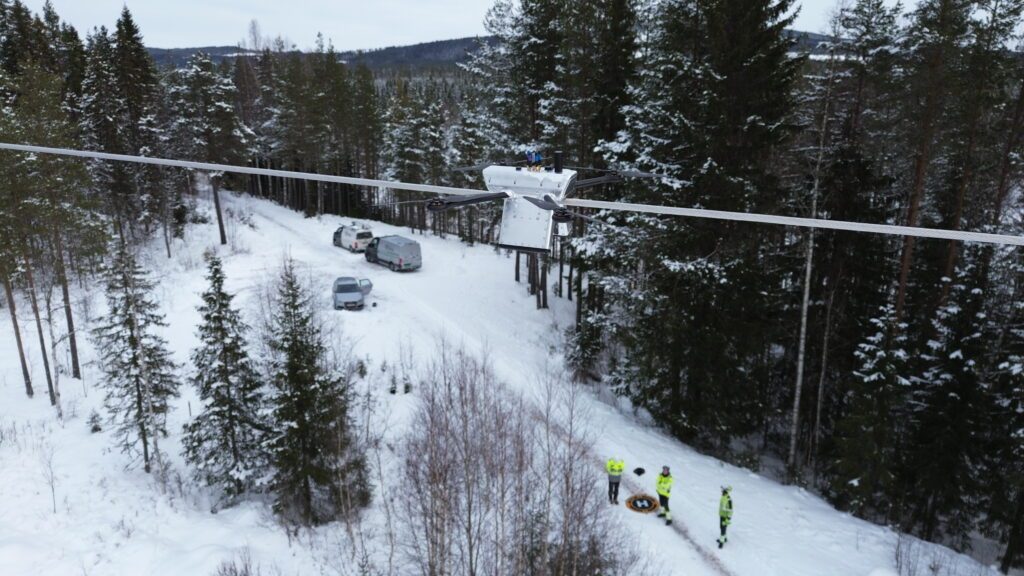
The company’s drones, called NOMADs, weigh approximately 4 kilograms (8.8 pounds). They can land directly on energized conductors without shutting down the line. Once attached, they recharge through induction, drawing energy from the magnetic field around the conductor.
According to Nomadic, a single drone can cover approximately 25 kilometers of power line. By comparison, utilities typically install fixed sensors at intervals of 1 to 5 kilometers.
“Grid operators often have a good picture of what happens at each substation. Everything in between, along kilometers of line, has been much harder to see, because installing anything on a live line is very difficult,” said Andreas Moldskred, CEO and co-founder of Nomadic. “NOMADs land on the line, charge from it and move to where they are needed. Nomadic OS turns those measurements into the physical context layer for the power grid.”
Combining Drone Data With Grid Monitoring Software
The drones work with Nomadic OS, the company’s monitoring software. The platform combines drone measurements with weather models, grid models, and historical power line data.
This information helps utilities understand conditions along individual sections of a line. It can also help operators identify potential problems and determine how much electricity their existing infrastructure can safely carry.
The approach could help utilities use capacity that conventional estimates may leave unavailable.
Unlike conventional inspection drones that return to a base for battery charging, NOMADs can remain on power lines and draw energy from them. This allows the system to support extended monitoring without frequent battery changes.
Utility drone pilots currently bring the devices to the installation site. Nomadic says they can deploy the drones within minutes without a planned line outage.
The company is also developing the ability for drones to relocate independently between sections of the grid. Operators would direct those movements remotely from their offices.
Technology Tested on High-Voltage Lines
Nomadic reports that its system has operated in temperatures as low as minus 25 degrees Celsius (minus 13 degrees Fahrenheit). The drones have also operated on lines carrying up to 420 kilovolts.

The company began deploying prototypes in German distribution grids approximately one year ago.
“Landing on a line carrying up to 420 kV, in wind and at minus 25 degrees, and then running on power from the magnetic field around it, is a hard robotics problem,” said Lauritz Weil, CTO and co-founder of Nomadic. “We built our own test grid with real conductors and high currents, so every version is tested under real conditions before it reaches a customer’s line. We are looking for more passionate problem solvers to join us on this mission.”
Funding Will Support Expansion in Europe and the US
Nomadic plans to use the new funding to expand its drone fleet and work with additional utility customers in Europe and the United States.
The company also expects to introduce remote drone relocation into production with customers in 2027. Additional investment will support growth of its Munich-based team.
Founded in 2024 at the University of California, Berkeley, by Moldskred and Weil, Nomadic is now headquartered in Munich.
The company’s technology reflects a growing role for drones in utility operations. While many utility drones capture images during scheduled inspections, Nomadic’s system aims to provide ongoing measurements directly from energized infrastructure.
By combining mobile sensors with grid monitoring software, the company hopes to help utilities identify problems earlier and use existing power lines more efficiently.
More information is available at Nomadic’s website.
Read more:

Miriam McNabb is the Editor-in-Chief of DRONELIFE and CEO of JobForDrones, a professional drone services marketplace, and a fascinated observer of the emerging drone industry and the regulatory environment for drones. Miriam has penned over 3,000 articles focused on the commercial drone space and is an international speaker and recognized figure in the industry. Miriam has a degree from the University of Chicago and over 20 years of experience in high tech sales and marketing for new technologies.
For drone industry consulting or writing, Email Miriam.
TWITTER:@spaldingbarker
Subscribe to DroneLife here.
