


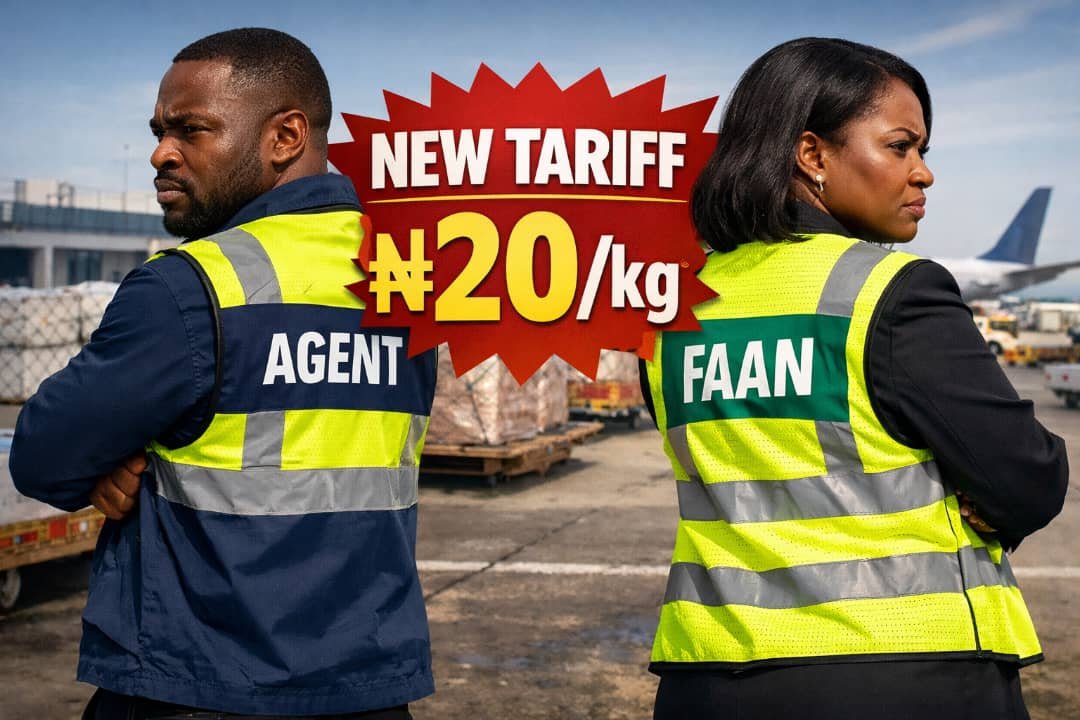
….exposes trust gap between FAAN and operators
Nigeria’s aviation cargo corridor is once again caught in a storm, one that exposes the fragile balance between economic reform and stakeholder trust.
At the heart of the dispute is the Federal Airports Authority of Nigeria’s, FAAN, decision to raise cargo charges from ₦7 to ₦20 per kilogram at Murtala Muhammed International Airport, Lagos, an increase that has ignited protests, halted operations and reopened long-standing grievances between airport authorities and freight forwarders.
The new tariff, which came into force on February 2, 2026, was designed, according to FAAN and its supporters, as part of a broader effort to modernize airport infrastructure and align Nigeria’s aviation system with global standards.
But for freight forwarding associations operating within the airport ecosystem represented recently at a news conference in Lagos by Mr. Temitope Akindele and Dr. Segun Musa, the increase represents more than a financial adjustment; it is viewed as a unilateral decision that reawakens decades of mistrust.
For leaders of freight forwarding groups, including the National Association of Government Approved Freight Forwarders (NAGAFF), Association of Nigerian Licensed Customs Agents (ANLCA), Africa Association of Professional Freight Forwarders and Logistics (APFFLON), and National Association of Freight Forwarders and Consolidators (NAFFAC), the controversy is rooted in history.
Their argument stretches back to 2005 when FAAN demolished operational facilities built by freight operators, allegedly worth about ₦150 million, leaving them without working space for years.
Mr. Akindele recall that tensions were later eased in 2010 when both parties negotiated an increase in cargo charges from ₦2 to ₦7 per kilogram, reportedly tied to land allocation for operational facilities. To them, that agreement was not merely financial but symbolic, an understanding that tariff adjustments must be tied to dialogue and shared benefit.
Now, freight forwarders insist the sudden leap to ₦20 per kilogram violates both precedent and fairness. They argue that federal guidelines traditionally limit tariff reviews to about 25 percent, while the new increase, which they calculate at roughly 185 percent, threatens the viability of cargo operations.
Dr. Musa also accuse FAAN of failing to consult major industry players before implementing the policy and warn that multiple existing charges from airlines, handling companies and other agencies already stretch cargo operators and importers.
Their protest, which included a temporary withdrawal of services, has reportedly led to significant revenue losses and operational delays at the country’s busiest cargo airport.
Yet FAAN and its defenders present a sharply contrasting narrative. To them, the adjustment is not only justified but overdue. Supporters of the policy argue that cargo charges have remained virtually stagnant for nearly two decades despite soaring inflation, currency depreciation and escalating security and infrastructure costs.
By their calculations, maintaining the real value of the 2008 tariff would place current charges closer to ₦27 per kilogram, meaning the new ₦20 rate still falls below inflation-adjusted realities.
They further insist the revised charges are crucial to funding sweeping reforms across Nigeria’s cargo airports. These include rehabilitation of dormant cargo warehouses, introduction of biometric access systems, development of new cargo terminals and planned infrastructure upgrades designed to ease congestion and enhance security.
Without such revenue streams, proponents warn, Nigeria risks falling further behind regional aviation hubs like Accra, Addis Ababa and Kigali, where sustained investment has strengthened cargo capacity and trade competitiveness.
Beyond the economic arguments lies a deeper institutional tension: the question of consultation and trust.
Freight forwarders insist they were excluded from meaningful engagement, while FAAN maintains that several meetings were held with industry stakeholders and that disagreements may reflect internal divisions within freight forwarding unions themselves.
This raises a difficult but unavoidable question: can policy reforms succeed in an environment where stakeholders dispute both the process and the legitimacy of engagement?
Another unresolved issue concerns the nature of FAAN’s role in the cargo value chain. Freight forwarders argue that airport authorities function primarily as infrastructure landlords and should deal directly with concessionaires rather than agents who receive limited direct services.
FAAN, however, views the cargo ecosystem as a shared operational environment where all participants benefit from infrastructure, security and regulatory oversight funded through user charges.
The dispute also raises broader economic concerns. Freight operators warn that higher cargo charges could ultimately be transferred to importers, exporters and consumers, potentially inflating the cost of goods and weakening trade competitiveness.
Conversely, aviation authorities argue that failing to invest in infrastructure could produce even greater economic losses by discouraging international cargo carriers and undermining export growth.
Both sides therefore face pressing questions. For freight forwarders, is resistance to tariff adjustments sustainable in an industry where operational costs continue to rise globally? Can operators demand improved infrastructure without supporting cost-recovery mechanisms?
For FAAN, does economic justification alone outweigh the need for inclusive dialogue? And can regulatory reforms succeed without building confidence among frontline operators who drive daily cargo movement?
The answers may lie not in confrontation but in recalibration.
Industry experts suggest that a phased tariff implementation, tied to measurable infrastructure delivery milestones, could help bridge the trust gap. Transparent disclosure of how revenue from the new charges is utilized would also reassure stakeholders that increases translate into tangible improvements.
Independent regulatory oversight and structured stakeholder forums could further ensure that future tariff reviews are guided by data, global benchmarks and consensus rather than crisis-driven reactions.
There is also growing support for developing a cargo community system that integrates freight forwarders, airlines, customs and airport authorities into a single digital platform.
Such integration could reduce duplication of charges, improve operational transparency and enhance revenue accountability across the cargo chain. Equally important is the need for clearly defined service standards that guarantee stakeholders receive measurable value for every fee paid.
Ultimately, the FAAN cargo tariff dispute reflects a wider challenge confronting Nigeria’s aviation sector: balancing the urgent need for modernization with the equally critical need for stakeholder inclusion.
As Nigeria seeks to position itself as a regional cargo hub and expand export capacity, the success of reforms will depend not only on economic calculations but also on trust, transparency and collaboration.
The current standoff may yet prove pivotal. It offers Nigeria’s aviation industry an opportunity to redefine its regulatory culture, strengthen institutional partnerships and build an airport cargo system capable of supporting national economic ambitions.
Whether that opportunity leads to lasting reform or prolonged conflict will depend on how quickly both sides replace suspicion with dialogue and transform disagreement into a shared roadmap for growth.
Reporting By Nosa Aituamen
