


Aces of Thunder Review
VR fans have been wondering if the air combat game Aces of Thunder (AOT) from developer Gaijin would ever take flight. It’s no surprise, given that the game was announced more than two years ago. As a cousin to Gaijin’s popular War Thunder, expectations were high. Early on, many assumed AOT would be a multiplayer, VR-only experience. However, its release has been delayed for over a year.
Initial concerns aside, the developers revealed that the game’s scope was expanding. Instead of being VR-only, Aces of Thunder would also be playable on a standard flat screen. The game would move beyond its multiplayer-only focus, featuring a full single-player campaign and even a few surprises. On top of that, WWI planes would make an appearance.
With these announcements, Gaijin recaptured some of the lost pre-launch hype. However, that was short-lived, as another delay happened. This time, thankfully, the delay was only a few months, from December 2025 to February 2026. Early previews of the game looked great, with glimpses of some excellent content. Over twenty meticulously recreated aircraft were to be available to players at launch.
From World War Two, these include the American P-51 Mustang, P-63 Kingcobra fighters, the German Bf 109 and Fw 190 fighters, the Soviet IL-2 attack aircraft, the British Spitfire fighter and the Japanese A6M3 Zero. From World War I, you can fly iconic fighters like the Fokker Dr.I, famously flown by the Red Baron himself, or the SPAD S.XIII, the favorite aircraft of René Fonck, Allies’ most decorated ace. All aircraft have authentically detailed cockpits and historically accurate weaponry.
VR Aircraft Showcase
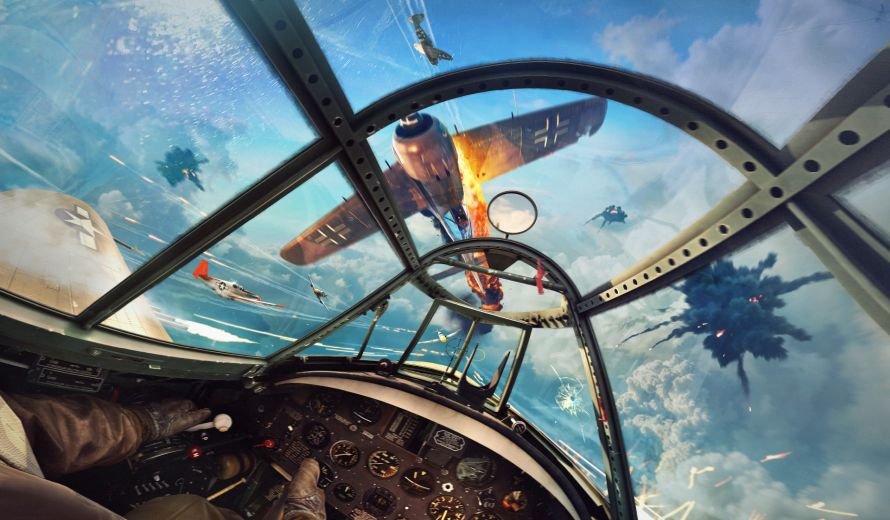
Much like the Virtual Garage in GT7, you can admire both the interior and exterior of these beauties. You can walk around them on the airfield and sit in the meticulously detailed cockpits. Depending on which controls you choose, you can literally grab the aircraft controls with your hands. It’s so cool to just sit in a cockpit in virtual reality and soak in all the detail. All the levers, dials, gauges, cockpit window and frames, cockpit mirrors, and weapon gun sights are modeled. As an added feature, you can turn on a VR menu option to display the name of a particular instrument when you look at it.
AOT supports several control schemes: mouse and keyboard, gamepad, VR controllers, and HOTAS. Each has its advantages and disadvantages. For the best control and handling of an aircraft, the HOTAS wins hands down. It’s also the most complicated to use, especially in VR. Flight sim veterans will have no problem, but for newbies there is a definite learning curve remembering all the button layouts and their functions. VR exacerbates the problem because you cannot see the HOTAS.
For the best immersion, VR controllers are the Goto choice. You can interact with most of the cockpit controls directly. This reduces the need to use buttons and/or menus to carry out actions. You also get force feedback and haptics, which make battles and damage much more visceral. The price for this interactivity is the lack of fine control over the actual flying of the plane.
Gamepads offer a lesser experience than VR controllers, but with the advantage of familiarity of the control layout. The PSVR 2 controllers and the PS5 DualSense both offer feedback and haptics. Plus, if played with the PSVR 2, both control schemes give you headset feedback. Great to drive home that you’ve been hit by enemy or friendly fire or that you’ve crashed.
Controller Choices
The choice of which control scheme comes down to preference as you learn to handle the game’s physically accurate flight and damage models. AOT may not be a hardcore flight sim game, but it sure leans far more towards realism than arcade. The game does little in the way of hand-holding so be prepared for a lot of trial and error. And time.
AOT, like most flight sims, is a big time sink. Even a simple test flight, where all you do is take off and then land takes time. Missions will easily take thirty minutes or more. Don’t be surprised if you spend over an hour!

As with learning the controls, AOT offers little in the way of help with battles. There is no radar. Everything is done by sight. So you must learn to identify aircraft, enemy or friendly, by their shapes. Or the color of their tracer fire. You get some help from an in-cockpit map, but it’s more useful on the approach to a mission versus in the heat of battle.
To battle successfully, you must learn the tactics of air warfare in line with the limitations of your aircraft. Situational awareness is paramount. Keeping track of enemy aircraft is vital. If you lose sight, you will probably end up losing flight. We cannot overstate the importance of starting an attack from above. This gives you the advantage of surprise and speed.
World War I & II Missions
Plus, these are propeller-driven aircraft that are designed for specific mission types. Some are designed for aerial combat, others can attack the ground, and others provide air support. As such, some will be more nimble versus those that carry more firepower. Aircraft characteristics dictate the terms of engagement. Especially true for World War I aircraft with their low engine power, where gaining height before an attack is the difference between life and death.
AOT battles place you in fights across the world, improving your understanding of how the war’s outcome was determined. There are fifteen maps representing three key theaters of World War II: the Western, Eastern, and Pacific Fronts, as well as signature World War I front-lines. You can take part in historic battles, like supporting D-Day operations in Normandy and patrolling the waters around Pearl Harbor. You can complete the other missions in any order, as they are not tied to any historical events.

Besides the predefined missions, a mission builder exists that allows sharing with other players. The era of aircraft determines the location of missions. Beyond that, all other parameters are under your control. You set the time of day, the weather, and the type of engagement. Plus, you can set the difficulty level too. Beyond the training flights, this is a good way to build up your skills. It is quite gratifying to move beyond all comfort options while learning to properly handle and fight with the planes.
While AOT is not a true sim, there is a definite learning curve, and you will have to put in time to realize the full benefits of the game. Restricting the game to World War I and II aircraft is an excellent choice for a VR game. VR is a perfect vehicle for flying planes restricted to line of sight. Plus, with flying, you can focus detail on the cockpit while allowing for graphical compromises in the world to maintain a smooth sensation of flight and motion.

The game is available now on Steam and PSVR 2. There is also a deluxe version that includes additional aircraft: the F4U-4, Spitfire Mk IV, Hurricane Mk IV, SBD-3, and the P-40E-1. No word yet on whether or not the additional aircraft will be available later as a separate DLC.
For a platform hungry for serious, sim-style experiences, Aces of Thunder is a welcome addition alongside Microsoft Flight Simulator and Gran Turismo 7. Having all three available on the PS5, in both flat-screen and PSVR2 versions, is a major boost for Sony’s console lineup. Fans can only hope this signals more AAA-quality, hybrid experiences in the future.
*****PSVR 2 game code provided by game publisher*****
The Good
- Wonderful recreation of WW I & II aircraft
- Realist flight model
- Single and multi-player support
83
The Bad
- High learning curve
- Mistakes are fatal
- Requires a time commitment
