


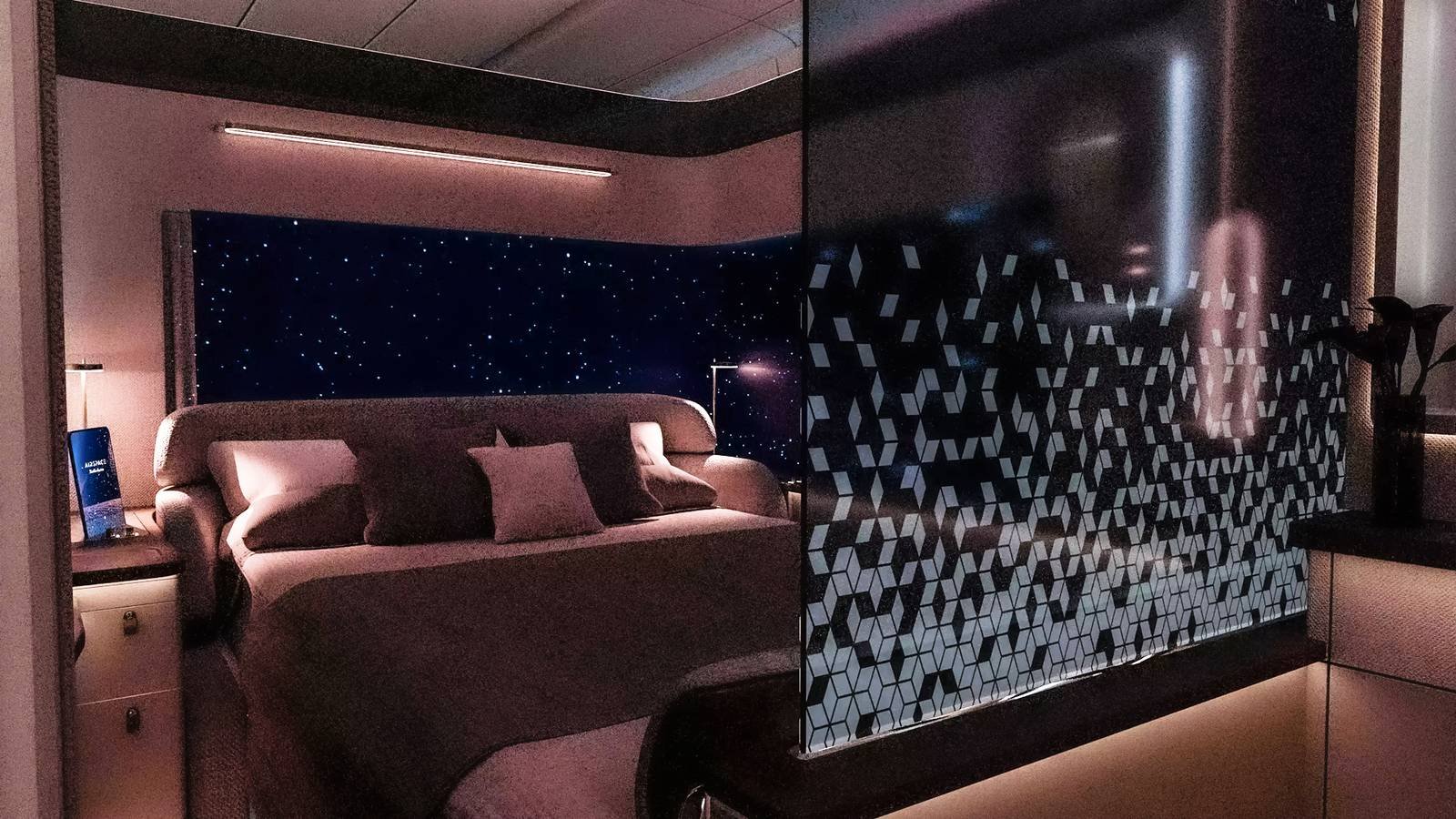
European aerospace manufacturing giant Airbus is betting that first class still has room to evolve, not through the addition of more suites, but rather by rethinking what the space at the very front of a widebody is capable of being. As business class becomes increasingly standardized around enclosed suites, airlines looking for a halo product need something that fundamentally feels different, especially on ultra-long routes where the cabin is increasingly becoming a destination in and of itself. That is the context for Airbus’ new A350-1000 First Class Experience concept, with a 1-1-1 layout that was built around a center Master Suite built for two.
This suite comes complete with a double bed, its own lavatory and changing area, and even a small bar. In order to make that kind of room possible, Airbus proposes shifting things like stowage and crew-rest access out of the prime real estate near Door 1 and into a dedicated center module, freeing floor area for larger suites and taller ceilings. The result is closer to a hotel room than a traditional aircraft seat, something which the manufacturer believes will be a differentiated premium product that can serve as a selling point for the world’s largest new twin-engine aircraft in service, a title the A350-1000 will only hold until the Boeing 777X enters service. We break down what exactly Airbus is proposing here, and what it would mean for airlines deciding whether first class is worth bringing back again.
A Brief Overview Of The A350-1000 And Its Capabilities
The Airbus A350-1000 is the stretched, flagship member of the manufacturer’s popular A350 family. The jet is the manufacturer’s largest twin-engine passenger jet, and it is undoubtedly the company’s answer to long-haul trunk routes where capacity, range, and premium yield are all critical components of the puzzle. In a typical three-class layout, it is sized for roughly 375-400 passengers, with a maximum of 480 in high-density form, and it pairs that volume with long-range legs.
Airbus lists the aircraft’s range at around 9,000 nautical miles (16,700 km) with a cruising speed of around Mach 0.85, which is what one would expect for a flagship long-haul airliner of this type. Power comes primarily from the Rolls-Royce Trent XWB-97 engines under the plane’s wings, and the airframe leans heavily on advanced materials. The majority of the aircraft is made of lightweight composites, keeping fuel burn low and efficiency at its maximum. The aircraft is certainly overpowered, making it an exceptional freighter. For airlines, the jet offers an impressive value proposition, with lower fuel burn, lower carbon emissions, and improved cargo payload capabilities.
For travelers, the aircraft has been effectively marketed as one of the most comfortable aircraft in the skies. The jet offers a quiet and modern interior with high ceilings and wide internal proportions, which help operators install roomier premium products without sacrificing density in the economy-class cabin. That combination is exactly why Airbus sees the A350-1000 as the natural canvas for its new first-class cabins, something which has helped it sell to airlines and non-traditional operators from all across the globe.
What Exactly Is Airbus’ New First Class Idea?

Airbus’ new first-class cabin is less of a finished seat than a forward-cabin blueprint for the A350-1000. Three oversized suites across the width of the cabin in a 1-1-1 layout, alongside a center-placed Master Suite, certainly is not something we have seen before. That middle suite has already been envisioned by the manufacturer to offer a private room between the two aisles, enclosed by ceiling-height partitions and mood lighting, which will be valuable since this middle cabin will not have any windows.
Instead of offering just a single seat, this product will feature lounge-style furniture, including a large sofa and an ottoman that can easily be reconfigured into a true double bed. The two passengers get exclusive access to their own dedicated lavatory and a separate changing area, alongside a small bar and refreshment zone that is inside the suite’s footprint. Airbus is essentially proposing relocating space-hungry first-class seats that typically eat into premium real estate with an incredible, unique center module.
This new setup will be located directly behind Door 1, exactly opposite the entrance to the cockpit. By moving a lavatory and stowage areas around, this can allow for genuinely larger first-class rooms and improved privacy without having to jump to a larger aircraft type. This allows Airbus to keep the cabin workable while offering an impressive opportunity for carriers to generate auxiliary revenue.

Why The Airbus A350 Has Such A Reduced Pilot Workload
Airbus calls its A350 the “best office in the sky” for good reason. It has exceptionally low pilot workload.
Why Does This Make Any Sense?

This all makes quite a lot of natural sense. Airbus is interested in the premium end of long-haul travel, a segment of the market that has fundamentally changed in recent years. Enclosed business-class suites with direct-aisle access have become the standard in international long-haul premium travel. Therefore, to offer a true flagship experience, airlines need to come up with something that feels materially above and beyond business class, not just something that offers marginally wider seats. A first-class cabin with only a handful of massive suites can also be a branding weapon, as it is an attention-grabber that sells the airline’s entire network.
This helps an airline justify its premium pricing in business and premium economy, giving high-value customers a reason to stay loyal. The airline’s concept is designed to solve the practical reason many airlines ditched first class in the first place, as it was designed for spatial efficiency. By re-engineering the area between the first two doors, Airbus is effectively creating a new kind of usable area where airlines can monetize a premium experience.
The master suite for two targets a fundamentally underserved use case, with couples, families, or VIP travelers who want a private-room feel without chartering, all while the two window suites keep the traditional solo premium option available. This new cabin construction is also part of a sales pitch for the A350-1000 itself. If Airbus can show airlines a realistic path to higher premium yields on its biggest twinjet, it can strengthen the A350-1000’s positioning at the top of the long-haul market.
Who Is This Product Geared Towards?

This unique Airbus concept has been tailor-made for travelers who see flying as part of the trip and not a necessary evil. The clearest audience is thus ultra-high-net-worth individuals and VIPs who will pay for privacy, space, and control on 10-16-hour sectors, especially when company policy or optics make private jets less attractive. It also targets premium leisure travel, as couples are celebrating honeymoons, anniversaries, or once-a-year bucket-list vacations who want a true double-bed experience and a private room vibe without chartering.
Entertainment and sports travel are another fit, with artists, agents, athletes, and security teams valuing discretion and the ability to rest properly before arrival. High-stakes business travelers are also a key part of the equation, but the use case for them is significantly narrower. CEOs, founders, and deal teams flying to board meetings or roadshows where sleep and confidentiality are worth more than points could make this a good product fit.
Diplomatic and government delegations are also natural customers for the type, particularly when protocols call for separation and privacy. Lastly, there is a status and storytelling piece to this story as well, with people who purchase the product for the novelty, social signaling, and the idea of trying the most exclusive cabin in the sky, exactly the kind of customer who helps airlines market the entire premium cabin stack.

10 Airlines That Still Offer A Long-Haul First Class That’s Much Superior To Business Class
These are a few of the airlines offering superior first-class service on long-haul flights.
What Does This Mean For The Airbus A350 Program As A Whole?

For the Airbus A350 program, this is Airbus trying to make the A350-1000 a platform for premium yield, not just improved fuel burn. The concept gives airlines a ready-made narrative for why the Airbus A350-1000 can be the company’s flagship, even as business class is slowly commoditized into suits.
If any carriers elect to adopt this cabin structure that Airbus is proposing, they are looking for a strategic payoff and stronger differentiation against rival widebodies. Airlines are looking to generate higher headline fares on key long-haul routes, with a halo cabin that elevates the entire brand.
Even if the exact master-suite layout never flies, Airbus is still signaling something important to customers. It argues that it can help them monetize the front of the aircraft with a flexible cabin architecture. This should help support arguments for why the Airbus A350-1000 is a suitable flagship for the future of long-haul travel.
What Is Our Bottom Line?

At the end of the day, the Airbus A350-1000 is undoubtedly the European manufacturer’s flagship product, and its way of pitching the company as a long-term solution to the challenge of handling a rapidly-changing premium environment. The plane was designed with long-haul travel in mind, as well as the overall passenger experience.
This latest cabin design proposal from Airbus highlights the manufacturer’s continued interest in supporting premium cabin growth, especially when it comes to first class. There will undoubtedly be airlines interested in some version of this product, as demand for premium services only continues to grow.
First class was also a cabin product that many carriers had simply left for dead a long time ago. Some simply grew to believe that the cabin served no purpose in an age where the highest-spending travel demographic increasingly wanted to fly private. This proves the opposite.
