


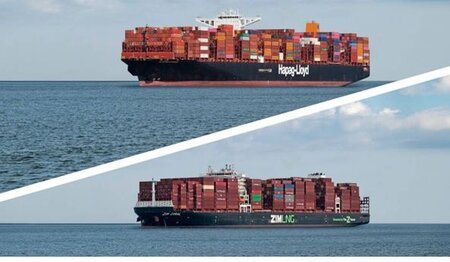
The world’s fifth-largest container shipping company is taking over the tenth-largest box carrier. Hapag-Lloyd CEO, Rolf Habben Jansen, announced this acquisition on Monday evening (16FEB26) in a call with trade journalists in Tel Aviv, where ZIM is based. The purchase price for 100% of the shares is USD 4.2 billion. This is an impressive 58% above last Friday’s closing price.
During a Teams call, the Hapag-Lloyd CEO admitted that this was a considerable price to pay. However, the merger would generate significant annual synergies of between USD 300 and 500 million, particularly in the areas of networking and procurement, said the executive. The deal will expand the customer base and secure Hapag-Lloyd’s position among the world’s top five container liners, thanks to a combined fleet of more than 400 modern ships with an annual slot capacity of over 3 million TEU. Hapag-Lloyd accounts for around 300 ships and ZIM for 117 vessels, 90% of which are chartered by the Israeli shipping company. Its fleet consists of modern and efficient ships, with 40 of them powered by liquified natural gas (LNG), reducing CO2 emissions by 25%, NOx by 85% and sulfur emissions by as much as 99% compared to ships powered by crude oil.
Approvals needed
The agreement still needs to be finally approved by the competition authorities. And a majority of the ZIM shareholders must still approve the deal by a simple majority vote at a shareholders’ meeting.
Hapag-Lloyd management emphasizes that ZIM will strengthen the shipping company’s position and improve its financial performance. ZIM’s network structure complements that of Hapag-Lloyd and improves the German container shipping company’s presence on transpacific routes from fifth to fourth place. On transatlantic voyages, it climbs to second place, narrowing the gap to market leader, MSC. The combined fleet operation will increase flexibility in deployment and support Hapag-Lloyd’s sustainability goals, said the Hapag-Lloyd boss.
Consolidation of market position
Some of the routes will be integrated into the Gemini Alliance set up between Maersk and Hapag-Lloyd, although specifics are still open. Together, Hapag-Lloyd and ZIM will consolidate their position among the top 5 in global maritime transport behind MSC, Maersk, CMA CGM, and Cosco, offering the market an annual transport capacity of 3.2 million TEU.
The merger will not disadvantage the State of Israel or its economy. “We will continue ZIM’s existing presence there as part of our future joint mission, which also includes the continued operation of the Innovation Center in Tel Aviv,” Habben Jansen assures.
Golden Share
To protect Israel’s strategic and commercial rights, ZIM will be split up. A liner network based on 16 vessels will be established under the brand name ‘New ZIM’, offering intra-regional Mediterranean services in combination with one transatlantic U.S. East Coast–Mediterranean service connecting Israel to key U.S. markets. All intercontinental ZIM routes will be taken over by Hapag-Lloyd. To ensure maritime access in times of crisis, protect national security interests, and prevent hostile influence, Israeli private equity firm, FIMI, will obtain ‘golden share’ rights in accordance with the Minister of Finance & Transport, allowing it to veto key corporate actions, should national interests require it.
Hapag-Lloyd expects the ZIM acquisition to be legally and operationally completed within the current year, provided the competition watchdogs consent the deal. Until then, the two companies will remain competitors on their international routes. CEO Habben Jansen does not expect the Hapag-Lloyd–ZIM merger to trigger a new wave of consolidation in global container shipping.
