


Researchers at University College London (UCL) and Brunel University London have developed a custom aluminum alloy that outperforms industry-standard materials in metal additive manufacturing. The researchers also used a novel combination of real-time imaging techniques to watch exactly how it forms, layer by layer, at the microscopic level.
The implications reach well beyond the lab, stronger, more printable aluminum alloys have direct relevance in aerospace, automotive, and biomedical manufacturing, where lightweight components must meet demanding structural and thermal requirements, often without the luxury of costly post-processing.
The Problem With Printing Metal
Most commercial metal alloys were developed for conventional casting and machining processes, in which cooling rates are orders of magnitude slower than those encountered in modern additive manufacturing systems. This incompatibility presents ongoing technical challenges for the production of complex metal components.
The disparity is particularly consequential in directed energy deposition (DED), a process in which a focused laser melts incoming metal powder as it is deposited. At the extreme cooling rates this generates, the resulting microstructure deviates significantly from what conventional alloy design anticipates, leading to cracking, structural weak points, and mechanical properties that frequently fail to meet application requirements.
Aluminum alloys have proven especially difficult to optimize under these conditions. AlSi10Mg, the most widely adopted option, reliably produces dense, crack-free parts but is limited in its achievable strength. This has prompted growing industry interest in alternative alloys that offer higher strength, improved thermal stability, and consistent printability without defect formation.
Designing an Alloy From the Ground Up
The research team took a different approach: rather than adapting an existing alloy, they engineered one specifically for DED conditions. The resulting material, designated PA1, is built around a combination of aluminum, nickel, cerium, manganese, and iron, with each element chosen for a specific role.
Cerium improves how the molten metal flows and helps form microscopic compounds that resist grain growth at high temperatures. Nickel and manganese contribute additional thermally stable structures. Iron, often an unwanted impurity in aluminum, was included in a small, controlled quantity rather than eliminated. The goal throughout was an alloy with a narrow freezing range, meaning it transitions from liquid to solid quickly and uniformly, which reduces the thermal stress that causes cracking.
The powder was produced through ultrasonic atomization and printed using a custom DED system under tightly controlled conditions, with an argon atmosphere to prevent oxidation.
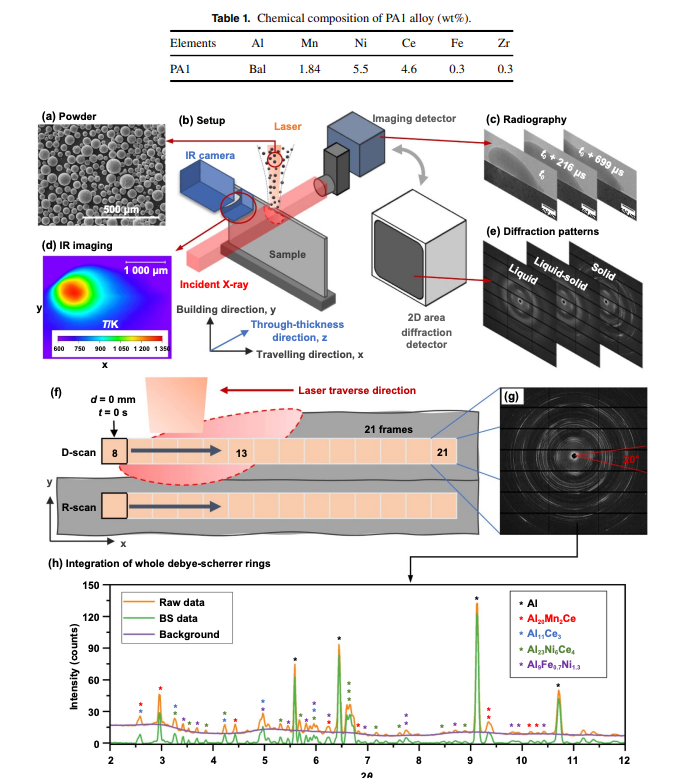
One of the most technical aspects of the study was how the team observed the alloy’s behavior during printing. Rather than relying on simulations or post-build analysis alone, they combined three simultaneous measurement methods at a synchrotron facility: high-speed X-ray imaging to capture the melt pool in motion, infrared imaging to map temperature distribution across the build, and X-ray diffraction to track which phases forming and dissolving in real time.
This approach allowed the researchers to pinpoint exactly when and where each intermetallic compound appeared during solidification, and how repeated reheating from subsequent layers altered the microstructure underneath. They found that two key compounds formed first, before the main aluminum matrix solidified, and that these early-forming structures appeared to constrain grain growth in the surrounding material, producing an exceptionally fine internal architecture with sub-grain sizes below 5 micrometers.

Stronger, With Low Residual Stress
The mechanical results were notably strong. PA1 achieved a yield strength of 191 MPa and an ultimate tensile strength of 421 MPa in the as-built state, improvements of roughly 70% and 50%, respectively, over AlSi10Mg under the same printing conditions. The density exceeded 99%, with minimal internal defects.
Equally significant was the alloy’s residual stress profile. Thermal stress locked into a part during printing can cause warping, cracking, or premature failure in service. In PA1, that residual stress remained below 32 MPa, less than 16% of the material’s yield strength, a figure the researchers attribute to the alloy’s unusually narrow solidification window and low thermal contraction during cooling.

Limitations
The study is not without constraints. Testing was conducted on relatively small block samples, and mechanical properties were estimated using an indentation-based method rather than conventional tensile testing, a validated but indirect approach. The authors also note a slight reduction in ductility compared to AlSi10Mg, likely because the higher volume of intermetallic compounds in PA1 provides more potential sites for microscopic cracking under load.
Scaling the alloy and process to larger, more geometrically complex builds remains an open question, as does performance under real-world service conditions. Still, the combination of purpose-built alloy design and real-time multimodal characterization represents a potential template for developing the next generation of high-performance printable metals.
The Metallurgical Bottleneck
Metal additive manufacturing has a materials problem: extreme cooling rates during printing alter a metal’s internal structure in ways conventional alloy design was not built to anticipate, leading to cracking, weak grain boundaries, and parts that fall short of performance requirements.
Aluminum sits at the center of this tension. The most widely used printing-grade option, AlSi10Mg, dominates not because it performs exceptionally well, but because it doesn’t crack. The alloys aerospace and automotive engineers actually want, remain largely unprintable without defects. The industry has been managing around the problem rather than fixing it.
Several efforts are now targeting this directly. Oak Ridge National Laboratory developed DuAlumin-3D, a new aluminum alloy that demonstrated superior printability and mechanical performance compared to conventional grades prone to cracking during laser powder bed fusion, while maintaining strong thermal stability. MIT researchers took a different approach, designing an aluminum alloy that works with the rapid solidification conditions of printing rather than against them, harnessing short-lived metastable structures that form under extreme cooling to generate fine, stable strengthening particles.
The pattern across all of these efforts points to the same conclusion. The microstructural mismatch between conventional alloy design and additive manufacturing thermal conditions is well understood, and closing that gap requires building alloy chemistry from the process up, not from specifications down.
3D Printing Industry is inviting speakers for its 2026 Additive Manufacturing Applications (AMA) series, covering Energy, Healthcare, Automotive and Mobility, Aerospace, Space and Defense, and Software. Each online event focuses on real production deployments, qualification, and supply chain integration. Practitioners interested in contributing can complete the call for speakers form here.
To stay up to date with the latest 3D printing news, don’t forget to subscribe to the 3D Printing Industry newsletter or follow us on LinkedIn.
Explore the full Future of 3D Printing and Executive Survey series from 3D Printing Industry, featuring perspectives from CEOs, engineers, and industry leaders on the industrialization of additive manufacturing, 3D printing industry trends 2026, qualification, supply chains, and additive manufacturing industry analysis.
Featured image shows Schematic of experimental set up during DED aluminum and data processing: (a) powder morphology of aluminum alloy PA1, (b) set up of correlative in situ X-ray imaging, IR imaging and X-ray diffraction, with representative results demonstrated in (c), (d) and (e) respectively, (f) scan strategy of in situ X-ray diffraction with (g) one frame of diffraction pattern at full solid state and (h) 2D profile of intensity as a function of 2-theta after integration. Image via University College London (UCL) and Brunel University London.
