


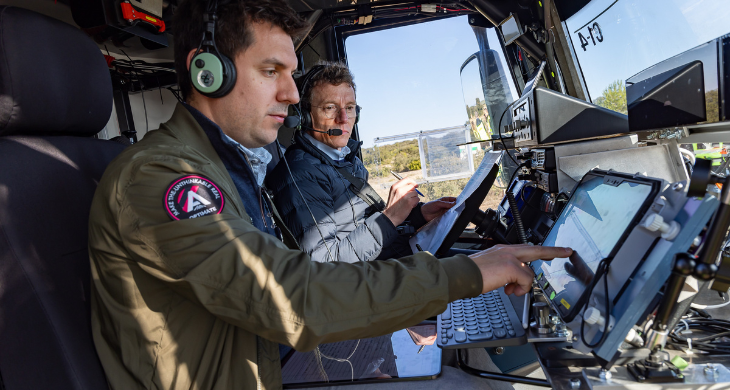
 Airbus has completed an aerial fire fighting trial which linked fixed wing, helicopters, UAVs and ground personnel via communication and data processing system which the company says demonstrates the ability to carry out highly accurate water drops and significantly reduce the growth of wildfires.
The trial mobilised employed the Airbus H130 based FlightLab helicopter, an ATR 72 test aircraft and a Cirrus SR20 light aircraft, four UAVs including an Airbus Aliaca, and three lorries from the Departmental Fire and Rescue Service of Le Gard (SDIS 30) to collect and process data. To interconnect the entire system, Airbus deployed a local private mobile network bubble in the area, connected to Agnet, the mission-critical communication solution developed by Airbus for security and emergency services.
These tests were carried out by Airbus and its partners at the Garrigues military camp in Nîmes (France), based on scenarios developed with Departmental Fire and Rescue Services (SDIS) as well as the Entente Valabre, a public body empowered by the French Ministry of the Interior to assess forest firefighting equipment, provide training for personnel in France and abroad, and which is recognised as an international authority.
In these scenarios, two drones and the light aircraft captured images of the fire area, including infrared footage, and transmitted them in real time to Airbus servers connected to a command centre aboard a ground vehicle. The images were analysed, geolocated and merged with data, including satellite imagery, taking into account the terrain, wind strength and direction measured by a drone, and the location of firefighters on the ground. Data processing systems using AI produced a comprehensive view of the tactical situation on the ground and in the air, and enabled flight paths and water drop points to be transmitted to the helicopter equipped with a precision water drop assistance system and to the ATR72, which was simulating a water bomber.
Image: Airbus
