


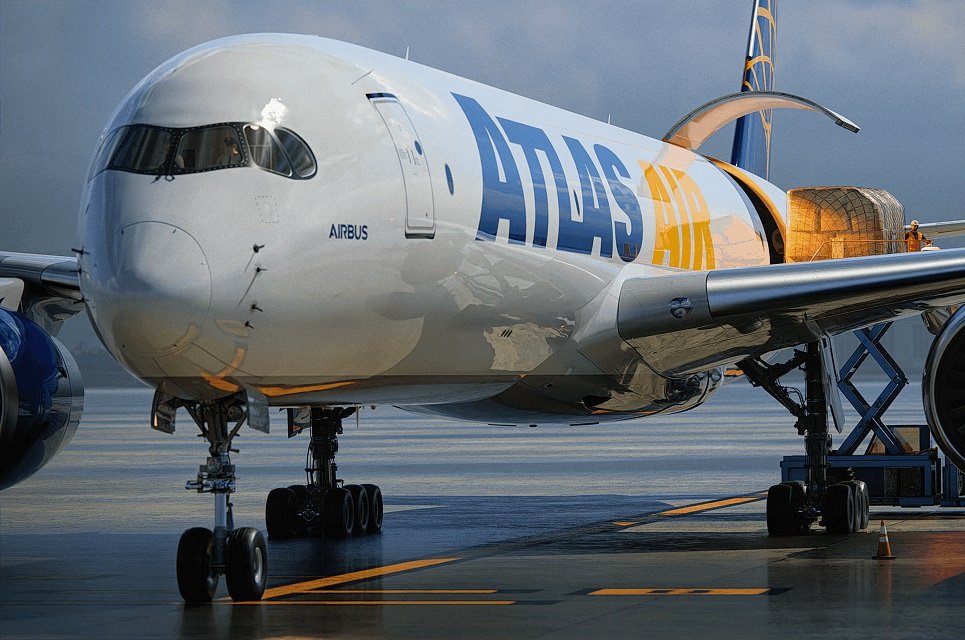
Atlas Air is planning to use its “landmark” order of Airbus A350 freighters to expand its fleet, while the company has also not ruled out ordering Boeing’s rival 777-8 freighter.
Speaking to Air Cargo News, Atlas Air Worldwide chief executive Michael Steen described the company’s mid-March order for 20 Airbus A350 freighters, with options for 20 more, as a landmark decision on several fronts.
Steen pointed out that it was the single-largest freighter order the company has placed in its 33-year history.
The order also represents a move away from a dedicated Boeing fleet for Atlas Air, which currently operates 113 aircraft made up of Boeing 747s, 777s, and 767s.
Asked why the company decided to expand its fleet beyond Boeing, Steen said that it was the first time in history that the industry had the option of large widebody freighters from two OEMs.
Having the various models gives the company increased versatility and scalability to work with different customers.
“Each aircraft is going to have a different deployment portfolio envelope for different customers,” Steen explained.
“It depends on the trade lane, depends on the freight density, volume, density ratio, as to which aircraft is going to serve the different customers best.
“I think having the versatility that we now have between the Boeing 747-400, Boeing 747-8, Boeing 777-200 and, in a couple of years’ time, the A350 is going to give us more scale and more flexibility to work with customers.”
He added that the expectation was that A350F was going to come to market “slightly” before the 777-8F and that was also an important factor in the decision.
Atlas has “secured early delivery positions” for the next-generation aircraft, with deliveries due to begin in 2029 and be completed in 2034.
“The A350 is going to produce phenomenal payload, excellent range and significantly reduced fuel burn, which is important for our customers.
“Also, if you look at the airline industry in general, it’s quite often that you see operators have a dual platform and we now have the possibility to have that on the freighter side as well, which we have not had in the past.
“So, I think those factors together drove us to this decision that we made.
“And then, of course, from an investment perspective, the financials have to be attractive, and I think all of that we found in the decision that we made.”
Future orders
However, Steen said that Atlas would consider an order of the Boeing 777-8F platform in the future.
“I’m absolutely not ruling that out,” he said. “I expect also that in the next couple of years we will add more aircraft to our fleet as aircraft become available in the marketplace.”
Steen explained that the company will use the freighters it has on order “predominantly” to expand its fleet rather than to replace older aircraft.
He pointed out that the average age of its 747-400s, typically the older aircraft in the Atlas fleet, was around 24 years, but these typically fly until they are in their mid- to late-30s.
“The majority of the order is going to be for expansion purposes and for growth. Some of them will be for replacement, but that is something that we will manage over time as we think about incremental aircraft opportunities we may acquire in the next couple of years,” he said.
On the outlook, Steen has in the past said he expects a shortage of widebody capacity in the coming years due to rising demand levels, the ageing of the current fleet and a lack of new order opportunities while the A350F and 777-8F programmes get underway.
“There is going to be a period of time where there will be no widebody freighter production, unless Boeing gets an exemption to extend the 777-200F production, which I think would be good for the industry.
“Widebody capacity is very constrained and will get even more constrained over the next decade, so when we think about any aircraft decision that we make, it has a long-term plan attached to it.”
