


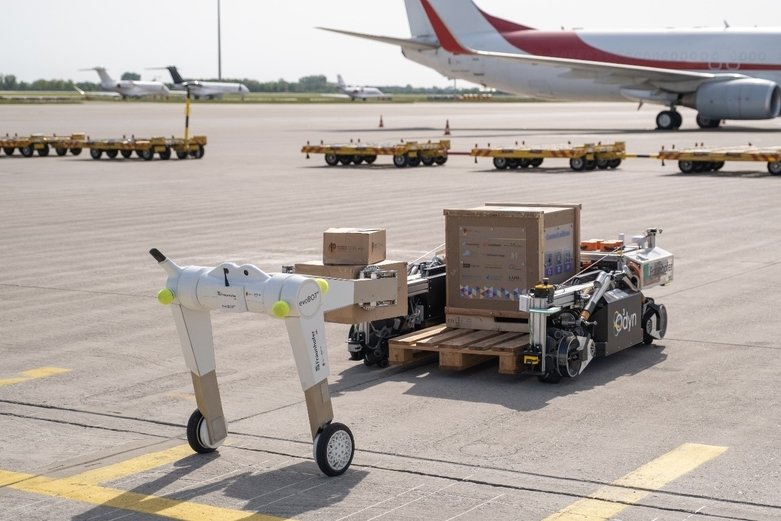
In Parts 1 and 2 of our 3-part series on air cargo automation, Manuel Wehner (MW), Project Manager and Research Associate at the Fraunhofer Institute for Material Flow and Logistics IML, took us through the overall autonomous robot testing/maturity situation in the industry, and a more detailed look at the robot projects being trialed by Fraunhofer IML and its Digital Testbed Air Cargo (DTAC), at Germany’s Munich (MUC) and Stuttgart (STR) Airports. Part 3 now addresses the issues of robots and circular economy, cybersecurity, and the human element in a future-oriented, automated air cargo industry.
CFG: Are robots being built with a Circular Economy in mind? What happens after their lifespan ends?
MW: This is an important question, not only for robots but for all types of sustainable upgrades to traditional diesel airport vehicles. Automation can contribute to more efficient operations and usage of resources, and to a reduction of accidents. Retrofit approaches can help re-use outdated solutions.
Sustainability is more than just CO2 reductions, which sadly not everyone in the industry seems to have fully understood yet. Comparing an electric robot vehicle with a regular electric vehicle, the sensor technology needs to be considered additionally in terms of a Circular Economy approach. When the lifespan of a robot ends, sensors can be deployed in other robots, and mechanical parts can be re-used just like those of our normal road cars.
Battery technologies remain a major factor for the Circular Economy. There are some interesting and promising approaches, for example, for recycling Nickel, Lithium and other battery elements, or to using old batteries as temporary energy storage.
CFG: What have been the greatest learnings in testing these robots?
MW: All solutions tested and observed so far have deficits. Positively speaking, there is still lots of potential for creative minds, start-ups and corporates to solve the most striking airport challenges. For all other operations, including repetitive transport and handling tasks, there are many solutions that can be tested and implemented in the airport context tomorrow. Level 5 autonomy still remains a major challenge for robot development and centralization of control.
CFG: How many different types of robots will be needed in a future warehouse?
MW: Most airports nowadays are ‘zoos’, showcasing many different vehicle types thanks to competition laws, tenders at different times, technological advances, etc. We do not expect this to change anytime soon for the vast majority of airports. Adding robots to this already complex environment, while slowly decreasing the number of traditional vehicles, probably will not significantly change the total number of vehicle types in operation.
For a while, we should see a constant, maybe even slightly increasing number of vehicle types due to the introduction of new robots. At some saturation point, we might see a decrease because vehicles and robots could be used more strategically, for example, to handle both luggage and cargo, to transport both passengers and crews, to fulfill more than one task for the aircraft turnaround, etc. Additionally, there might be superior robots that clearly outperform others at some point and, thus, become the preferred solution for many airports.
However, we do not see this happening in the next five years. There are more and more robot manufacturers entering the market and discovering airports as an exciting new application field with good scalability.
CFG: What about security risks – could these robots be hacked and manipulated?
MW: This is another important aspect, and we mentioned cyber-security in Part 1 of our interview series. Just like drone operations, driverless ground vehicles must remain controllable and stoppable in case of hostile intentions. This is why we prioritize on-premise software solutions to complement the existing airport IT systems in a critical infrastructure environment.
There will never be 100% security for any of these critical infrastructures, which is unfortunately being proven in several conflicts worldwide as we speak. On-premise solutions in direct stakeholder control will certainly help shape secure operation environments for robots at airports.
CFG: What about the cost aspect – robot versus human employee?
MW: It is not a secret, and it has been proven in many industries that automation investments can easily pay off within a few years, given the scalability and endurance of the employed solutions. Most business cases we have come across so far in the air cargo industry, focus on labor costs as the main variable.
From a research point of view, it is interesting to explore more factors – especially those difficult to quantify: scaling-up fleets, synergies between different vehicle types, global stations and autonomous functionalities, long-term maintenance considerations, AI-enabled fleet management, 100% automation zones, Circular Economy and dark warehouse concepts, and many more.
CFG: What areas will never be able to be taken over by robots and why?
MW: Never is a big word. Who would have thought in the 1960s that Orwell’s 1984 dystopia might become so scarily realistic so soon? Who would have thought in the late 1990s that the dystopia shown in the movie ‘The Matrix’ with AI-enabled machines in human form, could become reality in the military and service sectors so soon?
Personally, I hope that human factors will always play an important role in our societies and economies. Undoubtably, robots can be fantastic helpers, and logistics can be made much more automated and autonomous than it is now. We covered the human factors topic in another scientific paper called “Testing Autonomous Cargo Vehicles at Airports – An Analysis of the Basic Requirements Focusing on Staff-Related Human Factors”. It was published recently in the Journal of Air Transport Studies. Only time will tell to which extent machines will be able to learn and take over. I enjoy developing and interacting with robots, but they should perform certain tasks for humans as tools, definitely not take over informed decision-making entirely.
We 8.3 billion humans must remain aware of how important it is not to become too lazy to think for ourselves. This would be rather sad for both our professional and our private lives, and it would probably lead to more global problems than benefits.
Thank you, Manuel Wehner, for your extensive insights!
This concludes our three-part series. You can find the links to the two previous articles here:
