


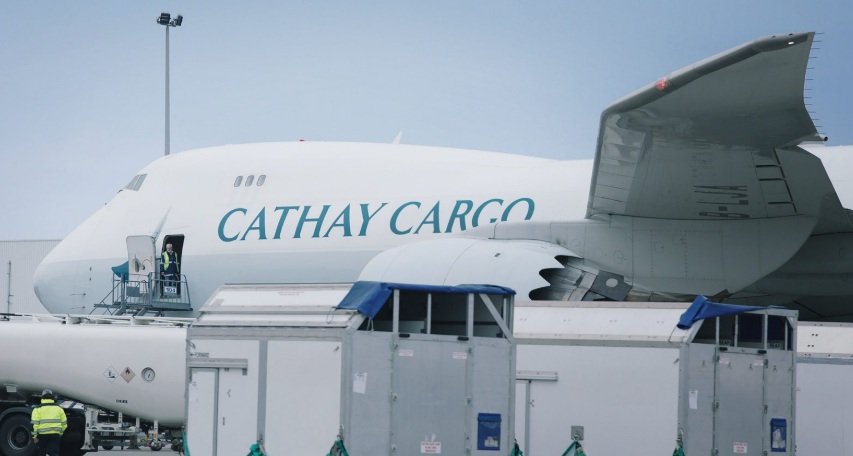
Cathay Cargo is searching for mid-point stops on the Asia-Europe trade as it faces capacity limitations as a result of the Middle East service adjustments, while it is also warning customers of fuel surcharge increases.
In the airline’s monthly newsletter, Cathay Cargo director of cargo Dominic Perret said that the carrier had cancelled passenger operations to Dubai and Riyadh until the end of May and freighter services to those destinations until further notice.
Five out of its eight freighter services that had been flying on the Asia-Europe trade via Dubai are now flying directly but this has resulted in payload limitation.
As a result, Perret said the carrier was “currently reviewing alternative mid-points with the aim of removing this restriction”.
Elsewhere, he also highlighted how the “surge” in jet fuel prices was impacting the carrier.
“The jet fuel our aircraft use is made by refining crude oil, and so its price comprises both the crude oil component and the refinery component, both of which have increased significantly in recent weeks,” said Perret.
Perret pointed to IATA data showing that the global average jet fuel price increased to $197 per barrel for the week ending 20 March, increasing from $95.95 per barrel for the week ending 20 February.
“Fuel accounted for approximately 30% of Cathay Pacific’s total operating costs in 2025,” he said. “Like many airlines, Cathay undertakes fuel hedging to manage price volatility.
“However, in 2026, our hedging covers only around 30% of the crude oil component and does not apply to the refinery component, making this measure insufficient given the scale of the recent surge in the price of jet fuel.”
Perret said that, like many airlines around the world, Cathay Cargo has had to increase fuel surcharges in response to the price increase in jet fuel.
“Cathay Cargo is determined to maintain our capacity as far as is practicable despite the escalating jet fuel price,” said Perret.
“We know how important this is to our customers and the Hong Kong international aviation hub – the world’s busiest cargo airport.
“We will continue to communicate and work with our partners as we navigate through these unprecedented and challenging times for our industry.”
Elsewhere, Perret said that the airline had enjoyed a positive start to the year despite the longer-than-usual Lunar New Year holiday, which softened the market in Hong Kong and the Chinese Mainland in February.
Since the end of February, events in the Middle East and the unprecedented surge in the price of aviation fuel had brought challenges and volatility to the market, he said.
