


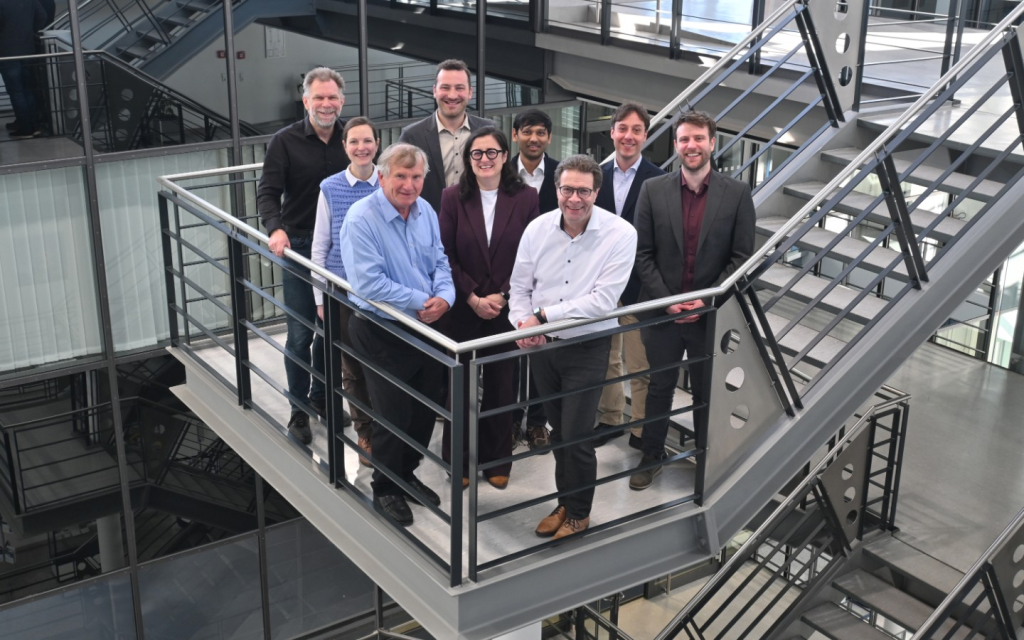
Researchers from the Fraunhofer-Gesellschaft and RMIT University have demonstrated a method to control the grain structure of metal components during additive manufacturing (AM). The work was carried out within the UltraGRAIN research project, which focused on laser-based directed energy deposition (DED-LB). The project concluded on February 25, 2026, following a final partner meeting in Dresden.

The consortium included the Fraunhofer Institute for Material and Beam Technology IWS, the Fraunhofer Institute for Additive Manufacturing Technologies IAPT, and RMIT University in Melbourne. Supported by the Fraunhofer ICON program and Australian partners, the project aimed to develop a scalable approach for tailoring microstructures directly during the build process.
Controlling microstructure is a longstanding challenge in metal AM. Grain structures tend to form naturally during solidification and are difficult to modify locally. These structures influence several mechanical properties such as fatigue strength, service life, and load-bearing performance.
UltraGRAIN explored methods to influence grain formation during production. Early experiments used ultrasound to affect solidification behavior. Researchers later shifted to pulsed-laser excitation of the melt pool, a non-contact technique that can operate with complex geometries and industrial equipment.
The pulsed laser approach directly excites the melt pool during deposition. According to the research team, the method can be integrated into existing laser-based DED systems and offers greater scalability than ultrasonic techniques.

Refining the grain structure of printed metal parts
Testing on demonstrator components showed that the approach can significantly refine the grain structure of printed metal parts. In some cases, researchers reported a reduction in grain size of up to 75 percent. This level of control allows engineers to create locally optimized zones within a component during production.
“UltraGRAIN shows how Fraunhofer IWS develops new manufacturing technologies consistently from concept to industrial application,” said Professor Christoph Leyens, Director of Fraunhofer IWS. “The results offer significant scientific insight and provide an excellent foundation for future industrial transfer.”
A key aspect of the project was collaboration across process development, digital design, and materials modeling. Fraunhofer IWS integrated pulsed laser melt-pool excitation into DED systems and validated the technology under industry-relevant conditions. Fraunhofer IAPT developed segmentation, path planning, and parameter assignment methods for components with locally varying microstructures.
RMIT University contributed multiscale modeling and simulation-based process design. According to Dr. Andrey Molotnikov, Professor and Director of the Centre for Additive Manufacturing at RMIT University, “Active collaboration among the project partners was a key highlight of the ICON project,” he said.

Simulation-driven processes for AM
The UltraGRAIN framework links digital models and AM processes to enable simulation-driven process design. By connecting modeling with real manufacturing systems, the project aims to accelerate the transfer of microstructure-controlled AM technologies into industrial use.
Industries that could benefit from the approach include aerospace, mechanical engineering, energy technology, turbomachinery, automotive manufacturing, and tool and mold making. In these sectors, components with locally optimized microstructures may improve performance while reducing material usage and extending service life.
The research consortium also presented project results at international conferences including ICALEO, ICAM, APICAM, and EUROMAT. In December 2025, Fraunhofer IWS signed memoranda of understanding with RMIT University and Swinburne University of Technology in Melbourne to support future research and technology transfer activities in advanced manufacturing.
Research explores new approaches to microstructure control in metal AM
Recent research has explored multiple approaches to controlling microstructure during metal additive manufacturing. In one study, researchers developed a process modeling tool designed to control the properties of nickel-based superalloys during laser powder bed fusion (LPBF). The system links thermodynamic modeling with process parameters to help predict microstructure and material performance during printing, offering a way to tailor mechanical properties without relying solely on post-processing.
RMIT University has also investigated methods to influence grain formation during the printing process itself. In a previous study, the team demonstrated that applying ultrasonic vibrations during metal 3D printing could refine grain structures and improve mechanical properties in printed alloys. These approaches highlight ongoing efforts across the sector to move beyond passive microstructure formation toward more deliberate control of material properties during additive manufacturing.
3D Printing Industry is inviting speakers for its 2026 Additive Manufacturing Applications (AMA) series, covering Energy, Healthcare, Automotive and Mobility, Aerospace, Space and Defense, and Software. Each online event focuses on real production deployments, qualification, and supply chain integration. Practitioners interested in contributing can complete the call for speakers form here.
To stay up to date with the latest 3D printing news, don’t forget to subscribe to the3D Printing Industry newsletter or follow us on LinkedIn.
Explore the full Future of 3D Printing and Executive Survey series from 3D Printing Industry, featuring perspectives from CEOs, engineers, and industry leaders on the industrialization of additive manufacturing, 3D printing industry trends 2026, qualification, supply chains, and additive manufacturing industry analysis.
Feature image shows UltraGRAIN project partners meeting in Dresden. Image via Fraunhofer IWS.
