


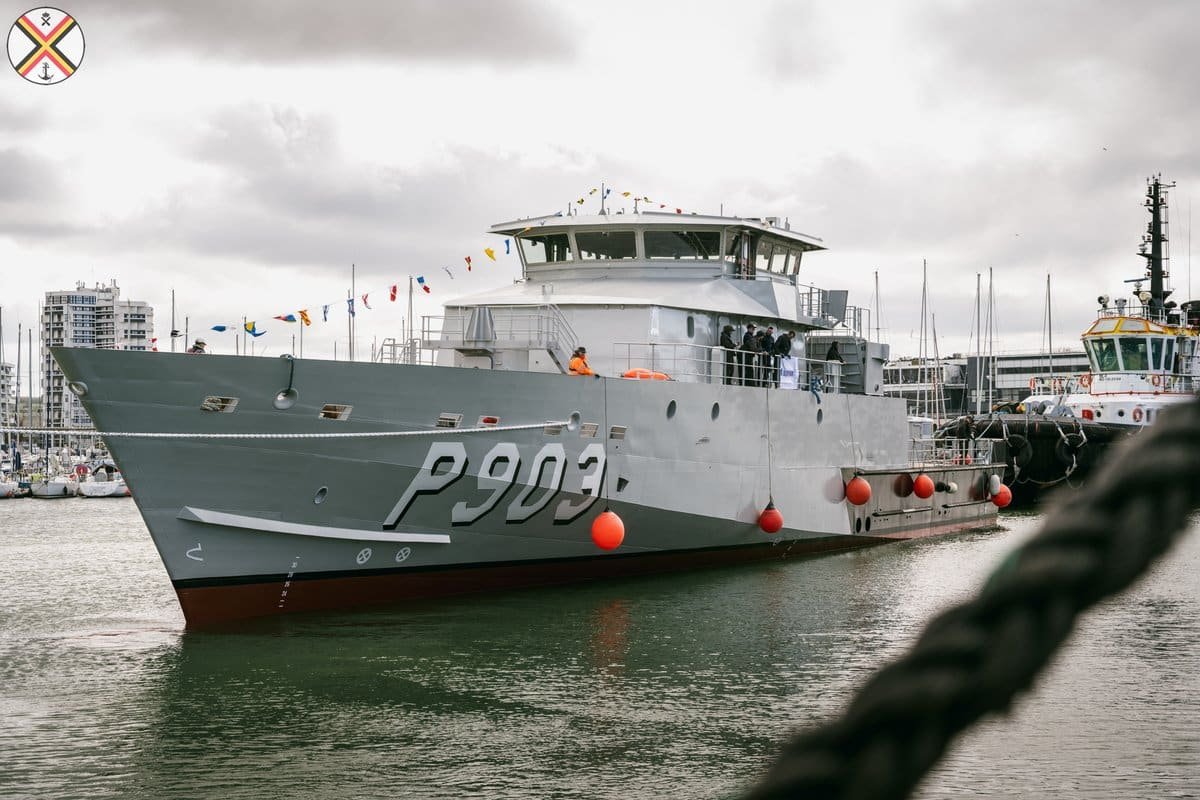
On April 2, 2026, French shipbuilder SOCARENAM launched the Castor-class coastal patrol vessel BNS Vega (P-903) for the Belgian Navy. This is the third ship-in-class after Castor and Pollux, launched about a decade earlier.
After launch, the vessel was floated out of the dry dock to commence the dockside fitting-out phase. During this stage, construction of the hull, the aluminum superstructure, and various mechanical and structural components is completed. Major propulsion elements, including the engines, gearboxes, and propeller shafts, are already installed on board.


During and following the launch, the shipbuilder conducts tests to verify the vessel’s stability, watertight integrity, and structural soundness. These validations confirm that the ship is ready to proceed to the next intensive integration phase, during which complex onboard systems, such as navigation, communications, and sensor equipment, are progressively installed, integrated, and tested.
The arrival of a third patrol vessel is not a luxury, but a necessity. With the intensification of geopolitical tensions, our presence must be strengthened 24 hours a day, 7 days a week, to guarantee our presence at sea. The North Sea is a vital economic artery for our country. This ship will assume its responsibilities, in combination with the Castor and Pollux.
General-Major Geert Bouchez, Chief of Armaments Systems Division (DGMR)
The Belgian Minister of Defence and Foreign Trade, Theo Francken, stated on X during BNS Vega‘s launch:
The decision to commission a third patrol vessel was approved in early 2024 during the tenure of then Defence Minister Ludivine Dedonder. According the the Belgian Armed Forces public release, the new ship will be an enhanced version of her sister vessels, featuring a steel hull and an aluminum superstructure. She will also be equipped with an advanced anti-roll system that uses water tanks and bulkheads to improve stability in challenging sea conditions. BNS Vega is expected to be fully operational in 2027.
The Castor-class patrol vessels perform an exceptionally broad spectrum of missions, including monitoring the Exclusive Economic Zone (EEZ), fisheries inspection, environmental surveillance, search and rescue operations, migration-related interventions, protection of critical offshore energy and communication infrastructure, close observation of non-NATO vessels, and combating smuggling and other illegal activities.

The continuous rotation between operational deployment, maintenance periods, and crew training creates a structural shortfall in available capacity, limiting overall operational readiness. The addition of a third vessel therefore represents a necessary response to several significant maritime challenges that have emerged in recent years.
Castor-class Patrol Vessels
The Belgian Navy acquired two modern coastal patrol vessels in 2014–2015 under the Ready Duty Ship (RDS) program, selecting the French shipyard SOCARENAM for their construction. The first vessel, Castor (P-901), was delivered in July 2014, 18 months after the order, followed by Pollux (P-902) in April 2015. The vessels are based on the OPV 530 design by Mauric, a 53.5-meter multi-mission coastal patrol vessel constructed with a high-tensile steel hull and an aluminum superstructure.

Full displacement is approximately 570 tons. Propulsion is provided by two MTU 16V4000M73L diesel engines. At full load, the vessels can achieve a top speed exceeding 22.5 knots. Their operational range is approximately 2,800 nautical miles at a cruising speed of 16 knots, increasing to about 4,500 nautical miles at 12 knots. The flexible design offers excellent seakeeping performance at both cruising and low patrol speeds, ensuring high levels of operability, versatility, and reliability.
The vessels feature a spacious 360-degree wheelhouse that provides excellent visibility. The standard crew consists of 16 personnel (including three officers), with accommodation available for up to 30 personnel across 15 cabins. Habitability spaces include a cafeteria, officers’ mess, and a fully equipped galley. The flexible internal layout allows for the integration of various command systems, weapons, sensors, intervention craft, and mission-specific equipment, enabling a broad spectrum of operational capabilities.
Belgian patrol vessel’s mission equipment, armament and sensors
Mission equipment of the Belgian Navy patrol vessels includes two identical 7.5-meter MST intervention RHIBs, capable of speeds up to 37 knots. One RHIB is launched via a stern ramp, while the second is deployed using a davit. Both RHIBs are fitted with Garmin navigation radar systems. The aft deck also provides space for a standard container, handled by an onboard crane. This container can be configured to support a variety of specialized missions, including UAV operations, explosive ordnance disposal (EOD), and underwater operations.

The primary armament consists of an FN Herstal Sea DeFNder remotely controlled weapon system (RWS) mounted forward. The system is armed with a 12.7 mm M2HB-QCB heavy machine gun. Its control console is located inside the bridge, allowing protected operation and close coordination with bridge personnel. Additionally, the vessels are fitted with two mounts for light machine guns.
Additional equipment includes a water cannon located behind the bridge, remotely controlled searchlights, SATCOM antennas mounted atop the bridge, and CCTV system. Sensor systems include an OIP Micro Orbis electro-optical surveillance system and two Hensoldt UK SharpEye surveillance and navigation radars operating in the X-band and S-band, installed on the mast above the bridge. Navigation and operational data are presented through Manta Digital MFDs.
